BCI Has Quietly Had Its ChatGPT Moment: The Papers That Mattered, 2023–2026
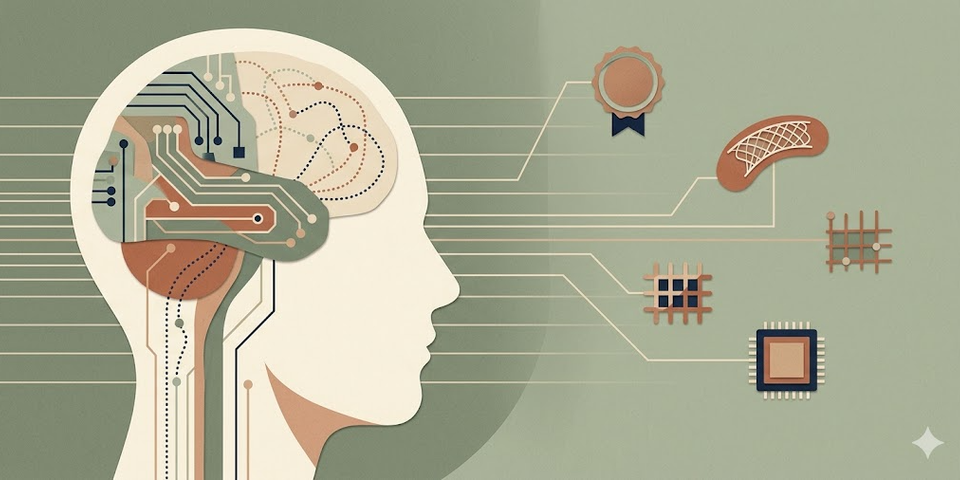
If you haven't been tracking Brain-Computer Interface (BCI) papers lately, you may have missed something: the field has gone through a "ChatGPT-class" leap in the last 18 months.
To be concrete: in August 2023, Stanford's Willett group published a Nature paper that pushed speech decoding to 62 wpm with 23.8% WER on a 125,000-word vocabulary — a milestone at the time. Twelve months later, in August 2024, Card / Willett published in NEJM: 99.6% accuracy on a 50-word vocabulary after 30 minutes of training on day one; 90.2% accuracy on a 125,000-word vocabulary after another 1.4 hours on day two; sustained 97.5% accuracy over 8.4 months of daily use, with 248+ cumulative hours of self-paced conversation.
WER dropped from 23.8% to ~2.5% — an order of magnitude — and the electrode count didn't change. This is the textbook case of BCI riding the LLM tailwind.
This piece puts the most important BCI academic work of 2023–2026 onto a navigable map across eight themes. It's the version for developers / founders / researchers — key papers, original authors, why they matter, where the limitations are.
The seven biggest leaps, 2023–2026
- Speech BCI crossed the "useful communication" threshold. Willett 2023 → Card 2024 took usable speech BCI from "demo" to "daily driver for ALS patients."
- Brain-to-voice became instantaneous and prosodic. Wairagkar et al. Nature 2025 and Littlejohn/Chang Nat. Neurosci. 2025 stream synthesized voice in 80 ms frames, preserving intonation, prosody, and even singing.
- The "brain-spine digital bridge" became a clinical platform. Lorach/Courtine Nature 2023 established wireless cortex-to-spinal-cord closed loops. ONWARD Medical now licenses the underlying WIMAGINE ECoG implant from CEA/Clinatec.
- Inner speech is decodable — and now ships with a "keyword unlock" privacy mechanism. Kunz/Willett Cell 2025 showed motor cortex encodes imagined, unvocalized speech and proposed a classifier + keyword-unlock privacy scheme. The first BCI neuroethics engineering fix was born.
- Neuroscience finally got real foundation models. POYO (NeurIPS 2023) and NDT2 (NeurIPS 2023) pretrain a single Transformer across many sessions, animals, and electrode arrays, then fine-tune in minutes on a new context — the "ImageNet → BERT moment" for neural data.
- Non-invasive decoding is no longer a toy. Tang Nat. Neurosci. 2023 used fMRI + GPT-style priors to reconstruct continuous imagined language; MindEye2 (ICML 2024) reconstructs images from one hour of fMRI; Meta's MEG work (Défossez 2023, Benchetrit 2024) does real-time image retrieval from scalp magnetic fields.
- The electrode-hardware race spread beyond Neuralink. Precision's Layer 7 (1,024 electrodes/array, 510(k) cleared March 2025), Synchron's endovascular Stentrode (COMMAND safety endpoint Sep 2024), INBRAIN's graphene ECoG (first human Sep 2024), and continued Neuralink flexible-thread progress — four very different electrode philosophies being validated in humans in parallel.
1. Speech Decoding: From Demo to Daily Driver
This has been the single most explosive area since 2023. In chronological order:
1.1 Willett et al., Nature 2023 — high-performance speech neuroprosthesis
Nature 620:1031–1036. Authors: Francis R. Willett, Erin M. Kunz, Krishna V. Shenoy, Jaimie M. Henderson, et al.
Participant T12 (bulbar-onset ALS) received four 64-channel Utah arrays: two in area 6v (ventral premotor cortex) and two in area 44 (Broca's area). An RNN decoder translated attempted speech into phonemes; a language model stitched phonemes into words.
Headline numbers: 62 wpm; 9.1% WER on a 50-word vocabulary; 23.8% WER on a 125,000-word vocabulary. 3.4× faster than the previous BCI record.
Why it matters: First credible demonstration that (a) large-vocabulary speech can be decoded from intracortical recordings and (b) area 6v carries enough articulatory information to do open-vocabulary speech — you don't need to record from Broca's directly. The "phoneme RNN + LM" recipe became the template everyone copied.
Limitations: WER still too high for effortless conversation; multi-week recalibration drift; single participant; invasive.
1.2 Metzger / Littlejohn / Chang et al., Nature 2023 — speech with avatar
Nature 620:1037–1046. UCSF Edward Chang lab. Participant: "Ann," 18 years post-brainstem-stroke.
Method: Instead of penetrating Utah arrays, used a 253-channel high-density ECoG grid over sensorimotor cortex. Deep-learning decoders simultaneously output three modalities: text, synthesized voice (personalized to Ann's pre-injury wedding-video recording), and a 3D facial avatar with orofacial articulation.
Results: 78 wpm median text decoding, 25% median WER on a large vocabulary; intelligible real-time speech synthesis and avatar animation.
Why it matters: First simultaneous multi-modal speech restoration. Proved ECoG is competitive with intracortical for large-vocabulary decoding — major implications for surgical burden, longevity, and scalability. The "her actual voice" moment crossed an emotional threshold pure text demos couldn't.
1.3 Tang et al., Nature Neuroscience 2023 — semantic decoding from fMRI
Nat. Neurosci. 26:858–866. Jerry Tang, Alexander Huth (UT Austin).
Collected 16 hours of fMRI per subject (listening to podcasts), then trained a GPT-2-conditioned decoder that generates continuous English sentences from fMRI signal. Demonstrated generalization to perceived speech, imagined speech, and even silent video viewing.
Why it matters: Shattered the assumption that non-invasive recordings couldn't support continuous semantic decoding. Also dragged neuroethics into the public conversation — the authors went out of their way to show the decoder requires explicit per-subject training, and that non-cooperation defeats it.
Limitations: Reconstructs gist, not word-for-word; fMRI is bulky, slow (~1–2 s per sample), expensive.
1.4 Card, Willett, Kunz et al., NEJM 2024 — "BCI's ChatGPT moment"
NEJM 391(7):609–618, 15 August 2024.
256 intracortical microelectrodes implanted in left precentral gyrus of an ALS patient. Key innovations: rapid calibration, better RNN + transformer language modeling, data hygiene.
- Day 1 (25 days post-op, 30 min training): 99.6% accuracy on 50-word vocab
- Day 2 (+1.4 h training): 90.2% accuracy on 125,000-word vocab
- Over 8.4 months: sustained 97.5% accuracy on large vocab; 248+ cumulative hours of self-paced daily conversation at ~32 wpm
Why it matters: This is the paper that moved speech BCIs from "impressive research" to "daily-usable assistive tech." WER dropped from 23.8% → ~2.5% in twelve months — primarily through better decoders and LM integration, not more electrodes.
Limitations: Still n=1; still Utah arrays (longevity question); still invasive; 32 wpm is below natural speech (~150 wpm).
1.5 Wairagkar et al., Nature 2025 — instantaneous voice synthesis
Nature 644:145–152, June 2025. UC Davis Stavisky lab + BrainGate2.
Same 256-electrode participant as Card 2024. Instead of decoding to text, they stream audio waveforms directly from neural activity with closed-loop auditory feedback. Solved the "no ground-truth audio for a silent speaker" problem with a pseudo-teacher training scheme. Captured paralinguistic features (intonation, pitch) so the user can intentionally modulate prosody.
Capabilities: Real-time voice synthesis; the participant could ask questions with rising intonation, emphasize words, even hum simple melodies. The voice is personalized to his pre-ALS recordings.
Why it matters: Text-based BCIs throw away everything interesting about speech (prosody, affect, timing). This closes the loop at the acoustic level — the key to making synthesized speech feel like it belongs to the user rather than a TTS engine.
1.6 Littlejohn et al., Nature Neuroscience 2025 — streaming brain-to-voice (ECoG)
Nat. Neurosci., March 2025. UCSF Chang lab.
ECoG version of streaming brain-to-voice. Decodes in 80 ms frames with an AR model for naturalness, personalized to pre-injury voice.
Why it matters: Proves the streaming-prosodic paradigm works with non-penetrating ECoG as well as intracortical. Mirrors Wairagkar 2025 — two different electrode families converging on the same capability simultaneously. A strong technical-convergence signal.
1.7 Kunz, Willett et al., Cell 2025 — inner speech in motor cortex
Cell, 14 August 2025.
Showed that the same 6v motor cortex region used to decode attempted speech also encodes representations of inner speech (imagined, unvocalized). Inner-speech decoding reaches 74% accuracy on a 125,000-word vocabulary.
Then — and this is the historically important part — they shipped two privacy mechanisms in the same paper:
- A classifier that discriminates attempted vs. inner speech and silences the latter.
- A keyword-unlock scheme (think "Hey Siri" / "Hey Chat-NT") with >98% recognition before allowing inner-speech decoding.
Why it matters: (a) Inner speech leaks into motor cortex — meaning BCIs have an accidental telepathy problem by default. (b) The paper doesn't just raise the alarm; it ships engineering fixes alongside the new capability. This sets a template for "responsible BCI" research: capability and ethical fix should ship together.
2. Motor BCI / Effector Control
2.1 BrainGate ongoing (2023–2026)
Key labs: Leigh Hochberg (Brown/MGH), Jaimie Henderson (Stanford), Frank Willett (Stanford), Krishna Shenoy (deceased 2023; lab continues under Willett + Henderson).
- 2024 highlight: "A flexible intracortical brain-computer interface for typing using finger movements" (Nat. Med. 2024, Willett et al.) — 30–40 point-and-click selections/min at ~90% accuracy from attempted finger flex/extend signals; supports keystroke typing.
- 2025–26: A Nature Neuroscience paper on bimanual QWERTY typing — the most natural-feeling BCI text input demo to date, building directly on the 2024 bimanual cursor work.
BrainGate keeps grinding through the unsexy-but-critical problems — longevity, recalibration, mainstream assistive use. Less splashy than speech news, but the typing pipeline is a daily driver for several participants.
2.2 Neuralink PRIME (2024–2026)
- Participant 1 (Noland Arbaugh): Implanted 28 January 2024 at Barrow Neurological. First public demo 20 March 2024: cursor control, chess, web browsing. Early thread retraction reduced channel count to ~15% of baseline; software compensation recovered most cursor performance. Still using the device as of August 2025, ~18 months post-op.
- Participant 2 (Alex): Implanted July 2024. Primary use: CAD modeling, gaming. Neuralink reports no thread retraction — surgical learning curve.
- Participant 3 (Brad Smith): First ALS recipient; uses Link + eye-tracking hybrid for communication.
Status: As of April 2026, Neuralink has not published a peer-reviewed paper on its human data. This is notable: Synchron, Precision, BrainGate, ONWARD all publish; Neuralink discloses via blog posts and livestreams. The academic literature on the device is thin relative to its media footprint.
2.3 Synchron Stentrode — endovascular BCI
COMMAND feasibility n=6, met 12-month safety endpoint September 2024 with no device-related serious adverse events. The Stentrode is delivered through the jugular vein and lodges in a cortical vein over motor cortex — you lose single-unit resolution but gain surgical simplicity (interventional radiology, not neurosurgery).
Why it matters: If ECoG-level signals over sensorimotor cortex are sufficient for speech (Chang group) and coarse cursor control, endovascular delivery may be the actual scalable mechanism for consumer-class BCI.
2.4 Chestek lab — Regenerative Peripheral Nerve Interfaces (RPNI)
Cynthia Chestek + Paul Cederna (University of Michigan).
Not a brain implant. Graft small pieces of muscle onto severed peripheral nerve stumps — the muscle grafts become "bioamplifiers" that produce large, recordable EMG when the nerve fires. Connect to a prosthetic hand.
Result: Real-time, individual-finger prosthetic hand control with 300 days of stable operation after ~15 minutes of training (Sci. Transl. Med. 2020 + 2024 IEEE T-NSRE follow-up).
Why it matters: For upper-limb amputees — the original target — RPNI may be a superior architecture: avoids brain surgery entirely, signals are larger and more stable than fascicular electrodes, and prevents neuroma formation. A reminder that "BCI" isn't always the right level of abstraction.
3. Restoration of Function (Walking, Grasping, Bladder)
3.1 Lorach, Galvez, Courtine et al., Nature 2023 — the brain-spine digital bridge
Nature 618:126–133, 24 May 2023. Henri Lorach, Andrea Galvez, Grégoire Courtine (EPFL/CHUV) + Jocelyne Bloch, Guillaume Charvet (CEA), and others.
Participant: "Gert-Jan," 40-year-old Dutch male, tetraplegic after a 2011 bicycle accident.
Method: Two WIMAGINE wireless ECoG implants over leg motor cortex + a spinal epidural stimulation array over L2/S1. A fast decoder converts cortical intent into patterned epidural stimulation of the lumbosacral spinal cord, producing natural stepping in real time. The whole loop is wireless; calibration takes minutes.
Headline result: Gert-Jan can stand, walk on flat ground, climb stairs, and traverse uneven terrain. More importantly: after neurorehabilitation with the BSI active, he regained the ability to walk with crutches even when the BSI was off — actual neuroplasticity, not just active stimulation.
Why it matters: First truly closed-loop "think-and-walk" platform. Crosses the boundary between prosthetic augmentation and therapeutic rehabilitation. In October 2024, ONWARD Medical signed exclusive rights to the WIMAGINE technology and has since implanted additional participants in their ARC-BCI System (upper-limb participant Sep 2023; lower-limb female participant Sep 2024).
Limitations: Two participants in published peer review; WIMAGINE ECoG degrades after years; requires brain + spine hardware plus extensive rehab.
4. Foundation Models for Neural Data
This is where BCI meets modern ML most directly, and where most of the 2024–2026 excitement lives.
4.1 POYO — Azabou et al., NeurIPS 2023
arXiv 2310.16046; project poyo-brain.github.io.
Authors: Mehdi Azabou, Vinam Arora, Blake Richards, Eva L. Dyer, et al.
Key idea: Tokenize each individual spike (not bins) — every spike from every electrode in every session becomes a token with channel and time information. Use cross-attention + PerceiverIO backbone to get a fixed-size latent regardless of neuron count. This allows training a single model across sessions with completely different neuron sets.
Pretraining: 158 multi-session NHP recordings, 7 animals, ~27,000 neurons total.
Results: POYO-1 fine-tunes rapidly to new sessions; strong performance on the Neural Latents Benchmark (R² ~0.95 on NLB-Maze after fine-tuning); generalizes to sessions from new animals with very little data.
Why it matters: This is the ImageNet → BERT moment for neural population data. Before POYO, every BCI session essentially trained its own decoder. After POYO, you have a pretrained foundation model that speaks "spike trains" and adapts to a new user in minutes. The scaling-laws question is now open: what does POYO-1 look like at 10× the data?
4.2 NDT2 — Ye, Collinger, Pandarinath, NeurIPS 2023
"Neural Data Transformer 2: Multi-context Pretraining for Neural Spiking Activity."
Masked autoencoder over binned spiking activity, with spatiotemporal attention, specifically tuned for motor iBCI decoding across sessions, subjects, and tasks. Released with pretrained weights.
Contrast with POYO: NDT2 is bin-based; POYO is spike-based. NDT2 targets motor iBCI specifically with a masked-language-model objective; POYO targets broader neural decoding.
Why it matters: Demonstrates rapid transfer to novel motor BCI contexts. Together with POYO, NDT2 set off a wave of "what's the right pretraining recipe for spikes?" work in 2024–2025.
4.3 Neuroformer, NeurIPT, and the broader landscape
- Neuroformer (Antoniades et al., ICLR 2024): GPT-style autoregressive pretraining over neural spikes jointly with behavior and stimulus modalities. Pushes beyond decoding into generation — sampling plausible neural activity conditioned on stimuli or behavior.
- NeurIPT (arXiv 2510.16548, late 2025): Attempts to unify intracortical, ECoG, EEG, and MEG with a single model. Early stage, but indicative of the modality-agnostic brain foundation model direction.
- A March 2025 arXiv survey (2503.00580) and the awesome-neurofm list are good orientation documents. By early 2026 there are ~15 distinct "neural FM" architectures.
4.4 Why this matters for builders
If you're thinking about a BCI startup, the existence of neural foundation models changes one thing: you no longer need to train a decoder from scratch for each user. This collapses calibration cost from "hours per day/session" to "minutes," and dramatically improves cross-subject transfer. For commercial BCI that needs to scale-deploy, this is a key enabler.
5. Non-Invasive Decoding (fMRI, MEG, EEG)
5.1 Tang et al., Nat. Neurosci. 2023 (already covered in §1.3)
Bears repeating as the flagship non-invasive result of 2023.
5.2 MindEye2 — Scotti et al., ICML 2024
arXiv 2403.11207. Paul Scotti (Stability AI / MedARC) + Princeton team.
Method: Pretrain across 7 subjects on NSD (Natural Scenes Dataset), learn a shared-subject latent space, then fine-tune to a new subject with only 1 hour of fMRI. Map brain → CLIP → fine-tuned SDXL.
Result: SOTA retrieval and reconstruction metrics, and much better data efficiency — prior work needed 30–40 hours of expensive fMRI per subject; MindEye2 needs 1 hour (2.5% of prior data).
Why it matters: Data efficiency is the single biggest blocker for non-invasive decoding commercialization. MindEye2 made per-subject cost plausible.
5.3 Meta MEG real-time image and speech decoding
- Défossez et al., Nat. Mach. Intell. 2023: MEG/EEG-based retrieval among candidate sentences (not open-vocabulary synthesis).
- Benchetrit et al., arXiv:2310.19812 (2023): Real-time image reconstruction on THINGS-MEG — brain → CLIP alignment + diffusion generation.
- January 2025 scaling-laws paper — first scaling-law study for brain decoders.
Why it matters: MEG has millisecond resolution (fMRI is ~1 Hz). Meta's pipeline produces per-instant visual reconstructions, which is closer to a streaming non-invasive BCI. The pitch: if hardware shrinks, this track might ship a consumer product before intracortical does.
6. Hardware: Electrodes, Interfaces, New Modalities
6.1 Precision Neuroscience — Layer 7
- Thin-film subdural microelectrode array; each array has 1,024 electrodes (50–380 µm diameter); thickness ~1/5 of a human hair; implanted via cranial slit (no craniotomy) and conforms to cortex.
- May 2024: Precision + Mount Sinai recorded with 4× arrays (4,096 electrodes) simultaneously from a single human brain — world record at the time.
- March 2025: Layer 7 received FDA 510(k) (up to 30-day implant durations).
- October 2025: Nature Biomedical Engineering paper — high-bandwidth recording, motor/sensory decoding, focal stimulation — at performance previously associated with penetrating electrodes, without opening the skull.
- January 2026: Strategic partnership with Medtronic to combine Layer 7 with StealthStation navigation.
- >68 patients by early 2026.
Why it matters: Precision is the most credible Neuralink alternative. Less hype, real peer-reviewed data, faster regulatory path (subdural film, not penetrating threads).
6.2 INBRAIN — graphene BCI
September 2024 first-in-human at Salford Royal Hospital (Manchester), during brain tumor resection. First cohort of 4 patients showed no device-related adverse events; ultrathin graphene electrodes distinguished healthy vs. cancerous tissue at micrometer scale; captured phoneme-linked high-gamma during awake language mapping. FDA Breakthrough Designation for Parkinson's disease.
Why it matters: Graphene electrodes have lower impedance, higher charge capacity, and better biocompatibility than platinum — potentially solving the long-term stability problem that plagues Utah arrays.
6.3 Openwater — ultrasonic / opto-acoustic BCI
Founded by Mary Lou Jepsen. Combines focused ultrasound, near-infrared optics, and computational imaging in a wearable. Raised $100M in 2024; moved to volume production in Taiwan in 2025.
"Open-Motion" diagnostic system (validated for severe stroke detection at Brown/Penn); "Open-LIFU" neuromodulation system (used in MIT consciousness studies and clinical depression trials).
Status: Not yet a BCI in the "decode thoughts" sense, but the bet is that cheap wearable functional imaging could become one.
6.4 DARPA N3 program
Goal: non-surgical, bi-directional BCI for able-bodied users. Teams include Battelle, Carnegie Mellon, JHU APL, Rice. Modalities span ultrasound, magnetogenetics, functional optics, and targeted magnetic resonance. No peer-reviewed human-scale results yet, but the program continues to seed novel modalities and is the main reason "ultrasonic BCI" and "magnetic BCI" are research areas at all.
7. DBS, Neuromodulation, Neuroethics
7.1 Closed-loop DBS for depression
- Scangos et al., Nat. Med. 2021: First case report of a personalized closed-loop DBS system for treatment-resistant depression. Patient "Sarah" had a chronic NeuroPace responsive stimulator delivering targeted stimulation to ventral capsule/ventral striatum only when a personalized mood biomarker was detected.
- Alagapan/Mayberg/Sheth, Nature 2023: "Cingulate dynamics track depression recovery with deep brain stimulation." 10 treatment-resistant depression participants received subcallosal cingulate DBS; researchers used explainable ML on local field potentials to identify a biomarker tracking individual recovery. Clinical: 90% response, 70% remission at 24 weeks.
Why it matters: This is where psychiatric DBS stops being "guess where to stimulate" and starts being closed-loop, biomarker-driven, individualized — more like a cardiac defibrillator for mood.
7.2 Neuroethics generally (2023–2026)
- Yuste et al.'s "neurorights" framework is now being adopted into legislation in multiple countries (Chile was first; other Latin American and EU efforts followed).
- Kunz/Willett 2025 (§1.7) is the first major example of neuroethics fixes shipped in the same paper as the new capability — a pattern the community should demand more of.
- Open issue: Decoder drift and adversarial robustness. There are essentially no published papers on attacking a closed-loop BCI (RF injection, model poisoning during recalibration). This is a gap that BCI founders will need to fill.
8. The Critique: What Isn't Working as Well as the Headlines Suggest
A rigorous dossier should be honest about weaknesses.
- Almost every headline result is n=1. Speech BCIs, brain-spine bridges, handwriting BCIs — typically a single participant, sometimes two. "Generalization to humanity" is not yet demonstrated.
- Longevity is the silent killer. Utah arrays degrade over months to years (gliosis, mechanical drift). Neuralink's first patient had ~85% thread retraction. Flexible / ECoG / endovascular platforms trade resolution for stability. No one has published a truly 10-year BCI with sustained high-performance decoding.
- Calibration drift requires constant recalibration — often daily, sometimes per session. Foundation models + unsupervised recalibration are the main hope. BrainGate published "Long-term unsupervised recalibration of cursor-based iBCIs using a hidden Markov model" at Nat. Biomed. Eng. in late 2025 — the most mature attempt at HMM-style auto-recalibration.
- Privacy / inner-speech leakage is real. Kunz/Willett 2025 showed it directly. Most BCI papers do not discuss this.
- Neural foundation models are still toy-scale vs. LLMs. POYO's pretraining is ~27k neurons; GPT-4 is ~1.8T parameters. We don't yet know whether neural decoding is compute-bound, data-bound, or biology-bound.
- Non-invasive decoding is per-subject. The most impressive fMRI/MEG demos (Tang, MindEye2) still train on tens of hours of that specific person. No true "generic decoder."
- No economic model yet. None of the speech / motor BCIs has a reimbursement pathway. Precision's path via 30-day intraoperative use and Synchron's via endovascular delivery are the nearest-term commercial plays. Neuralink's plan is unknown.
- Krishna Shenoy's death (2023) removed one of the field's senior statesmen; the Stanford lab is still productive (Willett, Henderson, Deo, Kunz) but the mentorship bench is thinner.
The Decade Ahead: Eight Bets
From highest confidence to most speculative:
- Speech BCIs hit clinical approval for ALS / locked-in by ~2028. Current 97.5% accuracy at 32+ wpm with 8+ months of daily use (Card 2024) is plausibly sufficient for a narrow indication. BrainGate + Neuralink + Synchron + Precision each have a credible path. Expect the first FDA PMA tied to a speech or motor assistive indication.
- Neural foundation models become the default decoder. By 2028 no one trains a decoder from scratch; everyone fine-tunes a POYO-N or NDT-N. This collapses calibration from hours to minutes and adds substantial cross-subject transfer.
- Brain-spine / brain-peripheral bridges become an SCI standard of care. ONWARD's ARC-BCI and derivatives will be the first commercial BSI platforms; by ~2030 we likely see cohort-scale trials (n=20+) with durable functional recovery results.
- The line between DBS and BCI blurs. Closed-loop DBS for depression, OCD, possibly addiction will be marketed as "psychiatric BCIs," and the Sheth/Mayberg/Scangos paradigm will spawn multiple implantable platforms.
- Non-invasive BCI gets a consumer beachhead. Not "type with your mind," but calibration-light attention / intent detection (cursor assist, hands-free VR control). MEG remains bulky, so EEG + strong priors will dominate.
- Memory and cognition remain harder and slower. Berger-style hippocampal prosthetics make real but incremental gains. No "Limitless" pill. A reasonable 2035 goal is 20–40% episodic recall improvement in MCI patients — meaningful, not superhuman.
- Brain-to-image becomes a scientific workhorse, not a product. Used widely to probe LLM/VLM representations and to study perception/imagery; commercial decoding of consumer images remains tied to subject-specific training for a long time.
- Speculative: ultrasound or magnetic BCI wildcards. If Openwater or a DARPA N3 team cracks resolution issues, the whole field could re-base on a non-surgical modality.
Open Problems
- Durable, biocompatible high-channel-count recording. The ultimate bottleneck. Nothing yet convincingly survives a decade at full performance.
- Cross-subject generalization without per-subject retraining. A "universal speech decoder" is science fiction today.
- Continuous, safe, long-term stimulation. Writing to the brain is much harder than reading. Optogenetics and ultrasound are leading candidates, but none are clinically mature for chronic closed-loop use in humans.
- Decoder robustness under adversarial conditions. What happens when a closed-loop BCI user is in a noisy EM environment? Under a hostile network? There is essentially no literature.
- Multi-subject / multi-session foundation-model benchmarks. NLB '21 is dated; we need an ImageNet-scale NLB '25 or POYO benchmark.
- Clinical endpoints and reimbursement. What does CMS consider "clinically meaningful" speech restoration? Until this is answered, scaling past research cohorts is impossible.
- Inner speech privacy (and the related problem of emotional / autonomic leakage). Kunz 2025 cracked it open; now it needs to be a default part of every paper.
- Data sharing and open benchmarks. BrainGate datasets, NSD, THINGS-MEG are improving the field's open-data culture, but it's still well behind vision / NLP.
BCI is no longer at "is this possible" — it's now competing on "how fast, how cheap, how safe." And the speed of that competition is unexpectedly accelerated by the LLM and foundation-model tailwind.
If the 2017 Transformer paper was the seed of NLP's ChatGPT moment, then Willett 2023 + Card 2024 + POYO 2023 may well be the seed of BCI's. The next 24 months are going to be very loud.
References
Speech BCI
- Willett et al. 2023 — Nature (DOI: 10.1038/s41586-023-06377-x; PMID 37612500)
- Metzger/Littlejohn/Chang et al. 2023 — Nature (DOI: 10.1038/s41586-023-06443-4; PMID 37612505)
- Tang et al. 2023 (fMRI semantic decoder) — Nat. Neurosci. (DOI: 10.1038/s41593-023-01304-9; PMID 37127759)
- Card et al. 2024 — NEJM (DOI: 10.1056/NEJMoa2314132; PMID 39141853)
- Wairagkar et al. 2025 (instantaneous voice synthesis) — Nature (PMID 40506548)
- Littlejohn et al. 2025 (streaming brain-to-voice, ECoG) — Nat. Neurosci. (PMID 40164740)
- Kunz/Willett 2025 (inner speech + privacy) — Cell (PMID 40816265)
- Défossez et al. 2023 (Meta MEG speech) — Nat. Mach. Intell.
- Code: brain-to-voice-2025 · nejm-brain-to-text
Motor BCI
- Willett 2024 (flexible finger typing, Nat. Med.) — PMC
- Deo et al. 2024 (bimanual RNN) — Sci. Rep. (PMID 38238386)
- BrainGate publications hub
- Neuralink PRIME update
Brain-Spine Interface / Restoration
- Lorach/Galvez/Courtine et al. 2023 — Nature (DOI: 10.1038/s41586-023-06094-5; PMID 37225984)
- NeuroRestore press release
- ONWARD + Clinatec WIMAGINE licensing
Foundation Models / ML
- POYO (Azabou et al. 2023, NeurIPS) — project · arXiv · code
- NDT2 (Ye et al. 2023, NeurIPS) — paper PDF
- Neuroformer (Antoniades et al. 2024, ICLR) — GitHub
- NeurIPT 2025 — arXiv
- Brain Foundation Models survey 2025 — arXiv 2503.00580
- Neural Latents Benchmark · arXiv 2109.04463
- awesome-neurofm list
Non-Invasive Decoding
- MindEye (2023) — arXiv · project
- MindEye2 (Scotti et al. 2024, ICML) — arXiv · project
- Meta MEG image decoding — arXiv · Meta AI blog
- Meta brain-decoding scaling laws — arXiv 2501.15322
- EEG + diffusion (Song et al. 2024) — arXiv 2403.07721
Hardware
- Precision Neuroscience Layer 7 FDA 510(k) — FDA PDF · BioSpace
- INBRAIN first-in-human graphene BCI — BusinessWire
- Openwater press · FUS Foundation profile
- DARPA N3 program page
Neuromodulation / DBS / Ethics
- Scangos et al. 2021 (personalized closed-loop DBS) — Nat. Med. (PMID 34608328)
- Alagapan/Mayberg/Sheth 2023 (cingulate dynamics, depression recovery) — Nature (PMID 37730990)
Memory / Cognitive
- Hampson/Berger/Song hippocampal memory prosthesis 2024 — Frontiers in Computational Neuroscience · Wake Health newsroom
Peripheral / Alternative
- Chestek RPNI (Vu et al. 2020, Sci. Transl. Med.) — Michigan Engineering feature