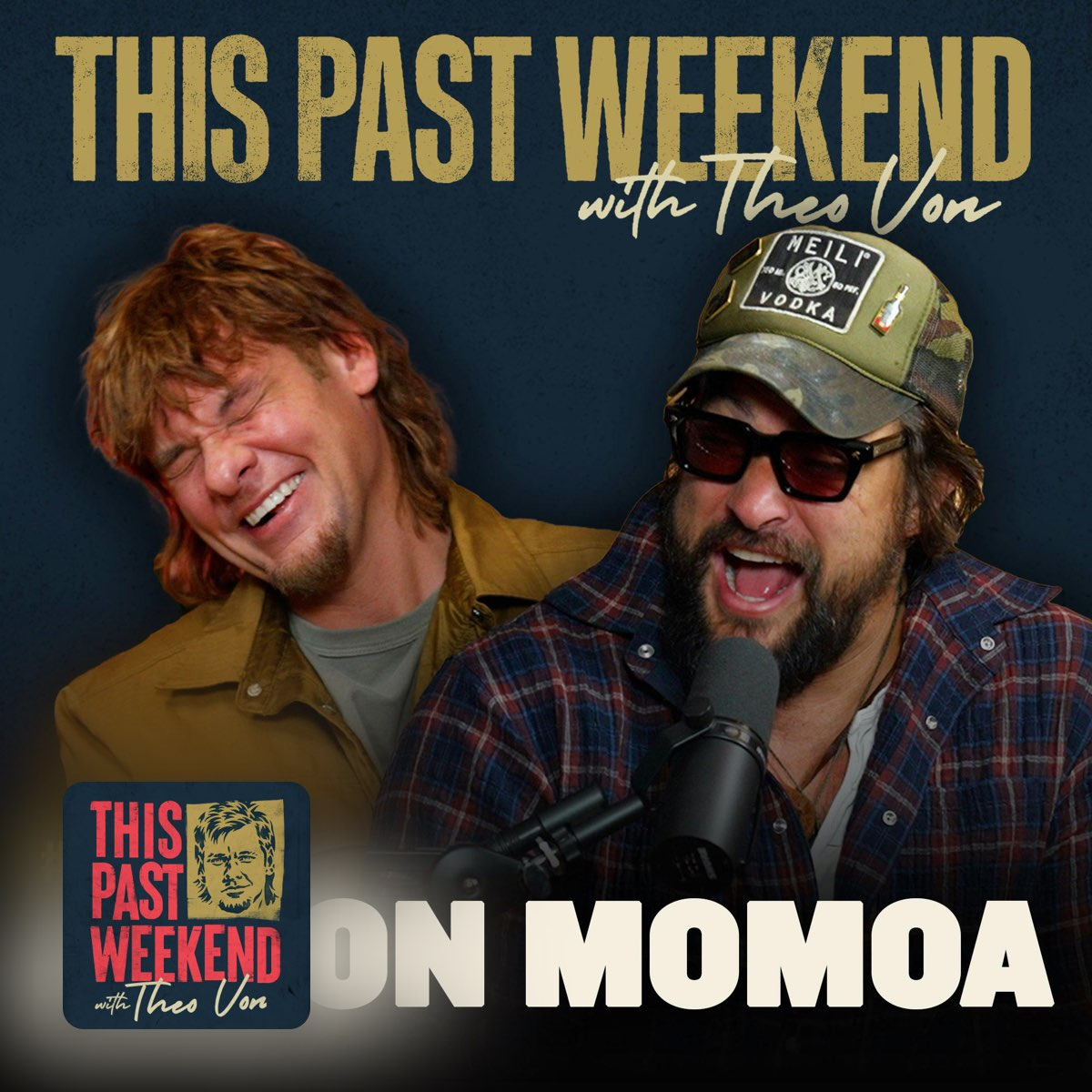
Jason Momoa: Acting, Hawaii, Fatherhood, and Finding Purpose Beyond Fame
Jason Momoa: Acting, Hawaii, Fatherhood, and Finding Purpose Beyond Fame
Based on a transcript from This Past Weekend featuring Jason Momoa.
Executive Summary
Jason Momoa sits down with Theo Von for a funny, heartfelt, and surprisingly deep conversation that covers the arc of his life -- from growing up in Iowa, reconnecting with his Hawaiian father, landing Baywatch Hawaii at 19, and spending decades working his way up to roles like Aquaman and Dune. Along the way, they explore Hawaiian culture and identity, the importance of storytelling for indigenous peoples, his friendship with Dave Bautista, fatherhood, rock climbing as meditation, and his environmental mission to eliminate single-use plastic.
Key insights from this conversation:
- Momoa grew up in Iowa with his mother and reconnected with his Hawaiian father as a young adult, which changed the trajectory of his life
- His show Chief of War on Apple TV was a deeply personal project -- a love letter to Hawaiian culture and history
- He spent years typecast after Game of Thrones and is only now getting opportunities in comedy
- Rock climbing and motorcycles serve as his meditation, forcing total presence and focus
- He founded Mananalu, an aluminum water company, and is building a circular water system to eliminate plastic waste in Hawaii
- Despite achieving his biggest career dreams, he reflects honestly on the paradox of feeling happier during the hungry years
Growing Up Between Iowa and Hawaii
Momoa was born in Hawaii in 1979 but moved to Iowa after his parents divorced when he was young. He grew up in the world of Bridges of Madison County-era Iowa, attending Des Moines Area Community College before heading to Colorado to pursue wildlife biology and enjoy rock climbing and snowboarding. He had a tight routine: work Thursday through Saturday bussing tables, then spend Sunday through Wednesday outdoors climbing and snowboarding with his best friend, who remains his closest companion and godfather to his children.
His path back to Hawaii came from a desire to reconnect with his father and explore in-state tuition options. That summer trip changed everything -- a TV show audition led to him being cast on Baywatch Hawaii at 19. His mother, still living in the same Iowa house, was bewildered when he called to explain his new career.
"I spent the next 30 years digging myself out of that hole."
Hawaiian Culture, Identity, and Chief of War
Momoa's father is a deeply Hawaiian man from the west side of Oahu -- Nanakuli, Waianae, and Makaha -- areas designated as Hawaiian homestead land. His family includes legendary watermen: his great uncle Buffalo Keaulana and cousin Brian Keaulana, along with four-time world champion Rusty Keaulana. His father was a coach, paddler, surfer, and outrigger sailor -- a true waterman in every sense.
When asked about Hawaiian identity, Momoa acknowledged the trauma and cultural erasure his people have endured, similar to other indigenous communities worldwide. He spoke about the ongoing effort to reclaim language, culture, and identity.
His most personal creative achievement is Chief of War on Apple TV, a show depicting Hawaii before Western contact. Growing up watching films like Last of the Mohicans and Braveheart, he longed to see his own culture portrayed on screen with the same grandeur. The show was filmed entirely in Hawaiian language, which was a significant challenge for the diverse Polynesian cast -- Maori, Samoan, Tongan, and native Hawaiian actors all had to learn this ancient tongue.
He described it as his love letter to his people, and possibly the creative peak of his career. He hired many of the same crew members who knew him when he was 19 on Baywatch, and returning at 44 to tell a story about Hawaiian history felt like coming full circle.
The Wrecking Crew and Working with Dave Bautista
Momoa's new film The Wrecking Crew is a buddy action-comedy set in Hawaii, co-starring Dave Bautista. The two first worked together on the Apple TV show See, where Bautista played his brother. Their friendship and creative chemistry led Momoa to pitch an idea he had been developing for two decades -- a fun buddy-cop film in the spirit of Lethal Weapon and 48 Hrs.
Bautista posted about the project before it was even formally announced, and it went viral overnight. Their agents scrambled, but the momentum was unstoppable. Momoa values Bautista as an acting partner because neither actor has ego about the work -- both are willing to bleed, get hurt, and die on screen in service of the story. He noted that many famous actors refuse to look vulnerable, but both he and Bautista embrace it.
He also mentioned upcoming projects with Jack Black (a Minecraft sequel) and Andy Samberg (a comedy set in Hawaii), plus a self-funded film called Busboys with David Spade about two guys who become waiters to win back a girlfriend.
The Paradox of Success and Fulfillment
In one of the most reflective moments of the conversation, Momoa opened up about a paradox many successful people face: achieving your dreams but not feeling as happy as you expected.
He noted that he never imagined getting this far. He achieved his biggest dreams -- making an authentic Hawaiian show, playing the comic book character he loved as a kid, starring in the video game franchise he grew up with. And yet he sometimes wonders why he felt happier during the lean years when he was still hungry and hunting.
His answer is gratitude and staying busy with things he loves. He describes himself as naturally high-energy, waking up every morning feeling like Christmas. He does not need coffee. He sleeps little. He says yes to everything because everything he does now is something he genuinely loves.
"I'm doing everything I love to do. So I don't ever think of it as work."
He also acknowledged the earlier years were about survival -- he could not get an agent, could not get called for good roles, and was typecast after Game of Thrones because his character did not speak English.
Rock Climbing, Motorcycles, and Presence
Momoa's greatest passion outside acting is rock climbing, which he has done since childhood when his mother first took him climbing in South Dakota. He describes touching rock and moving on it as something more natural than walking. He has traveled the world climbing and now does deep water soloing in Mallorca, where climbers ascend sea cliffs and fall into the water below.
He connects rock climbing and motorcycle riding to mental health. Both activities demand total presence -- you cannot think about emails or worries when one mistake means injury or death. For someone who suspects he has undiagnosed ADHD, these activities serve as meditation, creating moments where mind, body, and spirit fully connect.
Near-Drowning and Quitting Smoking
One of the most dramatic stories in the conversation involves Momoa nearly drowning off the coast of Maui. He was ocean paddling when his leash snapped, and the wind carried his board away. He was pulled half a mile offshore, exhausted, and going under. His toe touched the outer reef, and he grabbed onto it, holding on through waves until he was rescued by Laird Hamilton, Dave Kalama, and his friend Joe Flanagan.
Before this incident, Momoa was a heavy smoker -- two packs a day. He had tried to quit many times without success. But after nearly drowning, his body rejected cigarettes entirely. Any attempt to smoke made him vomit. The ocean took his breath, and the addiction died with it.
Fatherhood and the Next Generation
Momoa has two children: his daughter Lola, who is pursuing music, and his son Nakoa-Wolf, who has followed his father into acting. Wolf auditioned on his own and landed the role of Leto Jr. in the next Dune film. Both children grew up on set -- sitting on Ben Affleck's lap during Justice League when they were six and eight, watching their father become Aquaman.
While Momoa expressed initial concern about his children entering the entertainment industry, he also recognizes the value of doing what you love. He wants his kids to see a father who genuinely enjoys his work, even if earlier in his career that was not always the case.
Mananalu and the Fight Against Single-Use Plastic
As an environmentalist at heart, Momoa founded Mananalu, an aluminum water company, eight years ago. The idea came to him on a flight when he noticed that every other beverage on the plane came in recyclable aluminum cans, but water was served in plastic bottles made of three different types of plastic that cannot be recycled.
He approached Ball Corporation, the aluminum can manufacturer, and pitched the concept. He also approached Coca-Cola and Pepsi, asking them to make the switch, but was told plastic was easier and cheaper. So he built it himself.
The company has since evolved beyond aluminum cans into a circular water system called Boomerang. The concept works like this: hotels, hospitals, and schools have machines in their basements that sterilize reusable bottles, fill them with local water, add minerals, and send them back out. No shipping. No emissions. No waste. Fresh water always.
He is piloting the system in Hawaii first, partnering with hotels like Four Seasons. His vision is for guests to see exactly how the circular system works and carry that awareness home.
Theo Von on Sobriety and Finding Stability
Throughout the conversation, Theo shared his own reflections on sobriety, career, and the search for stability. He spoke openly about his history with cocaine, his involvement with AA, and the challenge of staying grounded when his career requires constant travel. After 17 years of touring, he is taking his first extended break from the road, and the stillness is helping him reconnect with himself and consider what matters beyond work.
Final Thoughts
The conversation closes with Momoa expressing genuine warmth toward Theo and extending an open invitation to collaborate. He mentioned that many of his best professional relationships started exactly this way -- meeting someone, connecting, and creating something together. From Andy Samberg to Dave Bautista to David Spade, the pattern is the same: friendship first, then creative projects that feel like play rather than work.
Momoa's life story is one of persistence, cultural pride, and staying true to what he loves. From bussing tables in Iowa to playing Aquaman, from nearly drowning in Maui to building a water company, his path has been anything but linear -- and that is precisely what makes it compelling.