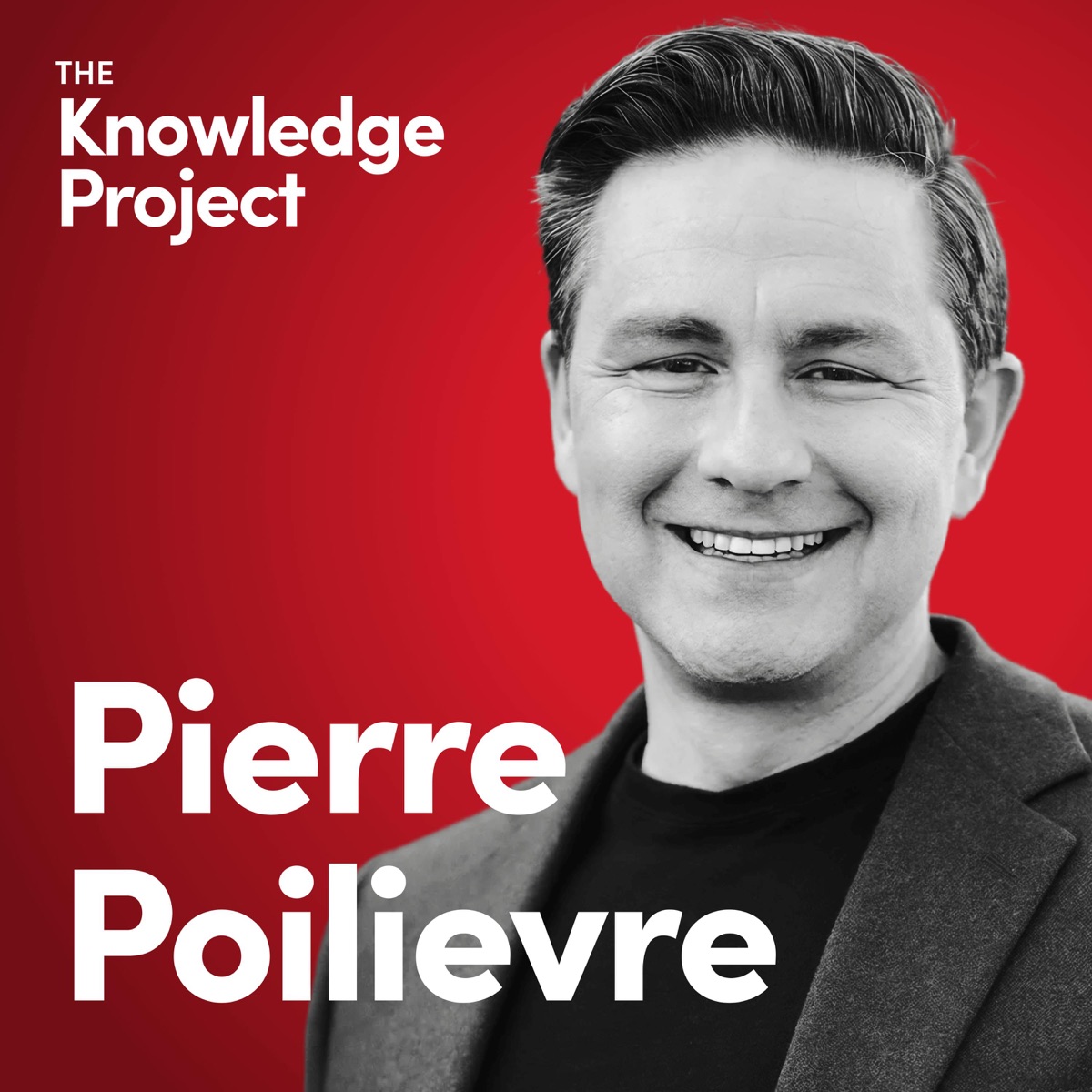
Pierre Poilievre: The Role of Government, Freedom, and Affordability
Pierre Poilievre: The Role of Government, Freedom, and Affordability
Based on a transcript from The Knowledge Project featuring Pierre Poilievre, leader of the Conservative Party in Canada.
Executive Summary
Pierre Poilievre joins Shane Parrish for a wide-ranging conversation on first principles of governance, Canadian national identity, and the affordability crisis facing young Canadians. Poilievre argues that government should only do what people cannot do for themselves, and that the current crisis in housing, jobs, and cost of living stems from excessive government intervention. He discusses immigration policy, media independence, the drug crisis, and why he believes hope is both a moral imperative and a political strategy.
Key insights from this conversation:
- Government is fundamentally the legal use of force and should only do what people cannot do for themselves
- Canadian identity is defined by freedom—people come here for freedom, not the weather
- The affordability crisis requires unblocking resources, cutting taxes on investment, and reducing government spending
- Media that depends on government subsidies cannot be truly independent
- Hope is a political strategy—if people believe change is possible, they'll vote for it
First Principles of Government
Poilievre begins with a fundamental question: What is government? His answer is precise.
"The only thing that's unique about government is that it has the legal power to apply force. That's it."
From this first principle flows his governing philosophy: government should only do what people cannot do for themselves—things that require collective action and would not exist without compulsion. This includes military, border control, policing, basic infrastructure, and providing necessities to those who cannot provide for themselves.
Everything else should be left to free people. There's no need for government subsidies to prop up businesses when capital markets exist. There's no need for government-provided media when citizens can create their own.
Canadian National Identity
When asked about Canadian identity, Poilievre quotes Wilfrid Laurier from a century ago: "Canada is free and freedom is its nationality."
People don't come to Canada for the weather. They come because where they came from, they weren't free—to build a life, start a family, speak their mind, or practice their faith. This has been true for pioneers in the 1800s, Catholics who settled Quebec centuries earlier, and immigrants arriving today.
The problem, Poilievre argues, is that the current government has said Canada has no national identity—that it's a "post-modern, post-nationalist state." Combined with mass migration at levels that overwhelm integration, people are increasingly divided along demarcation lines from their countries of origin rather than uniting under a shared Canadian identity.
"Protestants and Catholics tore each other's eyeballs out for centuries in Europe, but they got along in Canada because they said, we're Canadian here."
The Affordability Crisis
Poilievre calls today's youth "generation screwed"—and he's not surprised they feel detached and frustrated with the system.
The rap sheet against the government:
- Doubled housing costs, making down payments unattainable until the late thirties
- Driven up rent so that even treading water is difficult
- Food prices up, forcing diet downgrades
- Jobs missing due to unblocked resources and excessive temporary foreign workers
His three-word solution: hope, jobs, and homes.
Jobs: Stop bringing in temporary foreign workers, unblock resources so trades workers can earn good wages, cut taxes on job creation.
Homes: Speed up permits, remove taxes on home building, let people afford to start a family again.
Hope: The most important piece. Poilievre's greatest concern is that young people will be gaslighted into permanently lowering their expectations.
"My purpose is to provide people with hope. And that's not just a touchy-feely word. It's actually a political strategy for me. Because if people can be convinced that there's hope, then they'll vote for it in an election."
Economic Policy and Capital Gains
Poilievre diagnoses Canada's lagging economic prospects: too much spending on government, not enough on productive private sector jobs. Every new bureaucracy creates costs without productive outcomes and sucks money from the private sector.
His signature policy proposal: eliminate capital gains tax when you reinvest in Canada.
"The government's going to get its pound of salt one day anyway. Eventually, you'll fully cash out. But if you want to keep rolling it over, building factories, mines, pipelines, IT infrastructure, inventing new products—why wouldn't we encourage that?"
He points to Israel's example: when they reduced their deficit in the 1990s, it unlocked capital that fueled the tech sector and made Israel the "startup nation."
Canada-US Relations
Poilievre's framework for the US relationship begins with acknowledging reality: American capitalism is the most powerful economic force in history, and the American military is the most powerful defense force in history. Both are right next door.
His strategy:
- Create leverage: Unblock production and transportation of resources to domestic and overseas markets (one pipeline could add $30 billion in annual exports)
- Offer mutual benefit: Supply more oil to reduce American gas prices, provide critical minerals, secure the continent from external threats
- Negotiate from strength: With other market options available, Canada can demand fair treatment and tariff-free access
Media Independence
Poilievre makes a linguistic argument about media subsidies.
"You've just made the case that the media is dependent on the government. Can something that is dependent be independent?"
The government has provided over $3.4 billion in subsidies, tax breaks, and grants to the media industry since 2017—not including CBC funding or federal advertising spending. This creates a structural problem for independent journalism.
His solution: more decentralization, more competition, more freedom, more choice. If we don't trust average readers to determine what's true, how can we trust government officials to make that determination for them?
Free Speech and Information
Poilievre applies first-principles thinking to the debate over disinformation.
"If man is not capable of deciding for himself what is true and what is not, then how is he capable of deciding for others?"
He invokes the "who watches the watchman" problem. If independent media outlets might spread disinformation, what stops the same from happening in the government bureaucracy that decides what's true?
His conclusion: the least bad option is to allow unbridled free speech so that good ideas clash with bad, true information with false. In the long run, people can judge for themselves.
The Drug Crisis
Poilievre sees the drug crisis as perpetuated by those who profit from it—pharmaceutical companies, bureaucracies, consultants, and agencies. The irony is stark: corrupt pharmaceutical companies caused the opioid crisis through over-prescription, and now we're told the solution is more pharmaceutically prescribed drugs.
His approach: treatment and recovery, not "safe supply."
"Treatment centers that work are based on getting off drugs completely—treatment, counseling, physical exercise, group therapy, job placement, housing."
He advocates for severe penalties for fentanyl dealers: anyone caught with more than 40 milligrams should face murder charges.
Maintaining Hope
When asked how he maintains hope in politics, Poilievre points to the people he meets—those fighting every day to feed their kids, middle-aged couples who want children but can't afford homes, mothers who lost children to overdoses but still advocate for drug treatment.
"What other choice do we have but then to have hope?"
He quotes a Hindu priest's formula to end all worry: Do you have a problem? No? Why worry. Yes? Do you have a solution? Yes? Why worry. No solution? Why worry. Worrying won't make it better.
His advice for stress: focus on what you can control. It's incredibly liberating.
Key Takeaways
- Government is force: It should only do what people cannot do for themselves
- Freedom defines Canada: National identity comes from shared commitment to freedom, not ethnicity
- Hope is strategy: Providing hope prevents people from accepting permanent decline
- Leverage before negotiation: Build options (pipelines, overseas markets) before demanding fair treatment
- Dependency prevents independence: Media subsidies compromise journalism
- Free speech beats censorship: The watchman problem means government censors aren't more trustworthy
- Treatment over supply: The drug crisis requires getting people off drugs, not maintaining addiction
- Focus on control: Worrying about things outside your control serves no purpose
- Be consistent: In politics and life, consistency over time builds trust
- Put your mask on first: Canada must strengthen itself before helping others
Follow Pierre Poilievre on X (Twitter) for updates on Canadian politics.