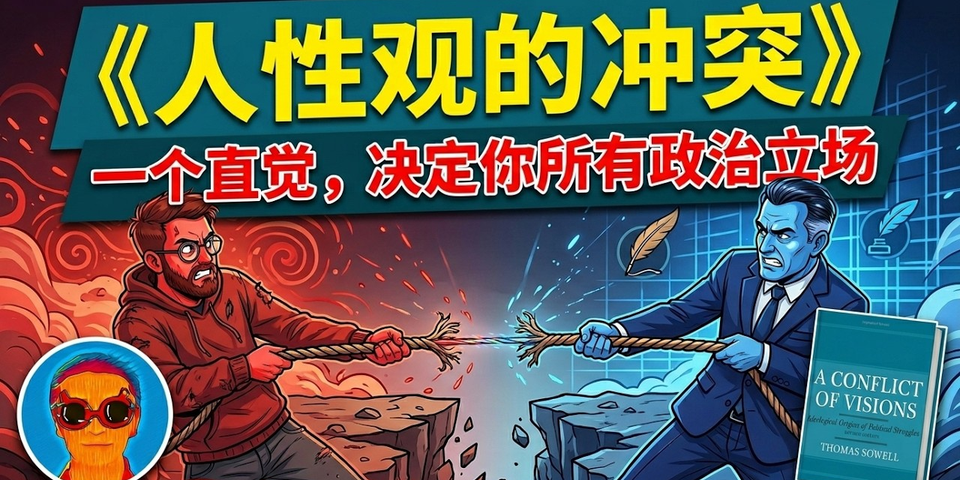
When the left and the right fight endlessly over equality, freedom, and justice, what they rarely notice is that they operate from incompatible foundational premises. American economist and social theorist Thomas Sowell identified this root cause in his landmark work A Conflict of Visions. Psychologist Steven Pinker later named these two frameworks the "Utopian Vision" and the "Tragic Vision." One holds that human nature is improvable, even perfectible; the other holds that human selfishness, short-sightedness, and fallibility are permanent features of the species. These competing visions have shaped not only academic debate but entire civilizations — from the guillotine of the French Revolution to the checks and balances of the American Constitution.
About the Host
Wei Zhichao (魏知超) holds a PhD in Psychology from East China Normal University. He is a psychology popularizer, book reviewer, and film critic whose website is weizhichao.info. On his YouTube channel "魏知超啥書都讀" (Wei Zhichao Reads Everything), he produces in-depth Chinese-language book reviews spanning psychology, philosophy, and social science. He is the author of multiple psychology books including The Advancing Mind (進擊的心智) and The Enchanting Illusion (迷人的假象). In this episode, he guides viewers through Sowell's A Conflict of Visions, uncovering the deep intellectual fault lines beneath centuries of political conflict.
What Is a "Vision"?
Thomas Sowell is among the most important social thinkers of the twentieth century. His central concept in this book is the "vision" — a pre-analytical cognitive framework, a set of assumptions about human nature that we bring to every social question before reasoning begins. Sowell's core question is: Is human nature more like a comedy or a tragedy?
This seemingly simple question determines how we approach social problems, institutional design, and the possibility of human progress. Steven Pinker formalized the two categories as the Utopian Vision and the Tragic Vision.
The Two Visions: Core Differences
The Utopian Vision holds:
- Human nature is malleable and can be improved, ultimately approaching perfection
- Through proper education, good institutions, and social reform, a near-perfect society is achievable
- Knowledge is concentrated in the hands of experts and rational elites
- Social problems have ultimate solutions
The Tragic Vision holds:
- Human selfishness, myopia, and fallibility are deep and permanent
- Institutions should be designed so that imperfect people can still live reasonably well together
- Knowledge is dispersed across the decisions and habits of billions of ordinary people
- Social problems involve unavoidable trade-offs, not ultimate solutions
Historical Lineage: Two Intellectual Traditions
Champions of the Tragic Vision
Adam Smith is the most important representative of the Tragic Vision. He illustrated the limits of human empathy with a thought experiment: if an earthquake in China killed hundreds of millions, a European observer would grieve briefly and then return to ordinary life — but the prospect of losing one's own little finger tomorrow would cause a sleepless night. This asymmetry is precisely why the Invisible Hand is necessary: it channels self-interest into social good without requiring perfect altruism.
Friedrich Hayek extended this insight to the theory of knowledge. Knowledge is not concentrated in expert minds; it is dispersed through market prices, customs, and the daily decisions of billions of people. Any attempt to centralize this knowledge is doomed to fail — which is why the price mechanism often outperforms central planning.
Edmund Burke, the founder of modern conservatism, was deeply suspicious of the French Revolution. He argued that social order embodies the accumulated wisdom of generations, and that radical reform risks destroying what cannot easily be rebuilt.
Alexander Hamilton, co-author of The Federalist Papers, designed institutions on the explicit assumption that all men are capable of abuse of power. Separation of powers and checks and balances are his answer to this permanent feature of human nature.
Champions of the Utopian Vision
William Godwin, the eighteenth-century British thinker, is the purest representative of the Utopian Vision. He believed that human reason could overcome selfishness, and that through education and moral improvement, people could achieve genuine perfection.
Condorcet, a central figure of the French Enlightenment, shared Godwin's faith in the unlimited perfectibility of humanity — and helped design the Revolution that would eventually send him to prison.
The Domino Effect: Four Key Divergences
Sowell argues that the difference between the two visions creates a cascade of downstream disagreements:
First Domino: The Question of Knowledge
The Utopian Vision believes there are correct answers to social questions, and that experts can find them. It therefore supports technocratic governance and top-down institutional design.
The Tragic Vision holds that no one can possess all the relevant knowledge. Market prices, legal traditions, and inherited customs are information systems that encode the distributed knowledge of society. Disrupting them carelessly destroys information that cannot easily be reconstructed.
Second Domino: Ultimate Solutions vs. Trade-offs
The Utopian Vision pursues definitive solutions. Social problems are engineering problems: find the right blueprint and build the right society.
The Tragic Vision insists that social problems are never definitively solved — only managed through imperfect trade-offs. Good institutions do not depend on good people; they constrain bad actors while enabling good ones.
Third Domino: War and Crime
The Utopian Vision treats war and crime as products of social injustice. Eliminate poverty, inequality, and alienation and violence will diminish.
The Tragic Vision holds that aggression and criminality are rooted in human nature and can be contained but never eliminated. Deterrence — raising the cost of destructive behavior — is more reliable than attempting moral transformation.
Fourth Domino: The Meaning of Words
This may be the most fundamental divergence. When the left and right argue about "equality," "freedom," and "justice," they are often not even speaking the same language:
- Equality: equality of opportunity vs. equality of outcomes
- Freedom: freedom from interference vs. freedom through access to resources
- Justice: procedural justice vs. distributive justice
Two people with different visions may use the same words while arguing from entirely different conceptual frameworks, which is why so many political debates generate heat without light.
The Historical Experiment: France vs. America
The late eighteenth century provides the clearest natural experiment in the consequences of the two visions:
The French Revolution: The Utopian Vision in Practice
The French Revolution sought to remake society from first principles. Its architects believed that human nature could be transformed by destroying old institutions and creating new ones. The result was the Reign of Terror — tens of thousands sent to the guillotine, revolutionary violence consuming its own authors, and a cycle of instability that lasted decades.
The American Founding: The Tragic Vision in Practice
The American Founders, by contrast, designed institutions on the explicit assumption that human nature cannot be changed. "If men were angels, no government would be necessary," wrote Madison. The separation of powers, judicial independence, and the Bill of Rights are all responses to the permanent reality of human fallibility. This system has persisted for over two centuries.
Economic Illustration: The Egg Shortage
A simple thought experiment illustrates how the two visions translate into policy:
Suppose there is an egg shortage.
Utopian Vision response:
- Government intervenes
- Experts determine a "fair" price
- Price controls are imposed
Tragic Vision response:
- Prices rise
- Consumers automatically reduce purchases
- Producers automatically increase supply
- Distributors automatically reallocate inventory
The historical record strongly favors the second approach. The price mechanism aggregates the dispersed knowledge of millions of market participants — information that no expert committee can replicate.
Sowell's Central Insight: Conflicts of Vision Dominate History
Sowell's most famous formulation: "Conflicts of interest dominate the short run, while conflicts of vision dominate history."
What appears on the surface as a policy disagreement is usually a symptom of a deeper divergence in assumptions about human nature. These assumptions are not resolved by evidence, because they shape how evidence is interpreted. They are not dissolved by dialogue, because the participants may be speaking different conceptual languages. Understanding this is the beginning of intellectual clarity.
Practical Implications
-
When facing social problems: Resist the urge to find root causes and ultimate solutions. Ask instead what trade-offs are available under imperfect conditions.
-
Be skeptical of grand plans: History consistently shows that attempts to redesign society from scratch produce disasters. Good institutions are evolved, not engineered.
-
Focus on institutional design: The character of leaders matters less than the constraints institutions place on them. Bad systems corrupt good people; good systems constrain bad ones.
-
Clarify definitions: Before debating equality, freedom, or justice, establish what each party means by these terms. The disagreement may be definitional, not factual.
-
Know your own vision: Identifying which vision you hold helps you understand your own political instincts and engage with opposing views more charitably and accurately.
Conclusion
The century-long conflict between left and right has never been primarily about specific policies. It has been about competing assumptions regarding what human beings are and what they are capable of becoming. The Utopian Vision and the Tragic Vision each have distinguished intellectual lineages, and each captures something true about human experience.
Understanding these two visions does not guarantee agreement. But it transforms the nature of political disagreement — from a contest of interests or a conflict of villains and heroes into a genuine debate about deep and difficult questions. In an era of intense political polarization, that reframing may be Sowell's most important contribution.