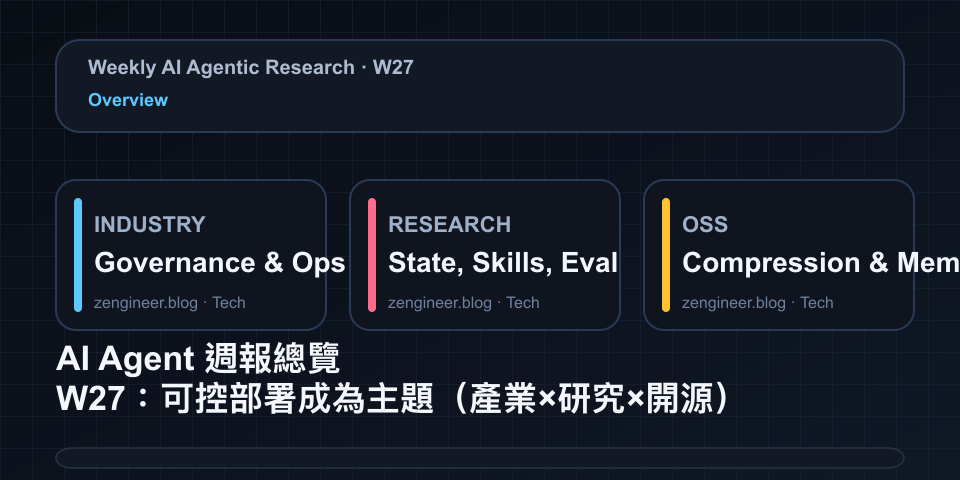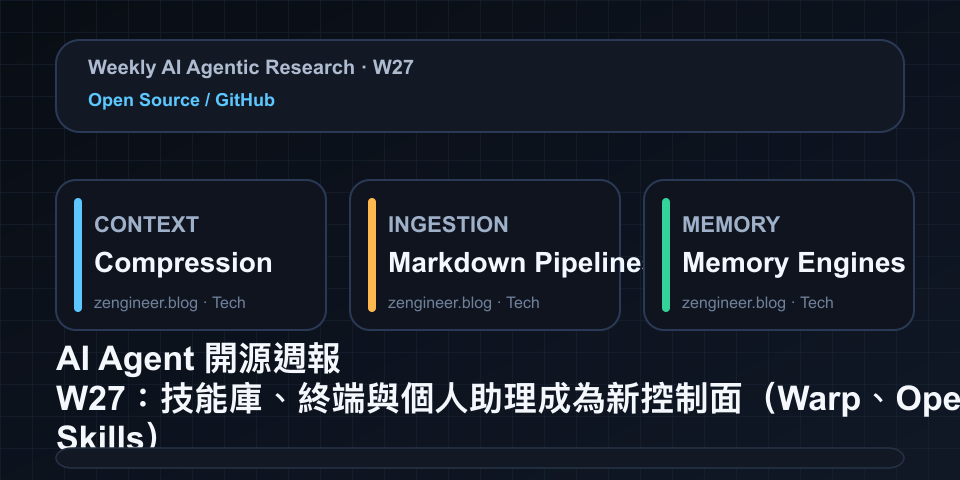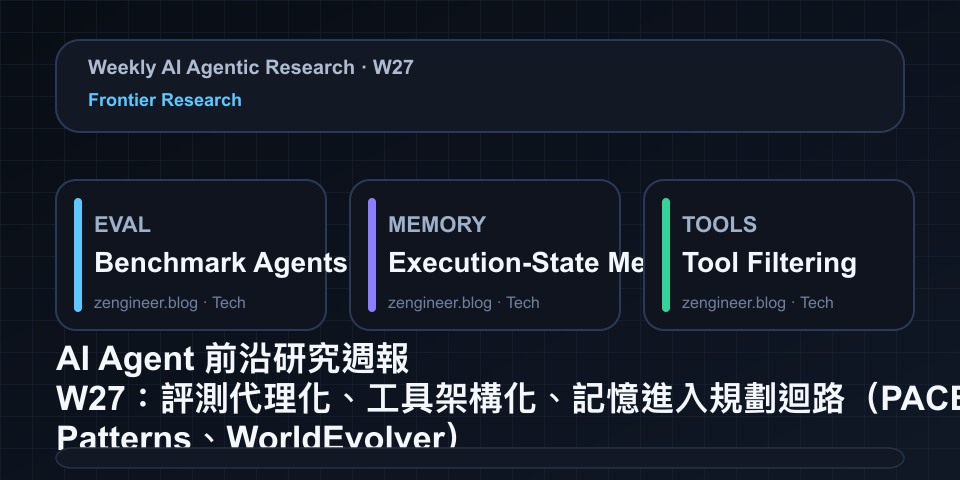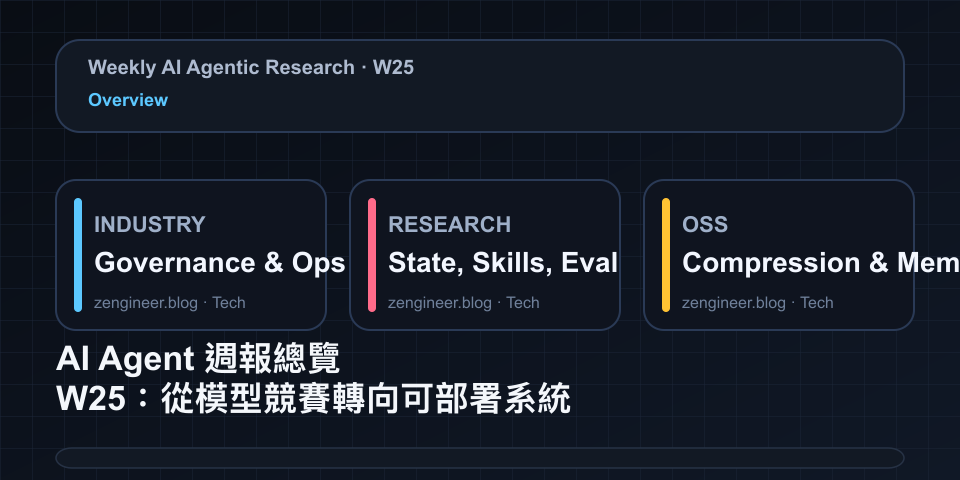
This article covers 2026-06-15 to 2026-06-21 in Asia/Taipei time. The week’s AI agent story can be summarized in one sentence: the market is moving from a model race to a deployable-systems race. Industry filled deployment and governance layers; research focused on evaluation, memory, and skills; open source moved toward harnesses and device control.
This week’s deep dives:
- Industry / product / deployment: AI Agent Industry Weekly W25: Deployment, Governance, and Physical Interfaces Heat Up
- Frontier research: AI Agent Frontier Research Weekly W25: Evaluation Validity, Memory, and Skill Routing
- GitHub / open source: AI Agent Open-Source Weekly W25: Harnesses, Skills, and Device Control
1. Industry: agents are being placed into platforms
OpenAI Partner Network, Databricks Agent Bricks and Unity AI Gateway, Cloudflare Flue, AWS Bedrock AgentCore, and NVIDIA XR AI all point in the same direction: production agents need runtime, governance, data-plane integration, delivery partners, and physical interfaces.
For builders, the checklist is shifting from “can the demo work?” to identity, permissions, logging, rollback, human review, cost control, data boundaries, and plugin provenance.
2. Research: the hard problem is system evaluation
The strongest research signal was system quality:
- benchmarks need predictive validity;
- memory needs updateable atomic facts;
- skills need to be mined, retrieved, and composed;
- agent safety must include internal systems and embodied devices.
Without these layers, long-running agents fail in familiar ways: progress that cannot be verified, memory that drifts, tool use that is over-permissioned, and behavior that benchmarks did not predict.
3. Open source: harnesses, skills, and device control became reusable layers
Hermes Agent, OpenClaw, Google ADK, browser-harness, agent-device, awesome-agent-skills, and azure-skills show that open-source value is moving into execution shells rather than one-off prompts.
This also widens the risk surface. Desktop, browser, phone, IoT, and cloud skill packs all touch credentials, permissions, plugin provenance, and replay safety. The next maturity threshold is not stars; it is security model and release discipline.
Synthesis
AI agent competition is becoming full-stack engineering:
- Industry must prove agents can be deployed, governed, and bought.
- Research must prove evaluations predict real behavior.
- Open source must prove harnesses and skills can be maintained safely.
The actionable conclusion for product teams: stop asking only “which model should we use?” Ask:
- Where does the agent run?
- What data and tools can it touch?
- How does it remember, forget, and update?
- Who reviews and rolls back failures?
- Does the evaluation score predict real user tasks?
Watchlist
- Agent deployment: whether OpenAI, Databricks, AWS, and Cloudflare publish repeatable reference architectures.
- Agent evaluation: whether predictive validity enters mainstream benchmark reporting.
- Agent memory: whether AtomMem-like methods appear in open-source frameworks.
- Agent skills: whether SKILL.md mining and skill registries become engineering standards.
- Agent security: whether browser/device/desktop agents establish clearer permission boundaries.