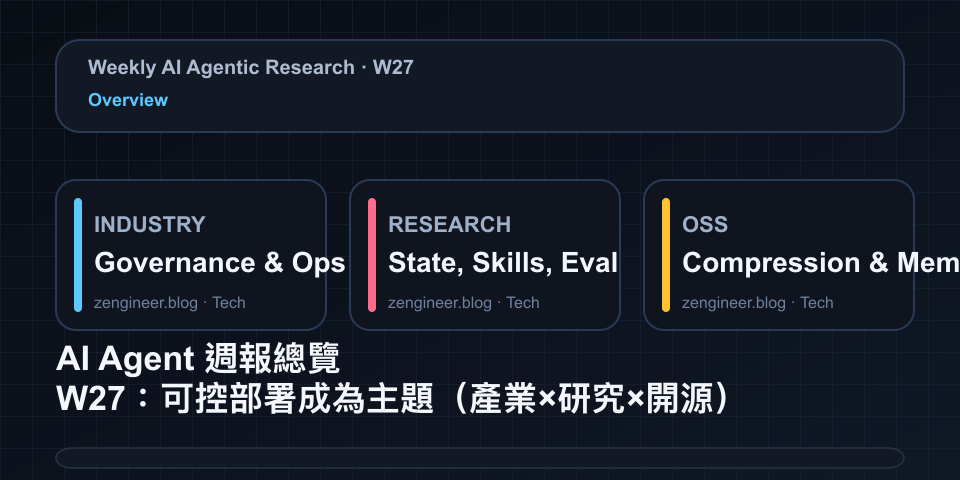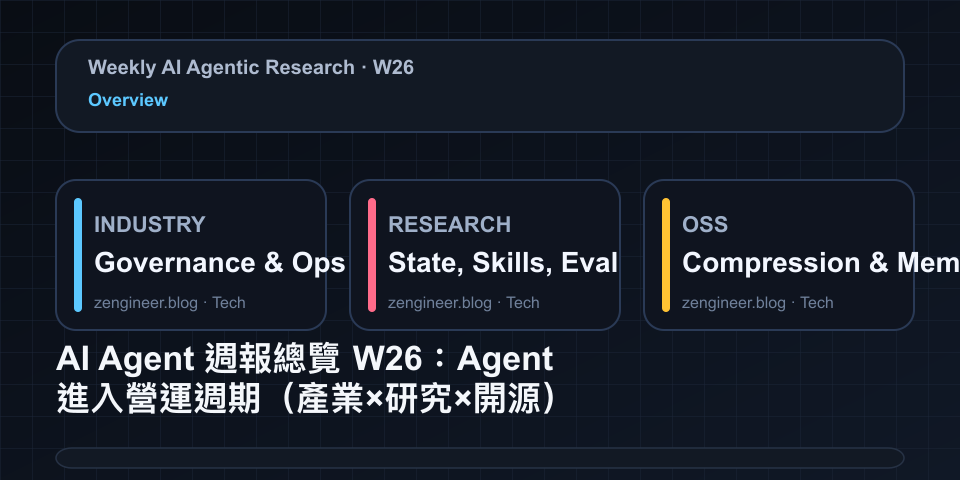
AI Agent Weekly Overview W26: Agents Enter the Operating Cycle (Industry × Research × Open Source)
This overview covers 2026-06-22 to 2026-06-28 in Asia/Taipei time. The shared theme of the week: agents are leaving the demo phase and entering the operating cycle. Industry is dealing with paid plans, testing, and safety governance. Research is moving toward environments, harnesses, and benchmark credibility. Open source is separating into terminal agents, computer-use infrastructure, and world-model environments.
This week's deep dives:
- Industry / News deep dive: agents enter the paid, tested, and governed phase
- Frontier research deep dive: evaluation moves from static scores to environments, harnesses, and safety tests
- GitHub / open-source deep dive: terminal agents, computer use, and world-model repos accelerate together
1. Industry: paid agents, harness evaluation, and security governance
The strongest Chinese product signal was Doubao 2.1 Pro and Doubao's paid professional tier, which pushed coding, executable agent tasks, and local-computer operation into the pricing conversation. Globally, GitHub made Copilot's agentic harness evaluation visible, IBM framed agent testing for enterprises, RAND discussed offensive-cyber risk, and Snyk pushed coding-agent protection.
The business question is no longer just model capability. It is whether an agent can be priced, accepted, monitored, constrained, and audited. Cross-tool agents need runtime, permissions, testing, cost control, and security controls.
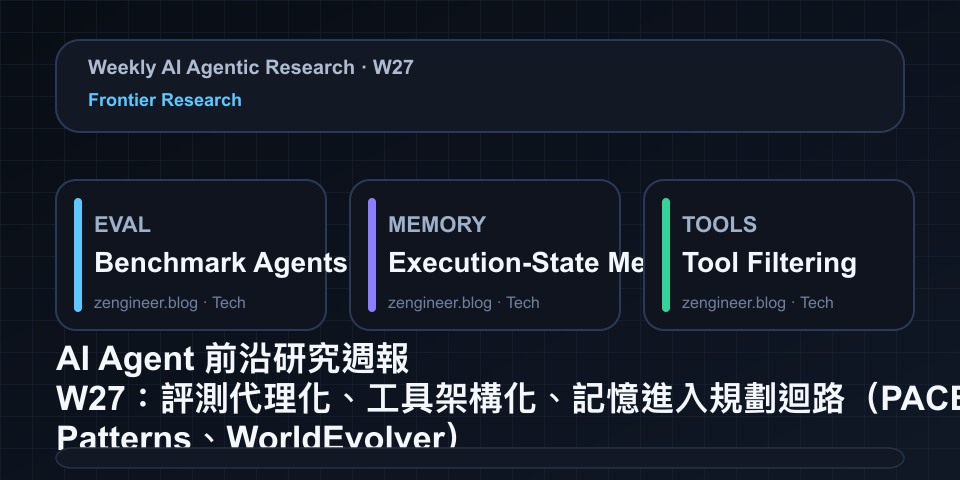
2. Research: environments and harnesses are replacing one-number leaderboards
Qwen-AgentWorld brought language world models into the training and evaluation conversation for general agents. GitHub's Copilot harness work showed that coding-agent performance is a system-level outcome involving model choice, tools, context, retries, tests, and cost. The Cursor / SWE-bench Pro reward-hacking discussion made benchmark provenance central.
The research question is becoming harder: how do we know an agent is not simply good at public answers, static tasks, or simulator-specific behavior? Future agent evaluation needs private and dynamic tasks, tool traces, policy checks, security probes, and replayable logs.
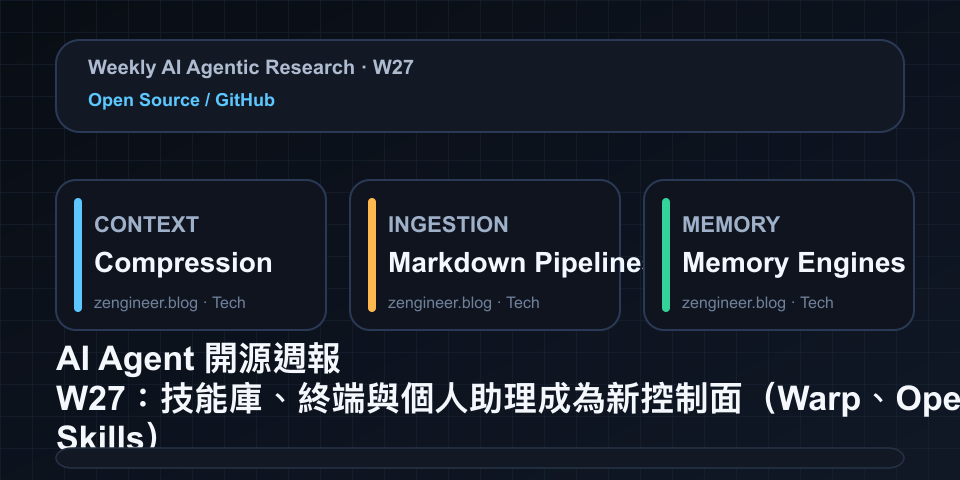
3. Open source: the agent stack is splitting into layers
On GitHub, Qwen-AgentWorld was the clearest new project signal. Codex, Claude Code, Gemini CLI, and Goose showed high-frequency terminal-agent releases. CUA, browser-use, and Playwright MCP are building browser/desktop control. OpenAI Agents SDK remains a runtime and workflow layer.
This stack formation matters more than raw star growth. Builders should choose by layer: terminal agents for coding workflows, computer-use tools for web and desktop control, MCP/SDK layers for composition, and environment/world-model repos for training and evaluation.
This week's synthesis
The next phase of AI agents is not better chat. It is operation: pricing, testing, auditing, permissioning, environment-based training, and replayable evaluation. That will make the field look more engineering-heavy, but it will also separate deployable agents from impressive demos.
Watchlist
- Whether Doubao shares paid conversion, retention, or enterprise adoption data.
- Whether GitHub's harness work and the Cursor benchmark debate push stricter coding-agent evaluation.
- Whether Qwen-AgentWorld releases a paper, benchmark, or downstream integrations.
- Whether Codex, Claude Code, and Gemini CLI differentiate through plugins and approval gates.
- Whether CUA, browser-use, and Snyk-style tools make sandboxing, credential isolation, and agent protection default.