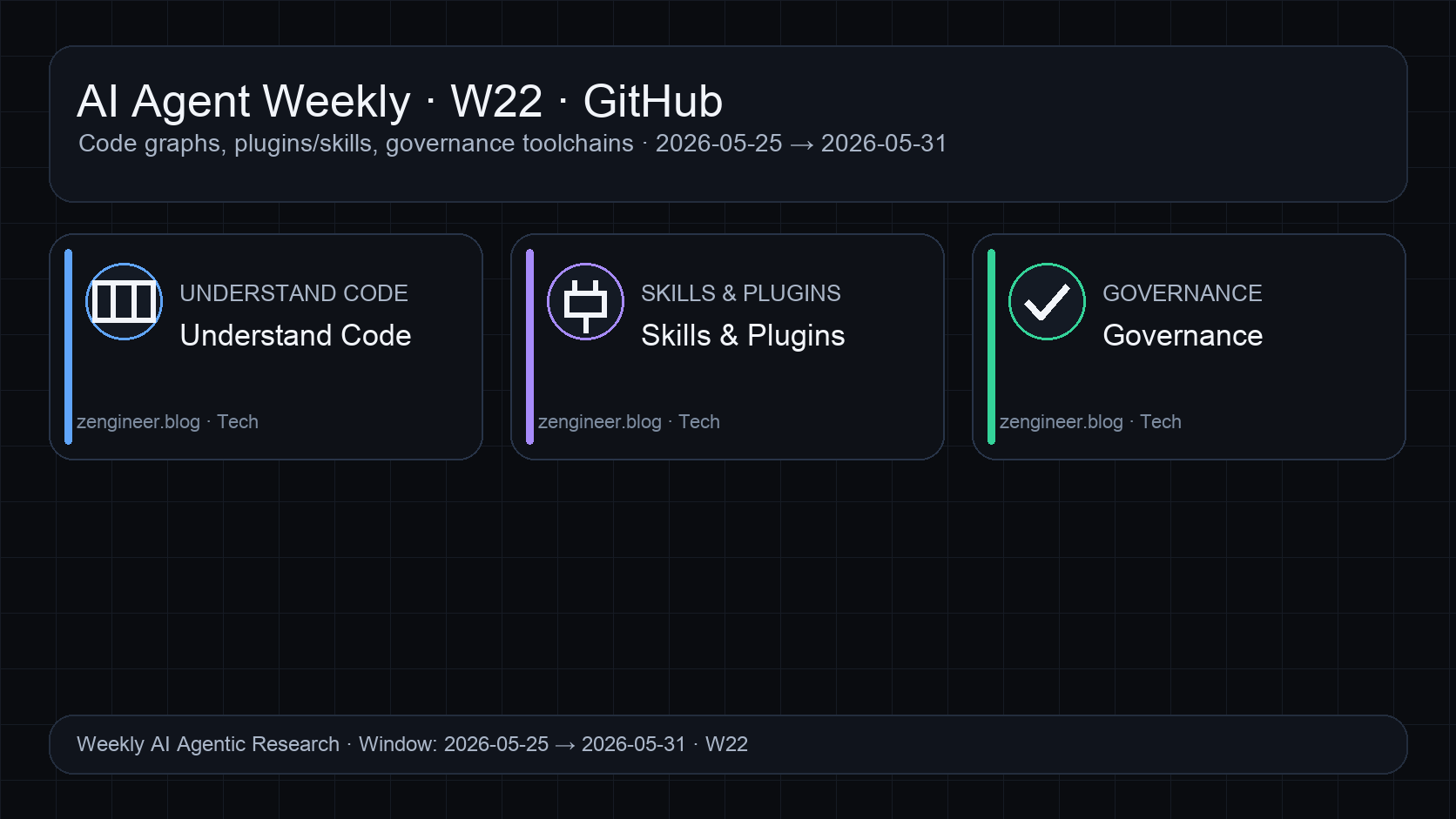
AI Agent Open-Source Weekly W22: Knowledge Graphs + Governance Tooling Spike (Understand-Anything, codegraph, agent-governance-toolkit)
This issue covers May 25 to May 31, 2026 (Asia/Taipei). The open-source pattern this week is clear: trending repos aren’t just shipping “another agent framework.” They’re closing agent systems engineering gaps—code understanding, plugin/skill supply, governance/auditability, and more controllable tool execution.
Below are eight repos selected using “weekly star growth” as a weak signal and interpreted through the engineering pain they target. Star data source: Git Trending Rank weekly list (2026 week 22).
- Source: https://git-trending-rank.github.io/post/trending-weekly-2026%E5%B9%B4%E7%AC%AC22%E5%91%A8/ (updated 2026-05-31)
1) “Understanding the codebase” becomes infrastructure: knowledge graphs + exploration
Lum1104/Understand-Anything(+25612 ⭐ this week)colbymchenry/codegraph(+15909 ⭐)
Practical evaluation lens: treat these as upstream “code ingestion” systems for RAG/agents and ask: (1) indexing cost + incremental refresh, (2) monorepo + multi-language support, (3) integration with your harness (retrieval, symbol resolution, provenance).
2) Skills/plugins supply expands: workflows as reusable modules
anthropics/knowledge-work-plugins(+5538 ⭐)
The value is distribution: turning “what agents can do” into installable, maintainable packs—making adoption look like package management + internal platform engineering.
3) Governance/compliance tooling enters the repo layer
microsoft/agent-governance-toolkit(+1553 ⭐)
Even if you don’t adopt it directly, treat governance toolkits as architecture review checklists: identity, permissions, audit trails, sandboxing, and risk routing.
4) Document ingestion substrate: stable “files → Markdown”
microsoft/markitdown(+6652 ⭐)
5) Voice agent platforms move toward on‑prem/BYOK + MCP-native
dograh-hq/dograh(+1236 ⭐)
6) Harness and team design becomes productized
revfactory/harness(+626 ⭐)
7) Terminal multiplexer: a controllable command-line workbench for agents
ogulcancelik/herdr(+923 ⭐)
8) Summary: from framework hype to “infrastructure heat”
Taken together, these repos point to the same transition: from “LLM capability” to “deliverable engineering substrate.”
Watchlist (next week)
- Knowledge graph/indexing tools: do we see MCP-native interfaces (graph retrieval, symbol resolution, incremental indexing)?
- Governance toolchains: deeper integrations with clouds/identity providers (SSO, policy-as-code, tracing).
- Voice agent stacks: more production-grade OSS around telephony, recording, compliance, and ops.