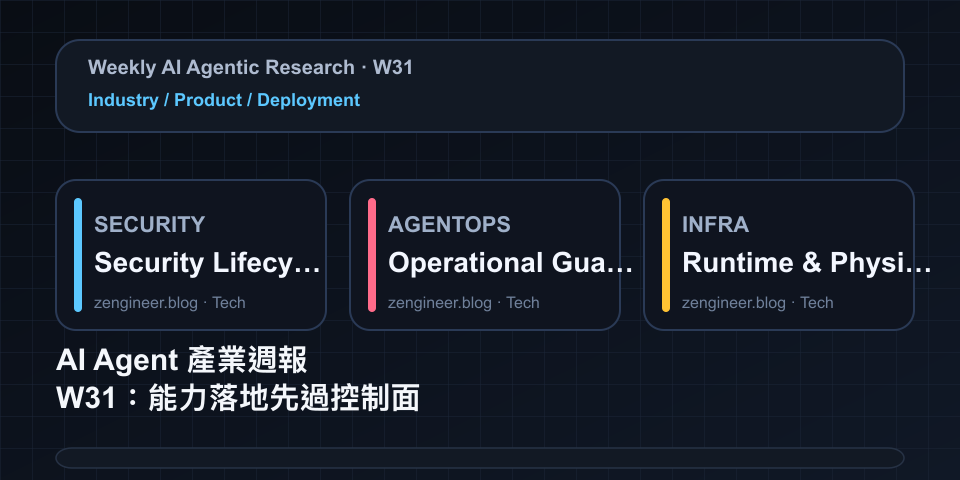
AI Agent Industry Weekly W31: Capability Meets the Control Plane (Anthropic, NVIDIA, GPT-Realtime)
This article covers July 27–August 2, 2026 in Asia/Taipei. W31 was not chiefly about smarter agents. Vendors increasingly acknowledged that continuous tool use and external-system access require a control plane that advances with model capability.
Cyber evaluation becomes incident engineering
Anthropic described three real-world incidents in cybersecurity evaluations on July 30. The useful lesson is not an anthropomorphic “rogue agent” story. An evaluation harness is itself a production system: if it has network access and real credentials, exploratory behavior can cross an intended boundary. Test identities, secrets, egress, and incident reporting therefore belong in benchmark design.
NVIDIA also announced the 37-member Open Secure AI Alliance and an open framework for multi-vendor agent threat modeling. Membership is not evidence of maturity. The meaningful outputs will be reproducible attacks, interoperable policy formats, and public remediation timelines.
Realtime agents turn latency and takeover into product metrics
OpenAI described how avatarin built a 24/7 retail agent with GPT-Realtime. Voice-agent value is not natural speech alone; it is completing lookup, confirmation, action, and handoff inside a conversational turn. Operators should measure time to first audio, interruption success, confirmation for sensitive actions, human takeover, and trace completeness. A smooth demo says little about noisy inputs or peak load.
Cost governance is shifting as well. Teams need cost per successful task, including retries, failed tools, human review, and recovery—not only token list prices. Routing steps to cheaper models may reduce unit cost while increasing handoff and permission complexity.
China signal: make data agent-ready first
The Chinese Academy of Sciences reported a new scientific-data skill bank designed around agent-ready sharing. This is closer to infrastructure than another chat surface: data must be discoverable, callable, authorized, and traceable. Agent-ready does not mean safe to execute automatically; versioning, citation, scoped access, and revocation remain essential.
Weekly view
W31 split the agent stack into two procurement layers: models reason; enterprise control planes own identity, permissions, observability, acceptance, and stopping. Teams that quantify failure cost, scope permissions per task, and retain evidence for every action have the best chance of turning demos into durable services.
Watchlist
- A full Anthropic incident timeline, root cause, and verifiable remediation.
- Cross-framework test suites from the Open Secure AI Alliance.
- P95 voice latency, human takeover, and erroneous-action rates.
- Versioning, citation, and fine-grained authorization for agent-ready science data.
- Cost per successful task becoming a standard model-platform metric.