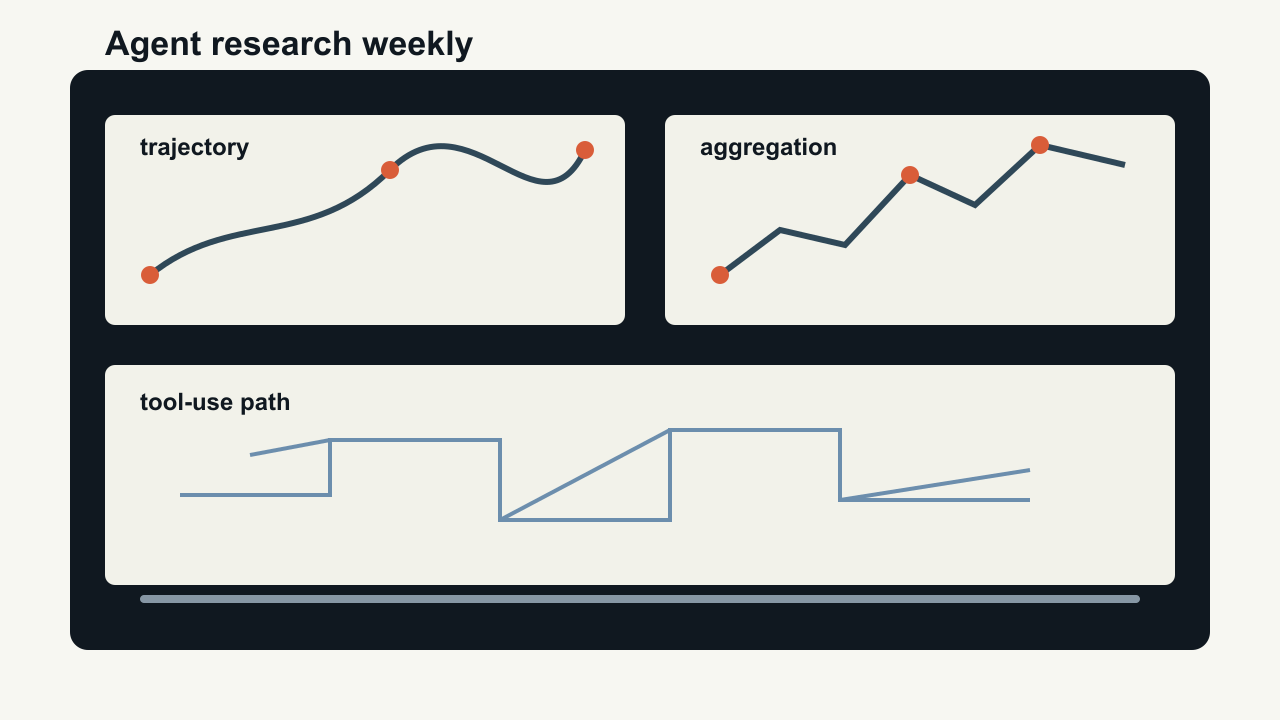
The research window for this issue is May 4 to May 10, 2026. The clearest research shift this week is that agent evaluation is moving away from only asking whether the final answer is correct. The better question is now: how did the system get there?
If the industry track is about agents entering finance, voice, enterprise deployment, and governance, the research track is asking the harder substrate question: how do we train, observe, and evaluate systems that delegate, call tools, run parallel trajectories, aggregate results, and stop?
1. Multi-agent RL needs orchestration traces
The most relevant new paper this week is Reinforcement Learning for LLM-based Multi-Agent Systems through Orchestration Traces, submitted on May 4.
Its contribution is not another single benchmark. It proposes a better unit of observation: the orchestration trace. Traditional RL for agents often focuses on individual actions: which tool to call, what to say next, when to return an answer. But multi-agent systems fail or succeed at the coordination layer: when to spawn a subagent, whom to delegate to, how to communicate, how to aggregate, and when to stop.
The paper frames those events as a temporal interaction graph and organizes the field around reward design, credit assignment, and orchestration learning. The most useful detail is a negative result: in its 84-paper pool as of May 4, 2026, it found no explicit RL training method for the stopping decision.
That gap matters. Real agents often fail not because they cannot do any work, but because they do not know when to stop, ask for help, merge results, or rerun a branch. Stopping is not a minor control. It is a cost, reliability, and trust boundary.
2. Tool-use evaluation is becoming trajectory diagnostics
The ICLR 2026 poster TRAJECT-Bench pushes the same idea into tool-use evaluation. It argues that existing benchmarks often focus on final answers while ignoring whether tools were selected, parameterized, and ordered correctly.
TRAJECT-Bench uses executable tools and production-style API tasks, then evaluates trajectories with fine-grained metrics: tool selection, argument correctness, and dependency/order satisfaction, in addition to final accuracy.
That is closer to production reality. Many agent failures happen in the middle: a similar tool is chosen, an argument is hallucinated, or the order of operations is wrong. If your eval only scores the final answer, you may not know whether the agent completed the task correctly or got lucky.
3. Tool use in web agents is not free capability
Microsoft Research's April paper The Tool Illusion: Rethinking Tool Use in Web Agents is not new this week, but it belongs in this week's research context. It asks a question that demos often hide: do tools consistently improve web agents?
The paper notes that many previous conclusions came from limited or non-comparable settings, then revisits tool use across tool sources, backbone models, tool-use frameworks, and benchmarks. The important takeaway is not that tools are useless. It is that tool design changes behavior and can introduce side effects.
For product teams, this is practical. More tools do not automatically mean a stronger agent. Tools are also action space. Tools are also error surface.
4. Long-horizon scaling is moving toward parallel rollout plus aggregation
Agentic Aggregation for Parallel Scaling of Long-Horizon Agentic Tasks studies a different but related path: if one long agent run is brittle, can we run multiple trajectories in parallel and then aggregate them intelligently?
The paper proposes AggAgent, an aggregation agent that treats parallel trajectories as an environment. Instead of only voting over final answers or concatenating everything into context, AggAgent uses lightweight tools to inspect candidate solutions and search across trajectories on demand. The authors report gains of up to 5.3 percentage points on average across six benchmarks and three model families, and 10.3 points on two deep research tasks, while bounding aggregation cost to roughly one additional agentic rollout.
Read alongside orchestration traces, the direction is clear: long-horizon agents need reusable records of what happened, and aggregation needs access to the path, not only the answer.
What this research track says this week
This week's research does not say that general-purpose agents are solved. It says the field is finally naming the failure modes more precisely.
The useful questions are now:
- Did the system delegate to the right subagent?
- Did it choose the right tool and fill the right arguments?
- Did it preserve dependency order?
- Did parallel exploration produce better evidence or just more noise?
- Did the system know when to stop?
- Can the benchmark see the middle of the run, not just the final answer?
That is progress. Problems that can be named can be engineered against.
What I am watching next
First, whether agent evaluation keeps moving from answer-level metrics to trace-level diagnostics.
Second, whether orchestration learning gets real replayable traces rather than only surveys and schemas.
Third, whether web/computer-use tool design converges on reusable rules: the right tool granularity, the right action space, and the right fallback to atomic browser actions.
References
- Chenchen Zhang, Reinforcement Learning for LLM-based Multi-Agent Systems through Orchestration Traces, 2026-05-04
- Pengfei He et al., TRAJECT-Bench: A Trajectory-Aware Benchmark for Evaluating Agentic Tool Use, ICLR 2026 poster
- Renze Lou et al., The Tool Illusion: Rethinking Tool Use in Web Agents, Microsoft Research / arXiv, 2026-04
- Yoonsang Lee et al., Agentic Aggregation for Parallel Scaling of Long-Horizon Agentic Tasks, 2026-04-13