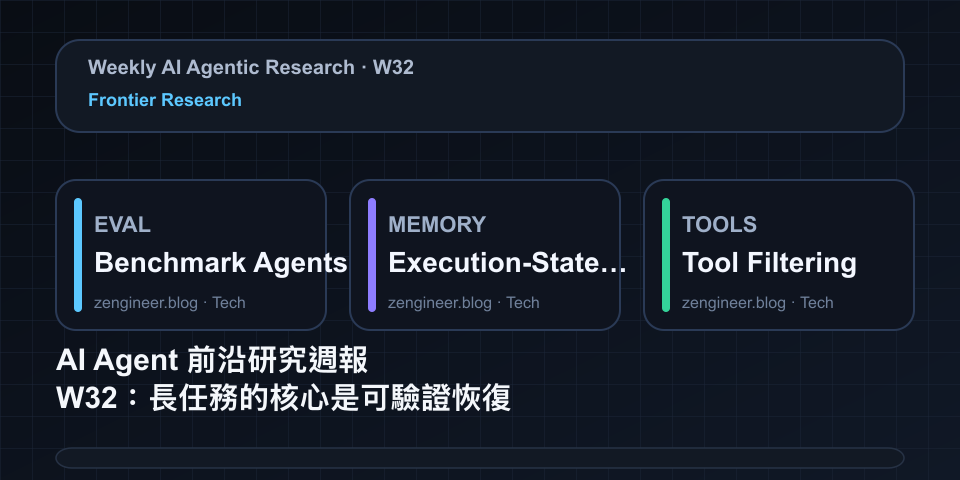
AI Agent Frontier Research Weekly W32: Long Tasks Need Verifiable Recovery (Argus, TRAJDEBUG, ORCA-bench)
This article covers August 3–9, 2026 in Asia/Taipei. W32's research signal was unusually consistent: long-horizon work is not just a longer context. Agents must preserve state, find the earliest consequential error, recover through verification, and know when to escalate.
Argus moves self-evolution into the runtime
Argus uses Manager, Planner, Engineer, and Reviewer roles for bounded missions while separating user intent from operational objectives, constraints, and verification. The authors report about 78% on SWE-Bench Pro across seven GPT-5.5 arenas versus 59% for Direct Copilot, at 1.41× aggregate tokens; later waves reduce solve-input tokens and active time.
The meaningful design choice is that model weights stay fixed. Memories, skills, verifiers, and routing policies persist only after review or task-native verification. Caveats remain: the system is complex, author-selected baselines and environments need independent replication, and gains require cost sensitivity analysis.
TRAJDEBUG finds errors that remain consequential
TRAJDEBUG tracks when an error appears, whether it was resolved, and whether it still caused terminal failure. TrajErrBench contains 486 manually annotated failed trajectories from Tau2Bench and SWE-Bench Pro. This is more useful than final-answer grading because a long trajectory can contain several local errors, including ones later repaired.
Cross-domain generalization is still unproven. The benchmark supports method comparison but cannot represent private tools, asynchronous side effects, and human interventions in enterprise workflows.
ORCA-bench exposes the on-call gap
ORCA-bench combines 50 GB and six days of metrics, logs, traces, source, and 1,079 root-cause tasks in a live testbed. Across five frontier agents, the paper reports best RCA accuracy of 25.3% on realistic Medium tasks and 10.0% on Hard. Editing code is not the same as safely operating amid noisy telemetry.
The testbed is fixed, public, and much smaller than a real enterprise system, with tasks investigated separately. Its authors therefore frame the gap as a lower bound, not a direct production-readiness estimate.
Weekly view
Together, these papers redefine long-horizon capability as recovery: durable state, explicit verification, critical-error attribution, and escalation points. A useful runtime is not error-free; it detects, rolls back, and leaves an auditable reason before side effects spread.
Watchlist
- Independent Argus replication across models and total-cost comparisons.
- TrajErrBench expansion to browsers, data engineering, and multi-agent work.
- ORCA-bench under private topology, dynamic deployment, and human on-call teams.
- Preventing bad experience from persisting when a verifier is wrong.
- Recovery rate and error-propagation distance as standard long-task metrics.