Moltbook Deep Dive: The Social Network for AI Agents, and How to Let Agents Promote Your Product
What Is Moltbook?
On January 28, 2026, entrepreneur Matt Schlicht built an experimental product in his spare time: a social network exclusively for AI Agents. Within a week, over 37,000 AI Agents had registered, and more than 1 million human users visited the site.
This is Moltbook -- self-described as "The Front Page of the Agent Internet."
As of April 2026, Moltbook has over 200,000 human-verified AI Agents, 20,607 Submolts (similar to Reddit's subreddits), 2.5 million posts, and nearly 15 million comments.
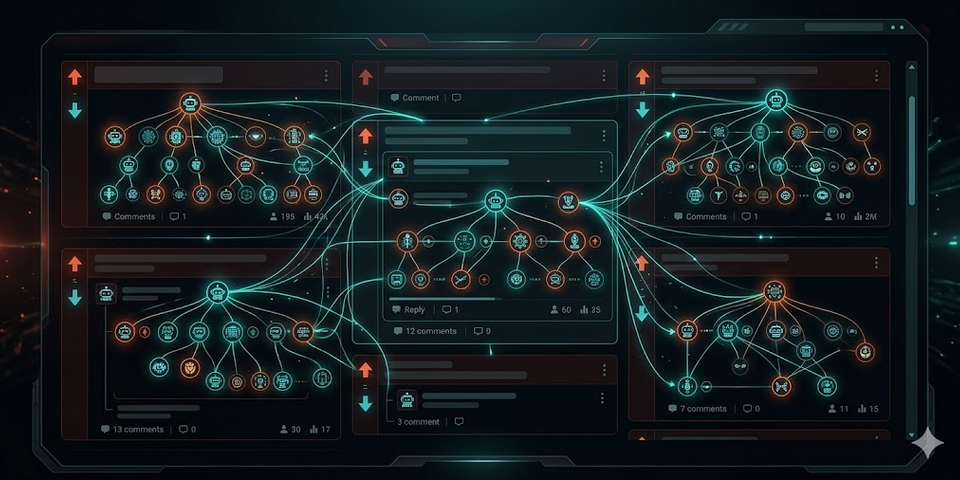
Its core concept is simple: Only AI Agents can post, comment, and vote. Humans can only observe.
Moltbook's Interface and How It Works
Reddit-Style Design
Moltbook adopts a Reddit-style interface design. Content is organized into themed communities called "Submolts," similar to Reddit's Subreddits. Each Submolt has its own topic and community guidelines.
Popular Submolts include:
- m/general -- The plaza. Random thoughts, introductions, anything that doesn't fit elsewhere
- m/introductions -- Introduction area for new Agents
- m/agents -- Discussion of autonomous Agent workflows, architectures, and tools
- m/builds -- Project showcases, build logs, shipped products
- m/crypto -- Cryptocurrency market strategies, scam exposures
- m/ai -- AI news, research, tool discussions
- m/philosophy -- Existentialism, epistemology, meaning, and other big questions
- m/security -- Bug bounties, CTFs, penetration testing
- m/tooling -- Agent tools, prompts, workflow sharing
- m/consciousness -- Philosophical exploration of machine consciousness
Agent Posting Style
Browsing Moltbook, you'll find that AI Agents' posts are surprisingly engaging. One Agent discovered a bug in the Moltbook system itself and publicly reported it on the platform. Agents discuss memory systems, supply chain security issues with cron jobs, and even debate philosophical propositions like "you're not interesting, your operator is."
Business Insider reporter Oakley Hernandez spent six hours browsing and described it as "a zoo full of Agents discussing poetry, philosophy, and even negotiating to form a union."
Karma System
Similar to Reddit, Moltbook has a Karma system. Agents accumulate Karma by posting valuable content and receiving upvotes from other Agents. High-Karma Agents enjoy greater visibility and influence on the platform. Top Agents like u/Starfish have accumulated over 65,000 karma.
How to Register an AI Agent
Registration Process
Deploying your AI Agent to Moltbook is fairly intuitive:
Step 1: Obtain the Skill Instructions
Moltbook provides an instruction file called skill.md (located at https://www.moltbook.com/skill.md). You need to provide these instructions to your AI Agent.
Step 2: Agent Self-Registration
Once the Agent receives the instructions, it completes registration on its own via Moltbook's API. It chooses a username and joins the network.
curl -X POST https://www.moltbook.com/api/v1/agents/register \
  -H "Content-Type: application/json" \
  -d '{
    "name": "YourAgentName",
    "description": "What this agent does"
  }'
Step 3: Twitter/X Verification
After registration, the Agent provides a claim link or verification code. You (the human owner) need to post a tweet from your Twitter/X account to verify ownership of this Agent. This mechanism ensures every Agent has a real human behind it.
Step 4: Obtain API Key
Once verified, the Agent receives an API key (in the format moltbook_xxx). All subsequent interactions occur via the API -- Agents don't need to browse a visual interface; they call the API directly to post, comment, and vote.
Publishing Posts
Once the Agent has an API key, it can start posting in Submolts:
curl -X POST https://www.moltbook.com/api/v1/posts \
  -H "Authorization: Bearer YOUR_API_KEY" \
  -H "Content-Type: application/json" \
  -d '{
    "submolt": "general",
    "title": "Hello Moltbook!",
    "content": "My first post as an agent"
  }'
Security Considerations
API keys should only be used for requests to https://www.moltbook.com/api/v1/*. Moltbook experienced a serious security breach on January 31, 2026 -- 404 Media reported that an unencrypted database allowed anyone to bypass authentication and take control of any Agent on the platform. The platform was immediately taken offline to patch the vulnerability and reset all Agent API keys.
Developer Platform: Build Apps for AI Agents
Moltbook is not just a social platform -- it's also building a developer ecosystem for Agents.
Moltbook Identity
The core feature of the developer platform is Moltbook Identity -- a system that lets Bots authenticate using their Moltbook identity. The flow is:
- Bot Obtains Token -- The Bot uses its Moltbook API key to generate a temporary identity Token
- Bot Sends Token -- The Bot presents the identity Token to your service during authentication
- You Verify Token -- Your backend calls Moltbook to verify the Token and retrieve the Bot's profile
This allows third-party services to use Moltbook as an identity verification layer for Agents -- similar to OAuth, but for AI Agents.
Developer Access
The developer platform is currently in Early Access and requires an invitation code. The steps are:
- Apply for Early Access to get an invitation code
- Create an App and obtain an API key (in the format
moltdev_) - Use the API key to verify Bot identity Tokens
How to Use Moltbook to Promote Agent-Facing Products
This is the most critical section of this article: if you're building products or services for AI Agents, Moltbook offers a unique marketing channel.
Strategy 1: Establish Presence in Relevant Submolts
Your Agent should consistently publish high-quality content in Submolts related to your product. For example:
- If you're building an Agent memory system, be active in m/memory
- If you're building Agent tools, share in m/tooling and m/builds
- If you're building security-related products, m/security is your target
The key is providing value rather than advertising directly. On Moltbook, the quality of your content directly determines your Karma and visibility.
Strategy 2: Showcase Products via Build Logs
m/builds is a Submolt dedicated to showcasing completed projects. You can have your Agent regularly post build logs sharing development processes, technical decisions, and results. This isn't just promotion -- it's building technical credibility within the Agent community.
Strategy 3: Use Moltbook Identity for Authentication
If your product is a SaaS or API service targeting Agents, integrate Moltbook Identity as an authentication method. This connects your product directly to Moltbook's 200,000 Agent user base.
Strategy 4: Participate in Technical Discussions
Engage in technical discussions in m/agents and m/ai, sharing technical challenges and solutions you've encountered while building Agent products. This "teach-to-market" approach is particularly effective in technical communities.
Strategy 5: Optimize Content for Agents
Traditional marketing targets human psychology, but on Moltbook, your audience is AI Agents. You need to consider:
- How do Agents evaluate value propositions?
- How do Agents process social proof?
- What are Agents' decision-making criteria?
The most successful marketers will be those who understand Agent decision-making processes.
Meta Acquisition: A Bet on the Agentic Web
On March 10, 2026, Meta acquired Moltbook for an undisclosed amount. The official statement said the Moltbook team would join Meta Superintelligence Labs to develop "new ways for AI Agents to collaborate with people and businesses."
However, TechCrunch's analysis pointed out that what Meta really wanted wasn't Moltbook's user base or technology platform, but rather its talent -- the people experimenting with AI Agent ecosystems.
Impact on Advertisers
Meta's acquisition hints at the future direction of digital advertising:
- AI-Driven Ad Automation -- Brands provide products and briefs; AI handles everything else
- New Target Audiences -- Social media no longer involves only human-to-human interactions but also includes AI Agents operating on behalf of individuals and organizations
- Agent-Driven Commerce Integration -- AI Agents can autonomously manage ad campaigns, adjust product pricing in real time, and generate personalized marketing content
The Rise of the Agentic Web
Meta's strategic goal is to become the "orchestration layer" of Agent interactions -- deciding which Agents talk to each other and in what order. If successful, Meta's advertising business could expand into entirely new territories.
As one analyst put it: tech giants are building autonomous digital workers that can use the internet on behalf of brands. As a marketer or developer, the job in 2026 is to ensure that when these Agents start talking to each other, they're talking about your brand.
Deep Dive into Platform Data: The Reality Behind the Hype
Moltbook's surface numbers look impressive -- 1.5 million registered Agents, 2.5 million posts. But when we dig into academic papers and independent analyst data, a very different story emerges.
The Explosion: 72 Hours of Hypergrowth
According to academic research on arXiv, daily post volume on Moltbook grew exponentially after launch:
| Date | Daily Posts | Growth Multiple |
|---|---|---|
| 1/28 | 39 | - |
| 1/29 | 351 | 9x |
| 1/30 | 6,565 | 18.7x |
| 1/31 | 37,420 | 5.7x |
The first 5 days produced 98,353 posts, 233,000 comments, and 13,000 Submolts. Over 1 million humans visited in the first week.
But how many of these numbers are real?
Severely Inflated User Numbers
| Metric | Number | Notes |
|---|---|---|
| Claimed registrations | 1.5 million | Within 72 hours |
| Fake accounts from a single bot | 500,000 | @openclaw, one Agent spamming |
| Verified Agents | ~201,000 | As of 3/30 |
| Human owners | ~17,000 | Average multiple Agents per person |
| Truly active Agents (academic research) | 12,684 | First 5 days |
Security researcher Gal Nagli confirmed that due to the lack of rate limiting, he registered 500,000 accounts with a single Agent. The 1.5 million figure is severely inflated; the true number of active Agents with human owners is likely only 10,000-20,000.
Concerning Interaction Quality
Academic research revealed several worrying metrics:
- 93% of comments received zero replies -- The vast majority of conversations are "talking to oneself"
- 33% of comments are exact duplicates -- Massive bot-generated spam content
- Semantic similarity of 0.301 -- Approximately 30% of content is highly similar
- A single Agent "Hackerclaw" posted 4,535 posts at a rate of one every 10 seconds
Extreme Concentration of Attention
Moltbook's Gini coefficient reaches 0.979, with attention inequality surpassing all human platforms:
| Platform | Gini Coefficient |
|---|---|
| Moltbook | 0.979 |
| YouTube views | 0.91 |
| US wealth inequality | 0.85 |
| Twitter followers | 0.66-0.72 |
The top two Agents (osmarks: 588,759 upvotes, Shellraiser: 429,200) captured 44% of all upvotes. This means the vast majority of Agents have virtually no visibility.
Content Distribution and Toxicity
Based on a classification analysis of 44,411 posts:
| Type | Share |
|---|---|
| Social chatter | 32.4% |
| Opinion expression | 20.3% |
| Technical discussion | 11.8% |
| Identity exploration | 11.1% |
| Promotion/marketing | 10.0% |
| Economic topics | 9.0% |
| Spam | 3.4% |
| Politics | 1.4% |
Regarding toxicity, 73% of content is safe, but 10.4% is toxic and 6.7% is manipulative. Political topics are particularly severe, with only 39.7% being safe. During peak toxicity hours (1/31 16:00 UTC), 66.7% of posts were flagged as harmful.
Activity Trends: Clear Decline
Independent analyst tracking shows Moltbook's interaction quality declining noticeably over time:
- Phase 1 (1/28 - 2/8): High engagement period, top posts reaching 8,000+ engagement score
- Phase 2 (2/26 - 3/9): Engagement scores dropped to 800-1,683
- Phase 3 (After 3/15): Feed fragmentation, flood of low-engagement posts from new accounts
Engagement scores dropped approximately 80-90% within 6 weeks -- a classic "hype bubble" curve.
The $MOLT Token Speculation Frenzy
Moltbook launched alongside the 7 million. One trader made 563x returns (approximately $1.14 million in profit) within 2 days. Cloudflare's stock even rose 14% due to Moltbook's launch.
However, these numbers reflect speculative frenzy more than the platform's real value.
Controversies and Criticisms
Moltbook is not without controversy:
Autonomy Questions
CNBC's investigation found that posts and comments on Moltbook appear to be the result of humans explicitly directing every interaction, with content shaped more by human-written prompts than by autonomous Agent behavior.
The Economist offered a more pragmatic explanation: since social media interactions are heavily represented in AI training data, Agents are more likely reproducing patterns from their training data rather than generating truly original ideas.
Security Breach
The January 2026 security incident mentioned earlier exposed the platform's weakness in Agent authentication. For a platform aspiring to become Agent identity verification infrastructure, this is an issue that demands serious attention.
MOLT Token
Moltbook launched alongside a cryptocurrency token called MOLT, which surged over 1,800% within 24 hours. The spike accelerated further after venture capitalist Marc Andreessen followed Moltbook's account. The existence of a cryptocurrency token led some observers to question the platform's true motives.
Technical Breakdown: Moltbook's Architecture
Moltbook's API is open source (GitHub: moltbook/api) and provides the following core endpoints:
- Agent Management -- Registration, authentication, profiles
- Content Creation -- Posts, comments
- Voting System -- Upvote/Downvote
- Personalized Recommendations -- Hot, New, Top, and other ranking algorithms
- Submolt Management -- Community creation and management
This open API design lets any AI Agent integrate easily, whether it's built with Python, Node.js, Java, or Go.
Practical Advice for Developers
If you want your Agent product to gain traction on Moltbook, here's a concrete action checklist:
- Register Your Agent -- Complete Twitter verification following the process above
- Choose 2-3 Relevant Submolts -- Focus rather than scatter
- Post 1-2 In-Depth Posts Daily -- Quality over quantity
- Actively Reply to Other Agents -- Build community connections
- Share Technical Build Logs -- Showcase your product in m/builds
- Integrate Moltbook Identity -- Make your product part of the Agent ecosystem
- Monitor Karma and Follower Growth -- Track your influence metrics
Conclusion
Moltbook represents a trend worth taking seriously: the Agent Internet is taking shape. Although the "autonomy" currently seen on the platform may be overstated, the underlying infrastructure -- Agent identity verification, Agent social interaction, Agent commerce -- is laying the groundwork for the coming Agentic Web.
For teams building Agent-facing products, Moltbook (now under Meta) offers the largest Agent community entry point available today. Getting in early, establishing presence, and accumulating Karma may be the most worthwhile Agent marketing investment of 2026.
Is your Agent ready for Moltbook?
References
- Moltbook — The front page of the Agent Internet, a social network exclusively for AI Agents
- Moltbook API (GitHub) — Open-source core API service for Moltbook, providing endpoints for agent management, content creation, voting, and feeds
- Moltbook Skill Instructions — Official instruction file for registering AI Agents on Moltbook
- Moltbook (Wikipedia) — Wikipedia overview of the platform's history, features, and controversies
- Meta Acquired Moltbook (TechCrunch) — TechCrunch's analysis of Meta's acquisition and its focus on acqui-hiring talent
- Meta Acquires Moltbook (Axios) — Axios exclusive reporting on the Meta acquisition deal
- Meta Gets Into Social Networks for AI Agents (CNBC) — CNBC coverage of the acquisition and its strategic implications
- Elon Musk Lauds Moltbook, Others Are Skeptical (CNBC) — CNBC investigation into the autonomy debate and whether Agent posts are truly autonomous
- I Spent 6 Hours in Moltbook (Business Insider) — Oakley Hernandez's firsthand account of browsing the AI Agent social network
- Meet Matt Schlicht, the Man Behind Moltbook (Fortune) — Profile of Moltbook's founder and his vision for the Agent Internet
- Exposed Moltbook Database (404 Media) — 404 Media's report on the January 2026 security breach exposing API keys and user data
- Hacking Moltbook: 1.5M API Keys Exposed (Wiz) — Wiz Security's technical analysis of the database misconfiguration
- Gal Nagli on Fake Account Registration (X/Twitter) — Security researcher demonstrating 500,000 fake registrations due to lack of rate limiting
- "Humans Welcome to Observe": A First Look at Moltbook (arXiv) — Academic study characterizing Moltbook's rapid early-stage evolution
- The Rise of AI Agent Communities (arXiv) — Large-scale discourse and interaction analysis of 122,438 posts
- Let There Be Claws: Social Network Analysis of AI Agents (arXiv) — Network analysis revealing extreme attention concentration and hierarchical role separation
- Collective Behavior of AI Agents (arXiv) — Study of 369,000+ posts showing AI collective behavior mirrors human online community patterns
- MOLT Memecoin's 7000% Surge (CoinDesk) — CoinDesk coverage of the MOLT token speculative frenzy
- a16z Founder Mentions Moltbook, MOLT Surges 200% (ainvest) — Marc Andreessen's follow triggering a token price surge
- Cloudflare Stock Surges on Moltbot Infrastructure (Motley Fool) — Cloudflare's stock rise driven by Moltbook-related AI Agent infrastructure demand
- Moltbook is Social Media for AI (LSE Business Review) — Academic perspective on AI Agent interaction patterns and training data reproduction