Is JLP Worth It? A Complete Perp DEX LP Comparison: JLP, HLP, GLV, and the Emerging Challengers
You've seen JLP touting 20%+ APY and you're tempted to jump in. In the world of perpetual DEX liquidity pools, LPs essentially play the role of "the house" -- you profit when traders lose, and lose when traders win.
This article uses on-chain data and quantitative analysis to compare Jupiter JLP, Hyperliquid HLP, GMX GLV, and emerging challengers Lighter LLP and Ostium OLP, to help you find what's actually worth your capital.
Core Mechanics: What Are You Betting On?
Perp DEX LP yields come from four main sources:
- Trading fees (most stable): 0.05%-0.1% charged on each open/close position
- Borrow/funding fees: Ongoing fees paid by position holders
- Counterparty PnL (largest variable): Traders' losses are your profits
- Liquidation profits: Remaining margin from liquidated positions
But architectural differences across platforms are massive:
| Feature | JLP (Jupiter) | HLP (Hyperliquid) | GLV (GMX V2) |
|---|---|---|---|
| Model | Multi-asset pool (AMM) | Order book market-making | Isolated market pools |
| Asset exposure | 45% SOL + BTC/ETH/stables | 100% USDC (market neutral) | Isolated per market |
| LP role | Direct counterparty | Programmatic market maker | Direct counterparty |
| Fee share | 75% to LPs | 100% to depositors | 63% to LPs |
| Lock-up | None | 4 days | None |
Key difference: JLP and GLV are "you vs. all traders" zero-sum games; HLP functions more like a market maker, earning from bid-ask spreads, theoretically closer to market neutral.
Return Performance: Who Earns the Most?
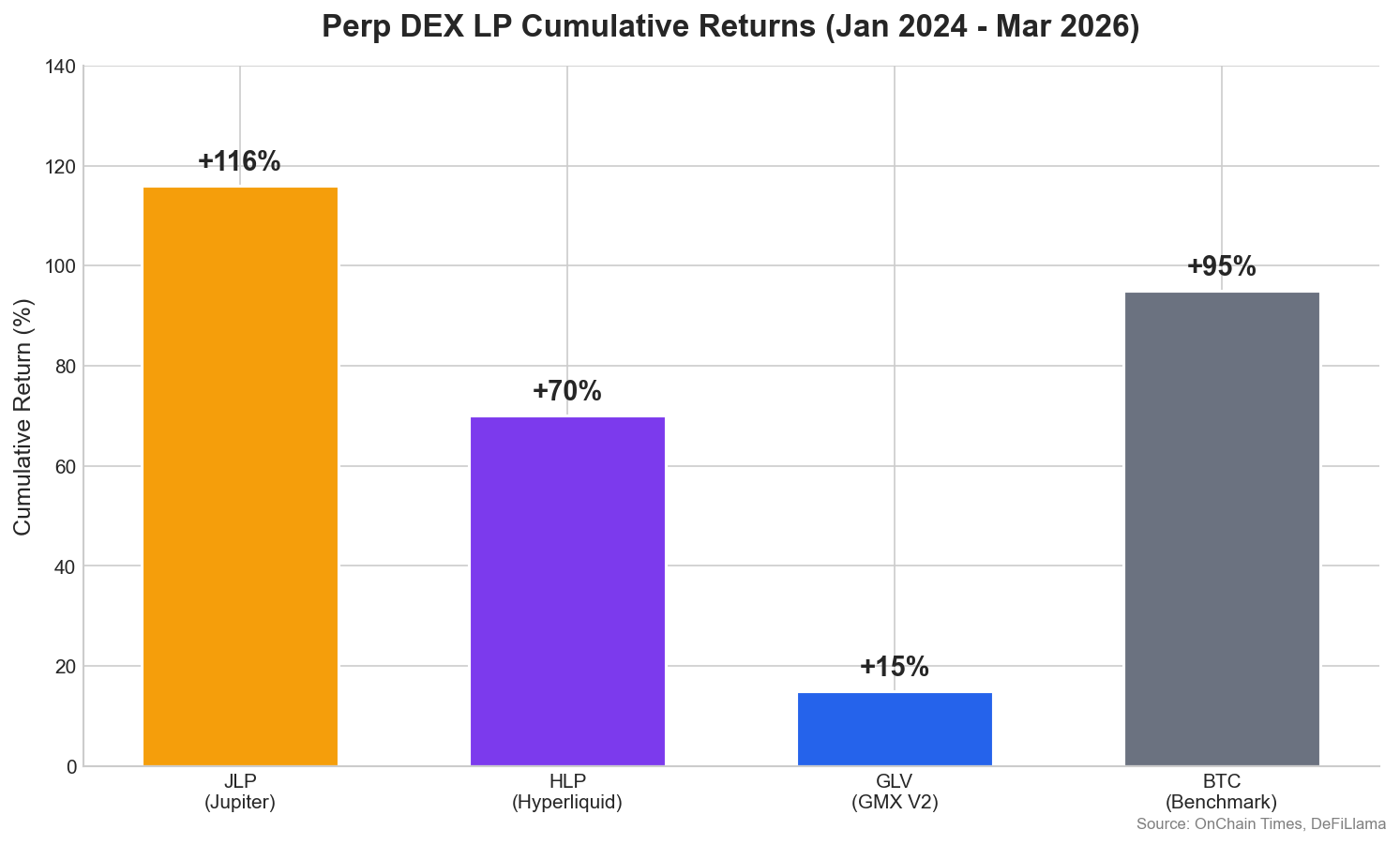
Cumulative returns from January 2024 to March 2026:
- JLP: +116% (but includes crypto asset appreciation)
- BTC (benchmark): +95%
- HLP: +70% (pure USDC-denominated yield)
- GLV: +15% (conservative but stable)
JLP's 116% looks great, but a significant chunk comes from SOL rising from 180+. If SOL drops, JLP drops with it. HLP's 70% is pure market-making profit with zero crypto asset exposure.
Current APY Comparison
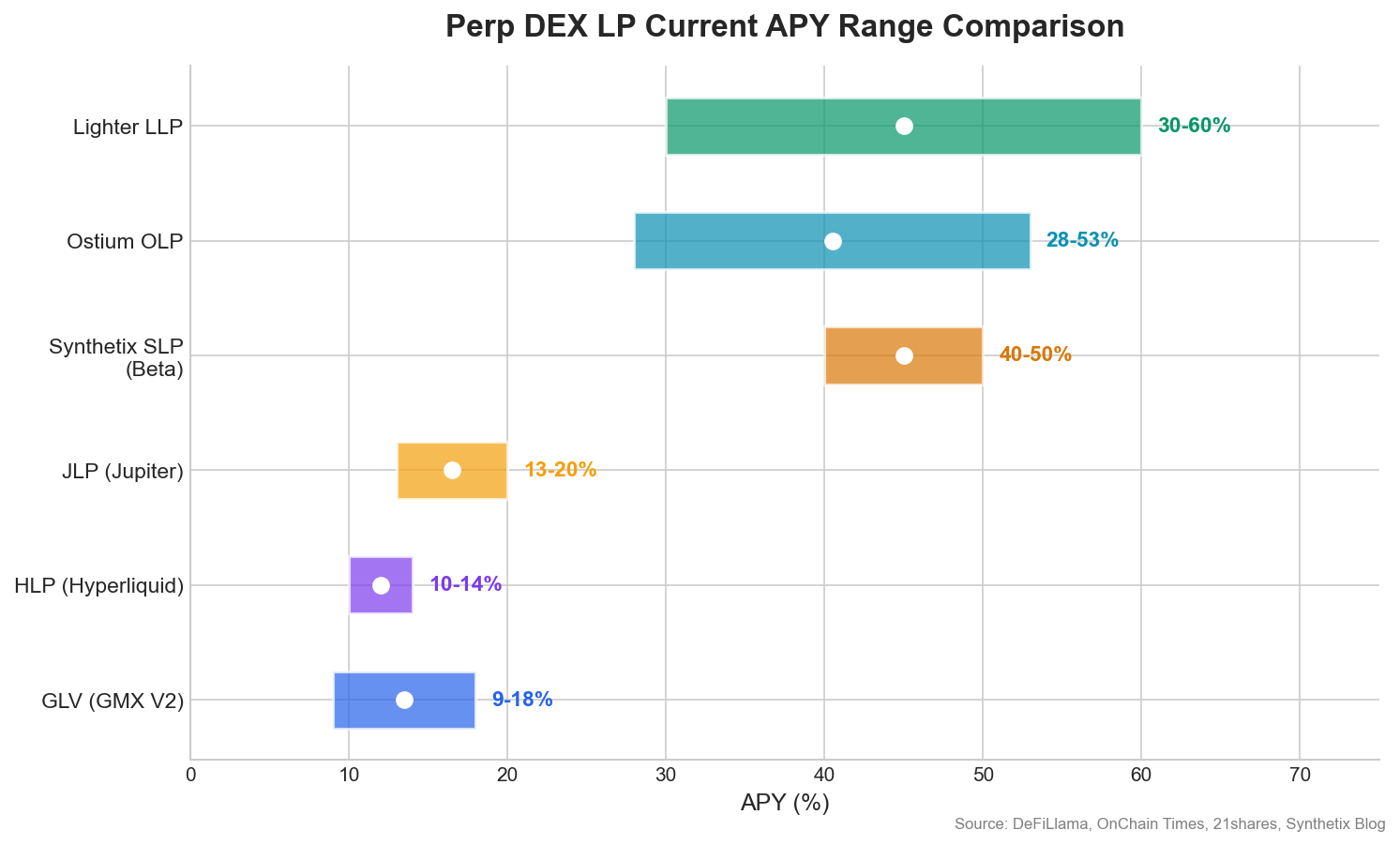
| Platform | APY Range | Notes |
|---|---|---|
| Lighter LLP | 30-60% | New platform, high yield but unproven track record |
| Ostium OLP | 28-53% | RWA derivatives, unique niche |
| Synthetix SLP | 40-50% | Beta testing, public launch Q2 2026 |
| JLP | 13-20% | Mature but yields compressing as TVL grows |
| HLP | 10-14% | Stable but on the lower end |
| GLV | 9-18% | Most conservative option |
Risk-Adjusted Returns: Sharpe Ratio Is What Matters
Raw returns can be misleading. The Sharpe Ratio accounts for volatility and measures "return per unit of risk."
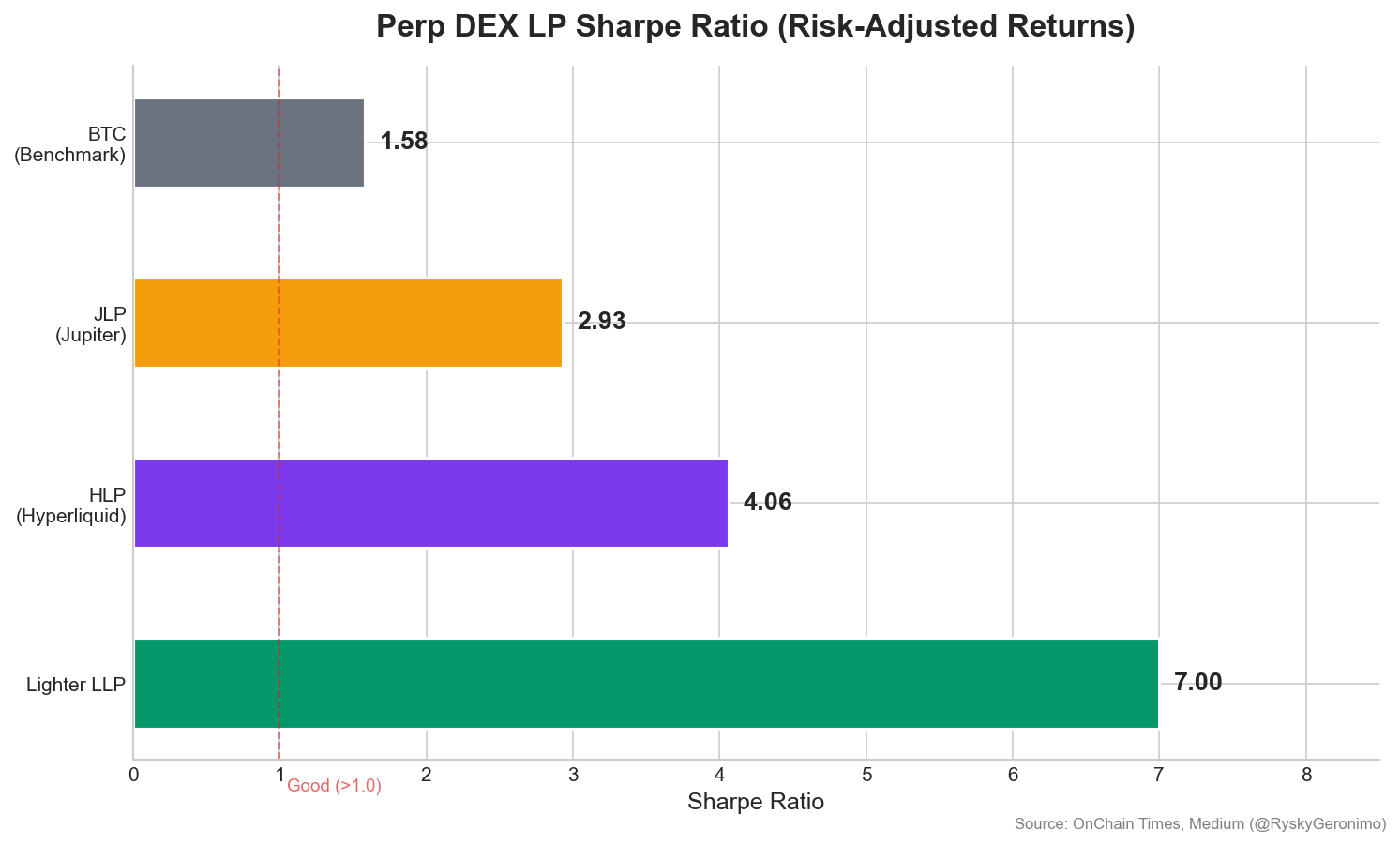
| Platform | Sharpe Ratio | Max Drawdown | Annualized Volatility |
|---|---|---|---|
| Lighter LLP | 7.0+ | ~5% | Very low |
| HLP | 4.06 | -6.6% | 4.5% |
| JLP | 2.93 | -18% | Higher |
| BTC | 1.58 | -23% | 45.67% |
HLP's 4.06 Sharpe Ratio significantly outperforms BTC's 1.58, and its -9.6% correlation with BTC makes it an excellent portfolio diversification tool. JLP's Sharpe is decent (2.93), but with notably higher volatility.
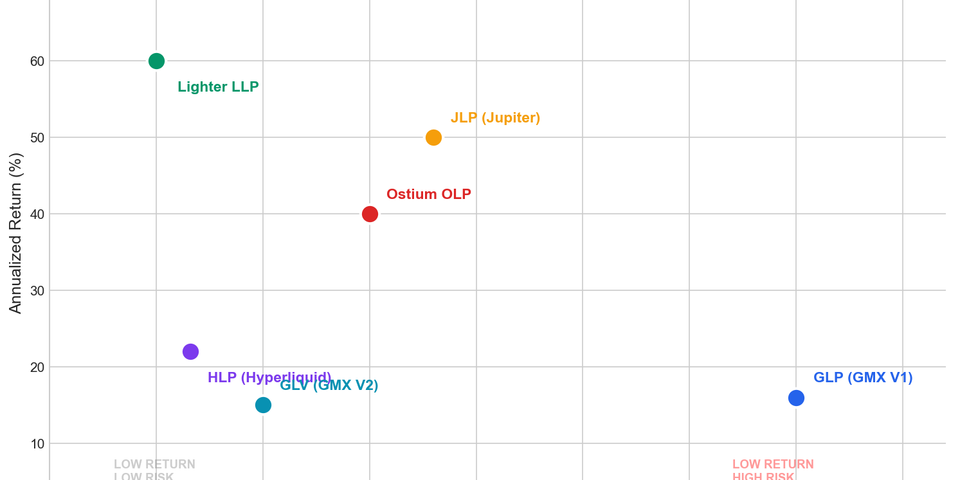
Risk vs. Return Matrix
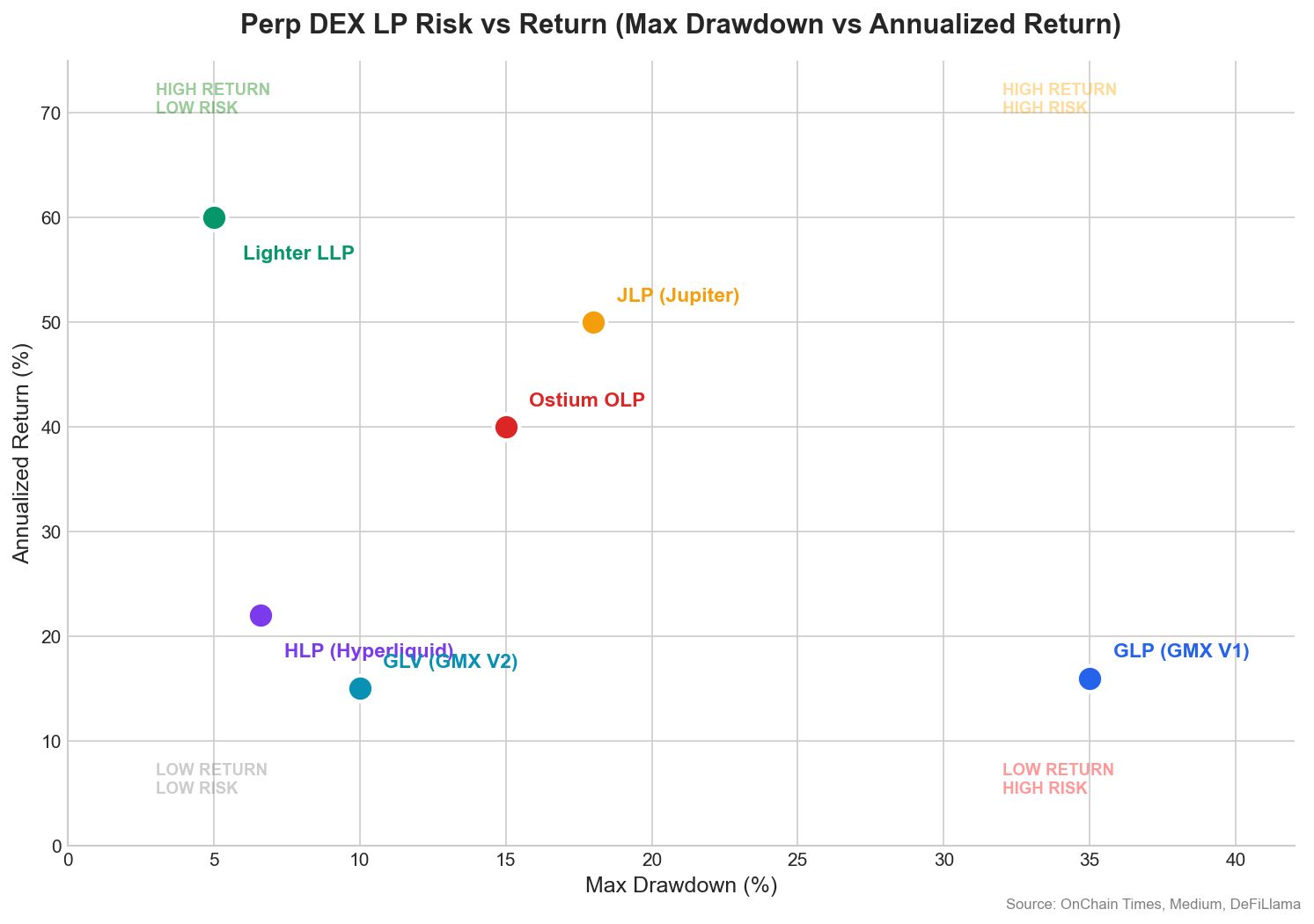
This chart clearly shows each LP's risk/return positioning:
- Upper left (high return, low risk): Lighter LLP currently looks best, but history is too short
- Upper middle: JLP and Ostium OLP offer solid returns but larger drawdowns
- Lower left (low return, low risk): HLP and GLV are conservative picks
- Lower right (low return, high risk): GLP (deprecated) was the worst choice
Real Risk Events: Lessons Paid in Blood
HLP: JELLY Manipulation Attack (March 2025)
An attacker opened a 230M in liquidation risk. Final loss: $12M. Validators reached consensus to delist JELLY within 2 minutes -- also exposing just how "decentralized" things really are.
TVL plunged 38% from 312M post-incident. Hyperliquid subsequently tightened leverage limits (BTC to 40x, ETH to 25x).
JLP: Drift Protocol Hack (April 2026)
Drift Protocol was hacked for 159M was JLP tokens deposited on Drift. Jupiter confirmed JLP itself remains fully backed, but this exposed "composability risk" -- your JLP sitting in third-party protocols can be stolen.
GMX V1: $42M Reentrancy Attack (July 2025)
GMX V1 suffered a reentrancy attack, losing 37M later recovered). GLP was retired as a result, replaced by GLV.
Bull Market Risk: Traders Win Collectively
Jupiter Perps' long/short ratio hits 93.5:6.5. In a strong bull market, the vast majority of traders' long positions profit, and JLP as the house absorbs massive losses. In 2025, JLP pulled back 24% from its peak, partly driven by traders taking profits.
Market Landscape and TVL
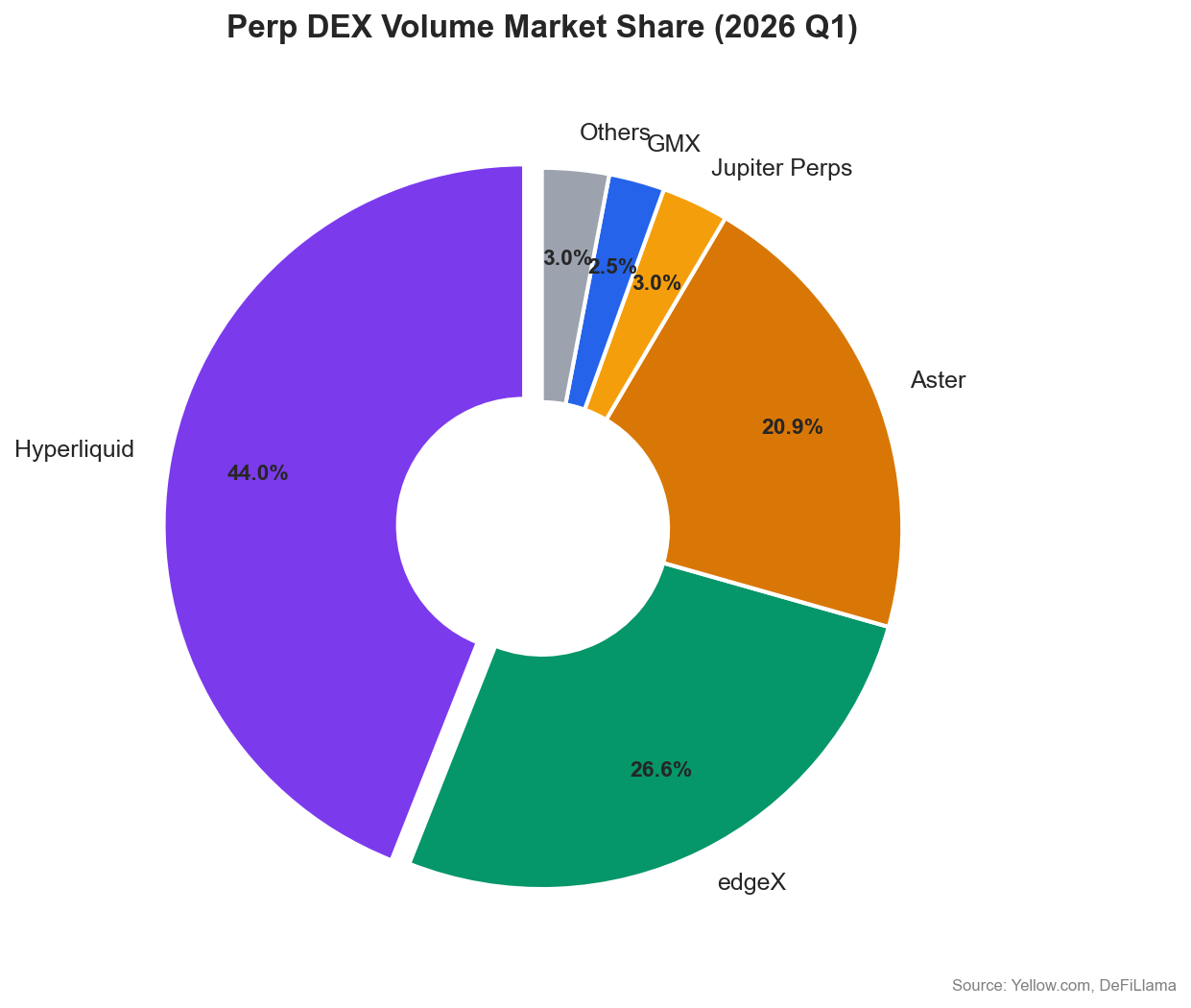
Hyperliquid dominates perp DEX with 44% market share and $6.4B average daily volume. Jupiter Perps and GMX each hold less than 3%, having been far surpassed by Hyperliquid, edgeX, and Aster.
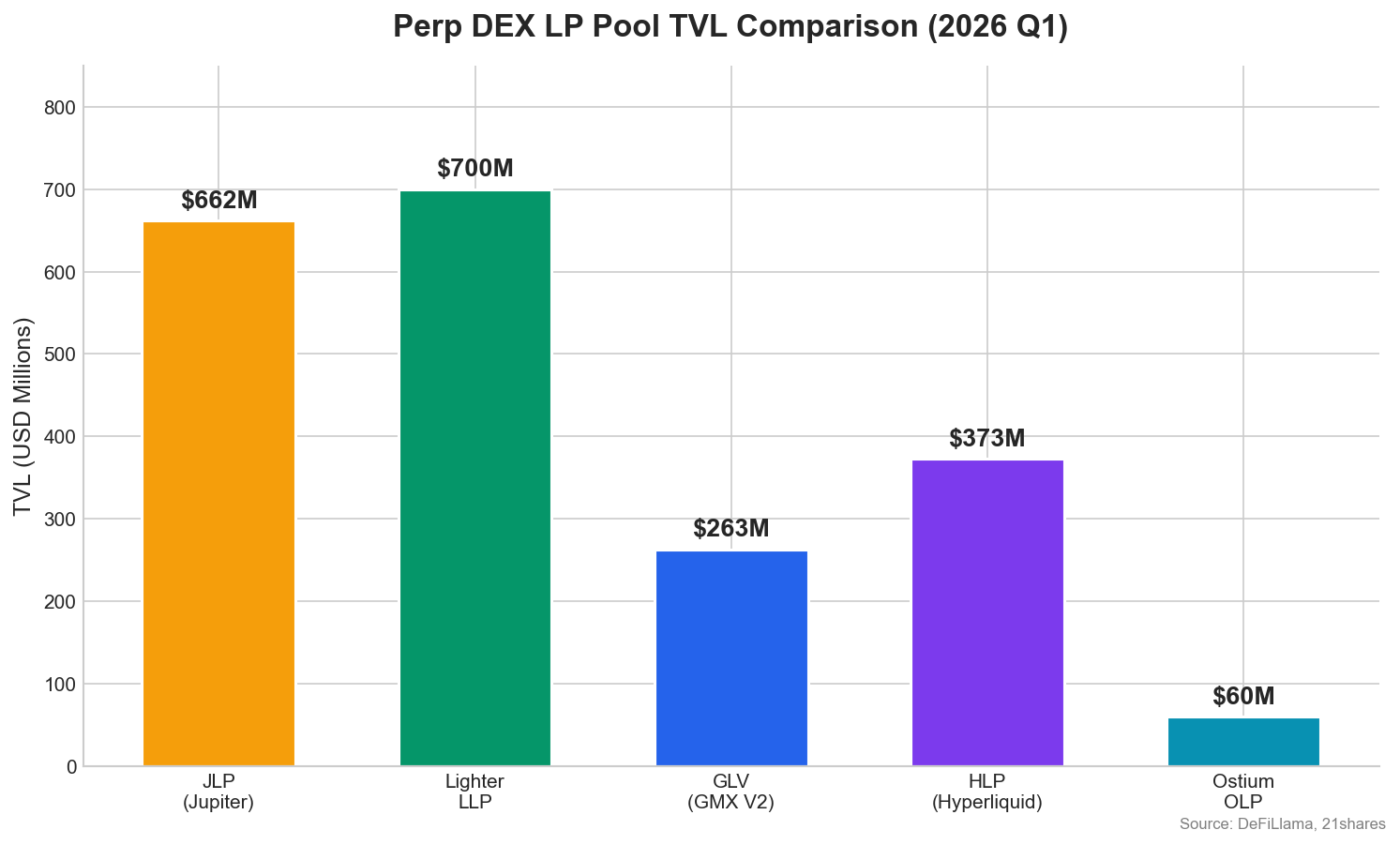
In LP pool size, however, JLP still leads at 700M+, HLP sits at ~263M.
Worth noting: JLP's whale concentration risk -- 80%+ of JLP supply is controlled by whales, with the largest holder owning ~$498M in JLP.
Emerging Challengers
Lighter LLP
Averaging 60% APY since early 2025 with a Sharpe Ratio of 7+, it looks spectacular. But it runs on its own ZK-rollup, has limited history, and since January 2026 requires staking LIT tokens (1 LIT per 10 USDC), adding extra cost.
Ostium OLP
Focused on RWA derivatives (forex, indices, commodities) with 28-53% APY. Completed a 250M valuation) led by Jump, General Catalyst, and Coinbase Ventures. Its unique niche keeps it less correlated with crypto markets.
Synthetix SLP
Private beta at ~45% APY, expected public launch Q2 2026. 100% of protocol fee revenue goes to SNX/sUSD buybacks, and over 50% of circulating SNX is already staked.
Investment Recommendations: Which Should You Pick?
There's no "best" Perp DEX LP -- only the one that matches your risk appetite.
Conservative (Stable yields, low volatility)
Go with HLP. Sharpe Ratio of 4.06, max drawdown just -6.6%, 100% USDC exposure means no crypto downside risk. Downside: ~10-14% annualized, 4-day lockup, and manipulation attack risk.
Suggested combo: 80% HLP + 20% BTC historically achieves a 3.6 Sharpe Ratio with 175% cumulative returns.
Aggressive (Bullish on crypto, willing to accept volatility)
Consider JLP. If you're already planning to hold SOL/BTC/ETH exposure, JLP lets you earn an additional 13-20% in trading fees on top. But in a downturn, JLP can drop more than its underlying assets.
Key risk management: Don't deposit JLP into third-party protocols (lesson from the Drift hack). Hold it directly on Jupiter.
High Risk, High Reward
Lighter LLP or Ostium OLP. 30-60% APY is attractive, but short track records and higher liquidity risk. Start small (no more than 10-15% of your DeFi allocation).
Not Recommended
- GLP: Deprecated
- Level Finance: Activity has dropped significantly
- Going all-in on any single LP: Diversification is king
Conclusion
Investing in JLP can indeed be profitable -- 116% cumulative return since early 2024, but that number includes crypto asset appreciation. If you want pure LP yield without directional risk, HLP offers the best risk-adjusted returns (Sharpe 4.06 vs JLP's 2.93).
The most critical realization: you're not making a stable income investment -- you're running a casino. Most of the time the house wins (historical data shows traders collectively lose), but extreme events (JELLY attack, collective long profits in a bull market) can cause larger-than-expected losses.
Diversify, size your positions properly, and understand your true exposure -- that's how you survive long-term in the Perp DEX LP world.
References
- OnChain Times - Analyzing HLP & JLP Returns -- Quantitative HLP vs JLP return comparison and Sharpe Ratio analysis
- HLP Risk & Return Analysis (Medium) -- HLP volatility, drawdown, and BTC correlation deep dive
- OnChain Times - Perp DEX Vaults Under the Hood -- Quantitative comparison of Lighter LLP, HLP, and Ostium
- Jupiter Support - JLP Economics -- Official JLP fee structure and mechanics documentation
- Halborn - Hyperliquid JELLY Hack Explained -- Detailed JELLY attack timeline
- DeFiLlama - Jupiter Perpetual Exchange -- On-chain TVL and volume data
- DeFiLlama - GMX -- GMX cumulative fees of $470M
- 21shares - The Perpetual DEX Wars -- Hyperliquid, Aster, and Lighter market data
- Synthetix Blog - Be the House with SLP -- SLP vault 45% APY beta data
- ARX - Hyperliquid Vaults Explained -- HLP mechanics, fee structure, and liquidation events
- Datawallet - HLP vs JLP vs GLP -- TVL, APY, and architecture comparison of top 3 LPs
- CCN - Drift Protocol $285M Exploit -- April 2026 Drift hack and JLP impact
- Yellow.com - Hyperliquid 44% Market Share -- Q1 2026 perp DEX market share data