Polymarket Field Guide: On-Chain Data Reveals Who Is Winning and How Regular People Can Find Real Opportunities
Polymarket processed over 95 million on-chain transactions in 2025, with nominal trading volume exceeding $21.5 billion. Those numbers attract a lot of attention — and a natural question: do regular people, or a small team of a few people, have any real shot here?
This is not a beginner's introduction. It's a field guide built from on-chain data, academic research, and market structure analysis — for people who want to take this seriously.
First: Understand What Market You Are Actually Facing
Architecture
Polymarket runs on a hybrid Central Limit Order Book (CLOB): matching happens off-chain for low latency, while settlement is executed non-custodially on the Polygon blockchain. Each market's order book is mirrored — a buy order for YES is simultaneously a sell order for NO — enforcing the identity YES + NO = $1.
There are three types of operations: direct user-to-user matching, minting new shares (when both sides have buyers), and merging/burning shares (when both sides have sellers). This structure gives Polymarket deeper liquidity than a traditional AMM — but also gives institutional market makers more precise tools to work with.
The April 2026 Upgrade (Just Happened)
As of April 6, 2026, Polymarket completed the largest infrastructure change since launch:
- Introduced Polymarket USD, a native stablecoin backed 1:1 by USDC, replacing Polygon-bridged USDC.e — giving the platform direct control over settlement rails
- Rebuilt the matching engine to reduce order execution latency and tighten spreads
- CTF Exchange V2 upgrade reducing gas costs
- EIP-1271 support, enabling smart contract wallets like Safe to sign orders directly on Polymarket
During the upgrade, all order books were cleared. Bot operators and API traders have a ~2-3 week adaptation window. For anyone building tools, this is a short-term opening.
The Wash Trading Reality
In November 2025, Columbia University published research analyzing 1.26 million wallets and found that approximately 25% of Polymarket's trading volume is artificial. The peak was December 2024 at 60%; it dropped to 5% as airdrop speculation faded, then climbed back to ~20%.
Sports markets were hit hardest (45% flagged as inauthentic), while election markets were relatively clean (17%). Researchers identified a cluster of over 43,000 wallets that almost exclusively traded with each other — the primary motive being to farm a potential platform token airdrop.
What this means for you: when reading market depth and volume, apply a discount — especially in sports markets. But the forecasting accuracy itself was not affected. Independent tracking shows Polymarket's market resolution accuracy remains above 95%.
The Brutal Reality: Who Is Actually Making Money
Dune Analytics data reveals a highly concentrated profit distribution:
- Only 7.6% of wallets are ultimately profitable (~120,000 wallets)
- Over 1.5 million wallets are losing money
- Wallets with PnL above $1,000 represent only 0.51% of total
- Arbitrage profits are extremely concentrated: the top 3 wallets captured $4.2 million between April 2024 and April 2025
But the upside for top performers is real: one trader using data models made 1.4 million in profit.
Before you enter: this market has a more extreme profit distribution than almost any traditional financial market.
Six Profit Models
These six models are extracted from 95 million on-chain transactions, ranked by accessibility for non-institutional players.
Model 1: Domain Specialization
This is the most sustainable edge for regular traders and small teams — and it's what almost everyone at the top of the leaderboard actually uses.
On-chain data shows that Polymarket's highest earners are almost all vertical specialists, not generalists who know a little about everything:
- One sports market trader had MLB pitcher rotation and weather data mastery rivaling professional analysts, adjusting positions based on real-time information — over $1.4M cumulative profit
- One trader tracking a specific politician's public statements built a predictive model from historical patterns, maintaining a 96% win rate
Your edge might come from: political information via local language and networks, tech event prediction from developer communities and GitHub activity, deep knowledge of a specific industry's supply chain, or statistical analysis capability in a regional sport.
Important context: Polymarket's CEO has publicly stated they do not prohibit insider trading, viewing it as making markets more accurate. This is the exact opposite of competitor Kalshi's stance.
Model 2: Near-Certainty Bond Strategy
This is the low-risk strategy favored by on-chain whales. Data shows over 90% of orders above 0.95 — events that are nearly certain to happen.
The logic: buy a "near-certain" outcome at 1.00 settlement. This is essentially a short-term high-yield bond. You're not predicting uncertainty — you're judging the certainty that "nothing unexpected will happen."
Why it suits retail: no speed advantage needed, no fighting institutional algorithms — just judgment and position sizing.
Risks: occasional black swans; opportunity cost of locked capital.
Model 3: Cross-Platform Arbitrage
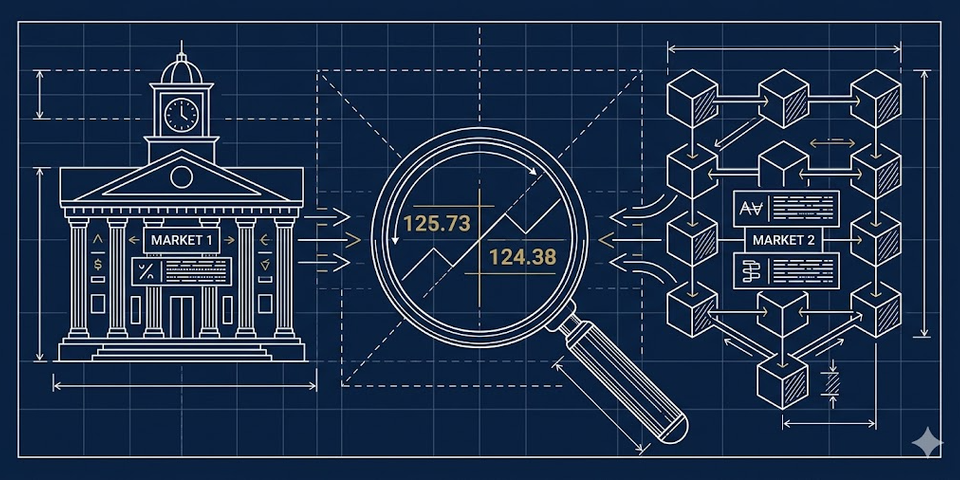
For the same event, Polymarket and Kalshi often price differently — gaps of 2-8%. Academic research documented over $40 million in risk-free profits extracted from Polymarket between 2024 and 2025.
A real 2025 example: ArbBets spotted a Senate nomination market where Kalshi priced it at 38% and Polymarket at 59% — a 21% gap.
Fee structure (directly impacts profitability):
| Platform | Fee |
|---|---|
| Polymarket International | 2% of net winnings |
| Polymarket US | 0.01% of volume |
| Kalshi | ceil(0.07 × contracts × price × (1 - price)) |
The biggest trap is different resolution criteria. During the 2024 government shutdown, Polymarket and Kalshi ruled differently on the same outcome. Before executing cross-platform arbitrage, compare both platforms' resolution criteria word for word.
Ready-to-use open source tools: polymarket-arbitrage (monitors 10,000+ markets) and eventarb.com (real-time arbitrage calculator).
Model 4: Liquidity Provision and Market Making
Post both bid and ask simultaneously, earning the spread, while collecting Polymarket's daily USDC liquidity rewards (distributed by Q-score, which measures spread tightness, depth, and sustained activity).
Professional market makers on high-volume markets report $150-300 per market per day — but spreads have compressed from 4.5% in 2023 to 1.2% in 2025, and major markets are now dominated by institutional players.
Retail space is in long-tail markets: no competition, wide spreads, low liquidity reward competition. The challenge is building tools to manage orders and risk across many markets simultaneously.
Model 5: Information Arbitrage
Markets are slow to process new information. After breaking news, Polymarket prices often lag by 30 seconds to a few minutes.
This path is fully covered by institutional algorithms on major high-volume events. Retail space is in non-mainstream markets: regional elections, niche sports, specific small-cap token events. The key is seeing information before the market — not executing faster.
Model 6: Latency Arbitrage
Exploiting the delay between traditional financial markets (Binance, Deribit) and Polymarket's crypto price markets. Documented cases achieved a 69.6% win rate.
Reality: this path is nearly closed by institutions. The only retail window is in obscure events where institutional bots haven't achieved full coverage.
Cross-Platform Arbitrage Map
Polymarket (global / USDC) relationships with other platforms:
vs Kalshi (US / USD / CFTC regulated)
Same-event pricing gaps of 2-8%. Polymarket has higher liquidity and typically leads Kalshi by several minutes. Risk: resolution criteria may differ. Kalshi's higher fees compress the available spread.
vs Manifold / Metaculus
No real money — not suitable for direct arbitrage. Use them as information sources to sense market direction before placing bets on Polymarket.
vs Traditional Sportsbooks
Pricing discrepancies for sports events do exist. Polymarket secured an official MLB partnership (3-year deal estimated at $150-300M), but cross-platform operations involve legal gray areas — read each platform's terms carefully.
Internal Polymarket Arbitrage
When YES + NO < $1.00, buying both sides locks in a guaranteed profit. This briefly appears during high volatility when market makers withdraw. It's the simplest form of arbitrage, but windows are extremely short.
Vibe Coding: Five Real Opportunities for Tool Builders
Polymarket's open API has spawned an ecosystem of 170+ tools, but most are still primitive — and demand keeps growing. Here are five directions with real opportunity for small teams or solo developers.
Direction 1: Vertical Domain Intelligence Tools
Build automated information aggregation plus pricing models for specific domains (crypto project events, regional politics, niche sports) — a tool that monitors markets and alerts you when your information advantage is relevant.
Stack: Python + Polymarket CLOB API + LLM analysis layer. API documentation is complete, open-source references exist, moderate barrier to entry. Use it yourself to trade profitably, or sell as SaaS to others in your domain.
Direction 2: Cross-Platform Arbitrage Monitor (Refined)
Existing arbitrage bots on GitHub are mostly prototypes that don't handle the most critical issue: resolution criteria differences.
Improvement: use NLP to automatically parse resolution criteria from both Polymarket and Kalshi, executing arbitrage only on semantically equivalent markets. This dramatically reduces losses from settlement divergence — a clear technical problem with strong defensibility once solved.
Stack: Python / TypeScript + both platform APIs + text similarity analysis.
Direction 3: Liquidity Reward Optimization Tool
Automatically manage orders across multiple long-tail markets, targeting maximum Polymarket Q-score to maximize daily USDC liquidity rewards. Existing market-making bots don't optimize for the reward mechanism.
Scale effect: in theory, one person can maintain orders in 50-100 markets simultaneously. The challenge is multi-market risk management and automated position rebalancing.
Direction 4: AI Agent Strategy Training
Polystrat, launched in February 2026, executed over 4,200 trades in its first month, with 37% of agents achieving positive PnL (vs 13% for humans). AI agents now represent over 30% of active wallets on Polymarket.
But Polystrat hasn't reached fleet-wide breakeven — meaning strategy design still has room for improvement. The opportunity is training more precise agents for specific niches rather than general-purpose ones. Polymarket's official agent framework is open source: Polymarket/agents.
Direction 5: Multi-Party Collaboration Tools (Post-EIP-1271)
This is a brand-new opportunity. Polymarket just added EIP-1271 support, allowing Safe and other multi-sig wallets to sign orders directly on the platform. This opens the door for building collective trading tools for DAOs or small groups: multi-sig authorized trading, strategy delegation, position transparency. Competition is essentially zero since the feature just launched.
The Optimal Team Model (3-5 People)
Based on the analysis above, the most effective small team structure is:
Domain Expert (1-2 people): Deep information advantage in a specific vertical. Responsible for identifying mispriced markets and making bet decisions.
Quant Engineer (1-2 people): Builds monitoring tools, automates execution, runs cross-platform arbitrage scans — freeing the domain expert to focus on judgment rather than operations.
Capital Manager (1 person): Manages position sizing using Kelly Criterion, prevents over-concentration in any single market, ensures long-term survival.
The core insight behind this structure: people who make money on Polymarket either have an information edge or an execution edge — almost nobody sustains long-term profitability without at least one. A small team combining both has more systematic advantages than going solo.
Seven Risks You Must Take Seriously
- 87% of users lose money: Do not be blinded by survivorship bias from success stories. Before entering, be clear about what your edge actually is.
- Settlement risk: The biggest trap in cross-platform arbitrage — different platforms may rule differently on the same event.
- Liquidity risk: Long-tail market orders may be difficult to exit when needed.
- Regulatory risk: US users face geographic restrictions. Using VPNs to bypass them violates terms of service and risks having funds frozen.
- Wash trading data: 25% of volume is artificial — apply a discount when reading market depth.
- Platform migration risk: Polymarket is migrating from Polygon to its own L2. APIs will change during the transition.
- AI competition intensifying: Bots now represent 30%+ of active wallets. The window for traditional manual strategies keeps shrinking.
Actions You Can Take Today
No capital needed — start by studying:
- Dune: Polymarket Whale Tracker — analyze top wallet behavior patterns
- PolyTrack — follow specific whales and learn their pricing intuition (free)
- Polymarket API Docs and Awesome Polymarket Tools
If you have engineering ability:
- Clone Polymarket/agents — run the official AI agent framework and understand how it works
- Study ImMike/polymarket-arbitrage architecture to understand cross-platform monitoring
- Connect to the Gamma API and build your own market scanner for domains where you have an information advantage
Pick one vertical. Validate your edge with small capital. Then scale.
This is the common path of everyone who has achieved long-term profitability here.