You know how to code, you have 50K in spare capital, and you want to make money on-chain — but you don't know where to start.
This article is your map. I spent extensive time deep-diving into every mainstream on-chain permissionless yield strategy for 2025-2026, from MEV arbitrage to prediction market making, flash loan liquidations to airdrop farming, using real data to tell you: what works, what's a trap, and what your best starting path looks like.
This article is the companion piece to the Intent Protocol Earning Guide. That article focuses on the Intent ecosystem (Solvers, cross-chain market making), while this one covers every on-chain yield opportunity outside of Intent.
Risk-Return Overview of All Strategies
Before diving into each strategy, let's look at the big picture. The chart below shows the annualized return range and risk level for every strategy:
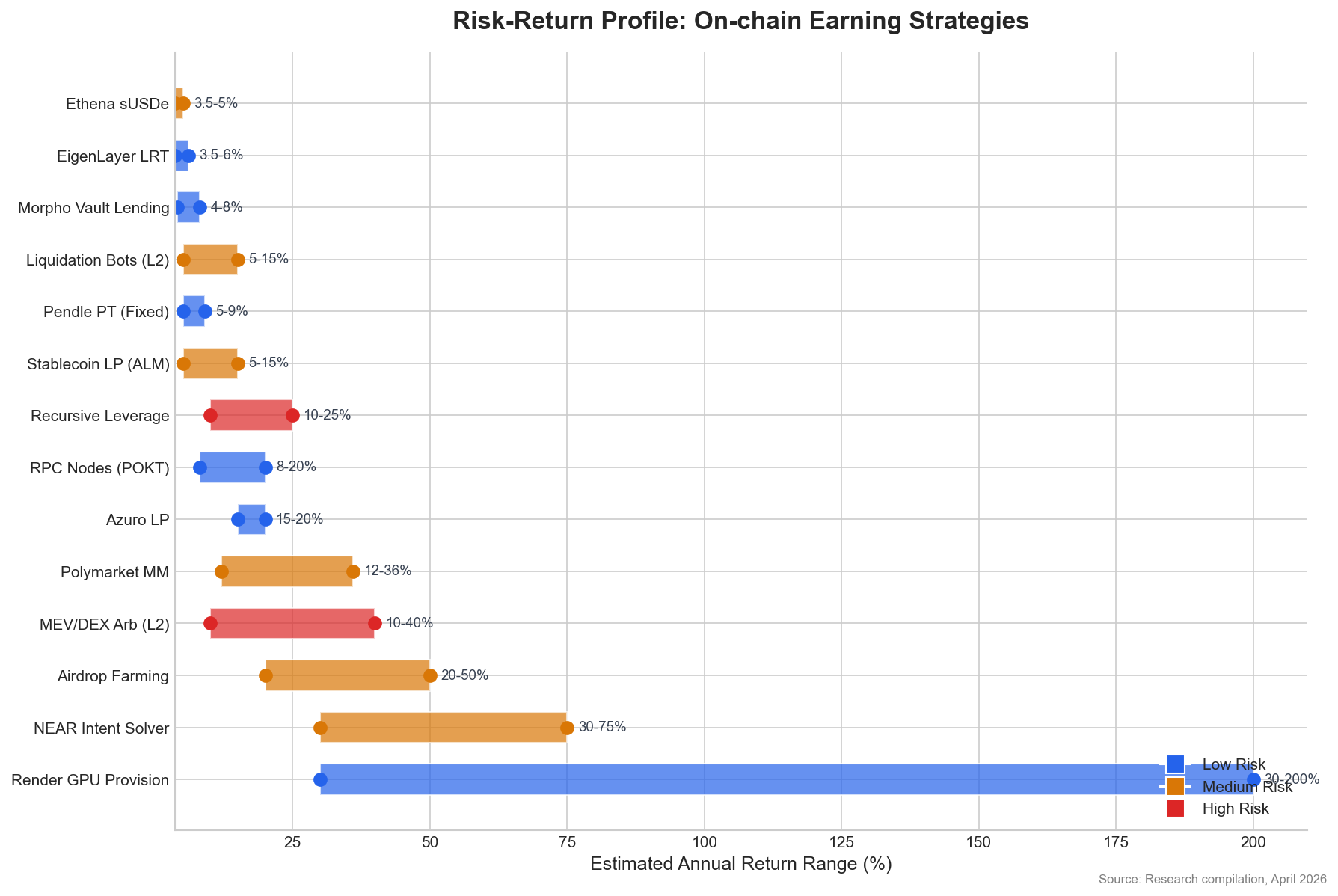
Key insight: The highest-return strategies (Render GPU, NEAR Solver, airdrops) also have the widest volatility ranges, while low-risk strategies (Morpho, EigenLayer LRT) offer stable but lower returns. Let's break each one down.
1. MEV and DEX Arbitrage Bots
What Is This
MEV (Maximal Extractable Value) is blockchain's "invisible tax." Whenever someone trades on a DEX, the price briefly deviates, and arbitrage bots extract profit from that gap. Key strategies include:
- Atomic arbitrage: Buy low on one DEX and sell high on another within a single transaction
- Sandwich attacks: Insert your own trades before and after a target transaction to capture the price differential
- Liquidations: Liquidate undercollateralized positions in lending protocols
The Harsh Reality
This is a market already dominated by institutions. The data speaks for itself:
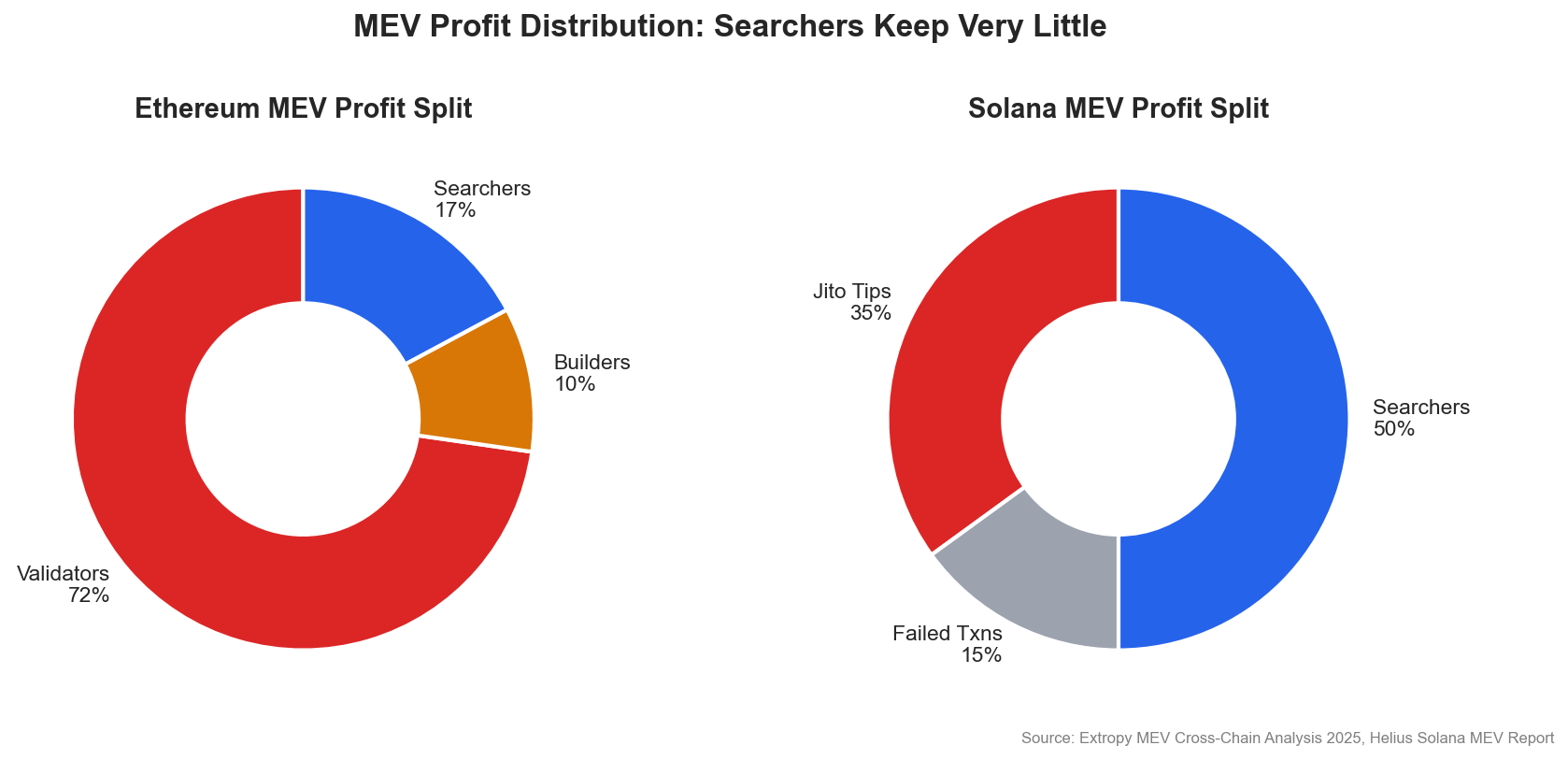
- Ethereum monthly MEV revenue is approximately $180M, but Searchers only capture 17% — 72% goes to validators, 10% to Builders (Extropy 2025)
- Solana annual arbitrage profit is $142.8M, but the top three bots control roughly 60% of sandwich attack market share
- **Average profit per Solana arbitrage trade is just 8.67 (Helius)
- By October 2025, approximately 1/3 of MEV bots break even, and 30% lose money (Extropy)
Developer Pawel Urbanek wrote an MEV bot with over 10,000 lines of Rust code, ran it for a year with monthly infrastructure costs of $750 — and ended up at a loss. His conclusion:
"MEV is extremely risky, and you're likely to lose all funds allocated."
Is There Still Opportunity for Individual Developers?
Yes, but only at the margins:
| Strategy | Chain | Min Capital | Monthly Infra Cost | Viability |
|---|---|---|---|---|
| Flash loan arbitrage | Ethereum L1 | $0 | $150-750 | Extremely difficult |
| Simple DEX arbitrage | Solana | 50K | $200-500 | Difficult |
| L2 cross-DEX arbitrage | Base/Arbitrum | 10K | $50-200 | Moderate |
| Long-tail/obscure tokens | New chains/DEXes | 5K | $50-150 | Best |
Recommended starting point: Arbitrage on obscure trading pairs on Base or Arbitrum. Gas is cheap (0.05), competition is lower, and use Artemis (Paradigm's Rust MEV framework) as your starting point.
2. Concentrated Liquidity Market Making (LP)
What Is This
Providing liquidity in AMMs like Uniswap V3/V4, Curve, and Aerodrome to earn trading fees. Concentrated liquidity lets you select a price range to amplify capital efficiency.
The Harsh Reality
Most LPs lose money. Research from Bancor/IntoTheBlock found:
- Across 17 major Uniswap V3 pools, LPs earned 260.1M in impermanent loss** — a net loss of $60.8M
- 49.5% of LP positions are unprofitable
- Volatile pairs are even worse: 54.7% of LPs lose money (MEXC Research 2025)
But a follow-up analysis by CrocSwap revealed a critical insight: The smallest 75% of trades (amounts below ~$100K) are actually profitable for LPs, yielding about +5 bps per trade. Losses come almost entirely from large arbitrage trades (the top 5% of orders).
The JIT Liquidity Threat
JIT (Just-In-Time) liquidity attacks insert massive liquidity before and after your trade, eating up to 44% of LP profits per transaction. The good news is it's extremely capital-intensive: only about 25 wallets globally do it, accounting for 740B in liquidity events.
Where Can You Still Profit
Stablecoin pairs + L2 + automated management = the only positive-expectation path for LP
| Platform | Pool Type | Expected APY | Notes |
|---|---|---|---|
| Aerodrome (Base) | DOLA-USDC | 21% | ve(3,3) incentives, $61M TVL |
| Aerodrome (Base) | USDC-AERO | 19.3% | Exposed to AERO price risk |
| Gamma Strategies | ETH pools | ~12% | About half of APY from external incentives |
| Bunni V2 (Base) | USDC-USDT | 9.3% | Uniswap V4 Hook, latest tech |
| Curve | Stablecoin pools | 3-7% | The purest passive strategy |
Recommended starting point: Start with stablecoin pools on Aerodrome (Base), $1K minimum. Gas is nearly zero, APY 15-21%, and impermanent loss is minimal. Use automated management tools (Gamma, Bunni V2) instead of manual rebalancing.
3. Prediction Markets
Polymarket: The $21.5 Billion New Frontier
Polymarket's 2025 trading volume reached 9B in 2024 and just 1,000**.
Six Profit Models
- Information arbitrage: Bet using exclusive information/analysis before prices reflect it. A French trader earned $85M by building a proprietary polling model
- Cross-platform arbitrage: Polymarket vs Kalshi price spreads. But the opportunity window has shrunk from 12.3 seconds to 2.7 seconds, with 73% of profits captured by <100ms bots
- Market making: Provide two-sided quotes to earn the spread. Win rate 78-85%, monthly return 1-3%
- New market liquidity: Annualized equivalent returns on newly opened markets can reach 80-200%
- Domain specialization: Build information edges in specific domains (sports, politics)
- AI probability arbitrage: Use LLMs to analyze news and compare against market pricing
Realistic Returns
| Strategy | Min Capital | Monthly Return | Risk | Dev Time |
|---|---|---|---|---|
| Azuro LP (passive) | $1K | 1-2% | Low-Med | None |
| Polymarket market making | 10K | 0-2% | Medium | 3-6 months |
| AI probability arbitrage | $5K+ | 3-8% | Medium | Very high |
| Domain specialization | $1K+ | Variable (can be significant) | Medium | Low (research-driven) |
Recommended starting point:
- Passive: Azuro LP, starting from $1K, historical APY 15-20%, >95% chance of positive returns if held for more than one month
- Development: Use Polymarket's Python SDK and official market-making bot as references, and market-make on new markets
Warning: The biggest killer in Polymarket market making is directional risk — a single 30-40% adverse price swing can wipe out months of profits.
Survivorship bias warning: The "X% per month" figures you see online are almost exclusively from survivors. The poly-maker bot's author himself admits "not profitable in today's market"; another developer, Tezlee, spent months developing and ended up with zero net profit. Only 0.51% of Polymarket wallets profit more than $1,000. Monthly 1-3% is the ceiling for good execution, not the typical expectation.
4. Liquidation Bots
How It Works
When positions in lending protocols like Aave, Compound, or Morpho become undercollateralized (collateral value drops below the liquidation threshold), liquidators can repay a portion of the debt and receive discounted collateral as a reward. Flash loans let you execute liquidations with zero capital.
Market Size
- Aave cumulative historical liquidation volume: $4.65 billion, 310K events (2020-2026.2)
- 2025 Aave liquidation volume: $1.1B+, 100K events
- Single-day record: $250M in liquidations on October 10, 2025
Profit Margins Are Being Compressed
Chainlink SVR is eating into liquidators' profits. Aave integrated Chainlink Smart Value Recapture (SVR), which has already recovered 675M in liquidations (73% non-toxic MEV recapture rate). Aave DAO voted to expand SVR coverage from 3% to 27% of TVL — directly reducing liquidator income.
The Path Forward for Individual Developers
| Platform | Competition | Profit Per Event | Capital Required | Monthly Infra |
|---|---|---|---|---|
| Ethereum L1 | Extremely high | $50-500 | $0 (flash loans) | $300-1000 |
| L2 (Arbitrum/Base) | Moderate | $5-50 | $0 (flash loans) | $50-150 |
| Morpho Blue (new markets) | Lower | $5-100 | $0 (flash loans) | $50-150 |
Recommended starting point: Focus on L2 liquidations and Morpho Blue new markets. Morpho's liquidation rewards go 100% to liquidators (no protocol fee), and the new market ecosystem is still immature with less competition. Reference: Aave V3 open-source liquidation bot.
5. Lending Yield Strategies
Recursive Leverage (Looping) — DeFi's Core Primitive
Recursive leverage now accounts for 1/3 of total DeFi volume (Yahoo Finance), and 64% of Morpho's transaction volume comes from looping strategies.
The mechanism: Deposit ETH -> Borrow USDC -> Buy ETH -> Deposit again -> Repeat. Aave ETH's LTV is 82.5%, giving a theoretical maximum leverage of 5.7x. Flash loans let you complete all loops in a single transaction.
But the risk is extreme: In a 113.62. A 2026 Bank of Canada study found that "leverage generally reduces returns and amplifies liquidation risk."
Yield Strategy Comparison
| Strategy | Expected APY | Risk | Min Capital | Key Risk |
|---|---|---|---|---|
| Aave/Compound stablecoin lending | 3-6% | Low | $1K | Smart contract risk |
| Morpho Vault (stablecoins) | 4-8% | Low-Med | $1K | Curator quality |
| Pendle PT (fixed yield) | 5-9% | Medium | $5K | Maturity liquidity, underlying depeg |
| Ethena sUSDe | 3.5-5% | Med-High | $1K | Funding rate turning negative, depeg |
| Recursive leverage (same-asset loop) | 8-20% | High | $10K+ | Cascading liquidation |
| Pendle YT (speculative) | -100% to 100%+ | Extreme | $1K | Can go to zero at maturity |
The Ethena Warning
sUSDe yield has plummeted from 60%+ in early 2024 to 3.72% by early 2026. More critically, 60% of USDe supply is locked in Pendle PT and Aave looping, with Chaos Labs warning that "a 20% crypto market decline could trigger 0.97.
Pendle: The Lego Blocks of Yield
Pendle TVL stands at ~$3.5B, splitting yield-bearing assets into PT (fixed yield) and YT (variable yield leverage). PT-USDe averages 8.8% yield — the best on-chain option for "fixed income." But 70% of Pendle's trading volume is YT speculation, which is essentially "leveraged yield gambling."
Recommended starting point:
- Conservative: Morpho Vault stablecoins, $1K minimum, 4-8% APY
- Advanced: Pendle PT fixed yield, $5K minimum, 5-9% APY
- Avoid: Ethena sUSDe (yield has compressed to a point where the tail risk isn't worth it) and Pendle YT (unless you deeply understand market dynamics)
6. Keeper/Oracle Networks
Debunking the Myths
Many guides suggest running Chainlink Keeper or Gelato nodes to earn money. Reality is completely different.
- Running a Chainlink node is not a viable strategy for individual developers. Official nodes average ~1,500/month/chain.
"Is running a Chainlink node profitable? The short answer — most likely not if you are just getting started as a community node operator." — LinkWell Nodes
- Gelato Network executors are not permissionless — DAO whitelist system, individuals cannot participate
- Pyth Network is permissioned — only exchanges and market makers can become data publishers
- Keep3r Network is the only nearly permissionless option, but activity is extremely low and earnings are negligible
Conclusion: Keeper/Oracle nodes are not a viable strategy for individual developers with 50K. Profitable positions are gated by permissioning, and permissionless positions don't generate meaningful income.
7. Restaking and AVS
EigenLayer Ecosystem Status
EigenLayer commands 93.9% of the restaking market, with $15-18B TVL, 1,900 active Operators, and 162+ AVSes.
Realistic Returns
Restaking's incremental yield is 1-3% APY, on top of ETH base staking's 3-4%, totaling approximately 4.8-6%.
| Strategy | Capital Range | Expected APY | Difficulty | Risk |
|---|---|---|---|---|
| LRT (EtherFi weETH) L2 | $1K+ | 3-5.5% | Low | Medium |
| Direct EigenLayer restaking | $5K+ | 4.8-6% | Medium | Med-High |
| Aggressive multi-AVS + DeFi combo | $10K+ | 7-15%+ | High | High |
| Running AVS Operator | $640K+ (320 ETH) | Variable | Extreme | Extreme |
Running an AVS Operator is not viable for individuals — EigenDA requires a minimum of 320 ETH restaked (~$640K), with a cap of 200 Operators.
Airdrop Bonuses Are Fading
EtherFi Season 1 airdrop median: 175 ETHFI (~1.3B to $62M — points-driven TVL is unsustainable.
Recommended starting point: Use EtherFi's weETH to restake on L2, where gas is 97-99% cheaper. The 3-5.5% APY isn't spectacular but it's stable, and weETH can be composed with Pendle, Aave, and other protocols to boost effective yield.
8. Airdrop Farming
Is It Still Worth Doing?
Yes, but the rules of the game have fundamentally changed.
- 2024 Top 5 airdrops peaked at over 4.5B
- But 88% of airdrop tokens depreciate within 3 months
- Only 0.51% of Polymarket wallets profit more than $1,000 — airdrops show similar patterns
Anti-Sybil Detection Has Evolved
LayerZero filtered out 803K Sybil addresses; detection now uses AI behavioral analysis, cross-wallet graph analysis, and ZK identity proofs. The risk-reward ratio for multi-wallet strategies has inverted.
Realistic Expected Value
| Effort Level | Expected Per Airdrop | Gas Cost | Time Investment |
|---|---|---|---|
| Light (1-2 protocols) | 100 | 50 | 1-2 hr/week |
| Moderate (5-10 protocols) | 5,000 | 500 | 5-10 hr/week x 6mo+ |
| Heavy (deep-dive single protocol) | 45,000 | 5,000 | 10+ hr/week x 6-12mo |
Airdrops Worth Watching in 2026
| Protocol | Type | Funding | Community Allocation |
|---|---|---|---|
| OpenSea (SEA) | NFT marketplace | Confirmed | 50% |
| MetaMask (MASK) | Wallet | Consensys | Points ongoing |
| Base | L2 | Coinbase | Token exploration confirmed |
| Polymarket (POLY) | Prediction market | Confirmed | Trademark registered |
| MegaETH | L2 | $107M | Points ongoing |
| Monad | L1 | $244M | Testnet ongoing |
Recommended starting point: Single wallet, deep-dive into 2-3 high-EV protocols. Sell 50-80% of airdrop tokens immediately upon receipt (88% depreciate). Operate on L2 to reduce gas costs. Simultaneously combine with restaking to generate yield while waiting for airdrops.
9. On-Chain Infrastructure Services
RPC Nodes (Best Entry Point for Individual Developers)
- POKT Network: Monthly income $58-250, 21,000+ active nodes, truly permissionless
- Lava Network: Network has generated $3.5M+ in revenue since August 2024, 95% distributed to providers
DePIN (Decentralized Physical Infrastructure)
- Render Network: RTX 5090 peaks at $150-180/day (but actual utilization may only be 20-40%)
- Helium: Hotspot monthly income ~300 with good placement), but the August 2025 halving has reduced emissions
- Akash Network: GPU daily average fee ~10-155
Validators
| Network | Minimum Stake | APY | Suitable for Individuals? |
|---|---|---|---|
| ETH (Rocket Pool) | 8 ETH (~$28K) | 6-8.5% | Yes, $28K+ |
| Avalanche | 2,000 AVAX (~$50K) | 7-8% | Yes, no slashing risk |
| ETH (Solo) | 32 ETH (~$112K) | 4-6% | Requires $112K+ |
| Solana | $60K+/year operating costs | 6-7% + MEV | Not viable |
Recommended starting point:
- $0 capital: If you have a GPU, run Render or Akash
- 5K: POKT/Lava RPC nodes, coding skills are directly useful
- $28K+: Rocket Pool minipool, higher returns than solo staking
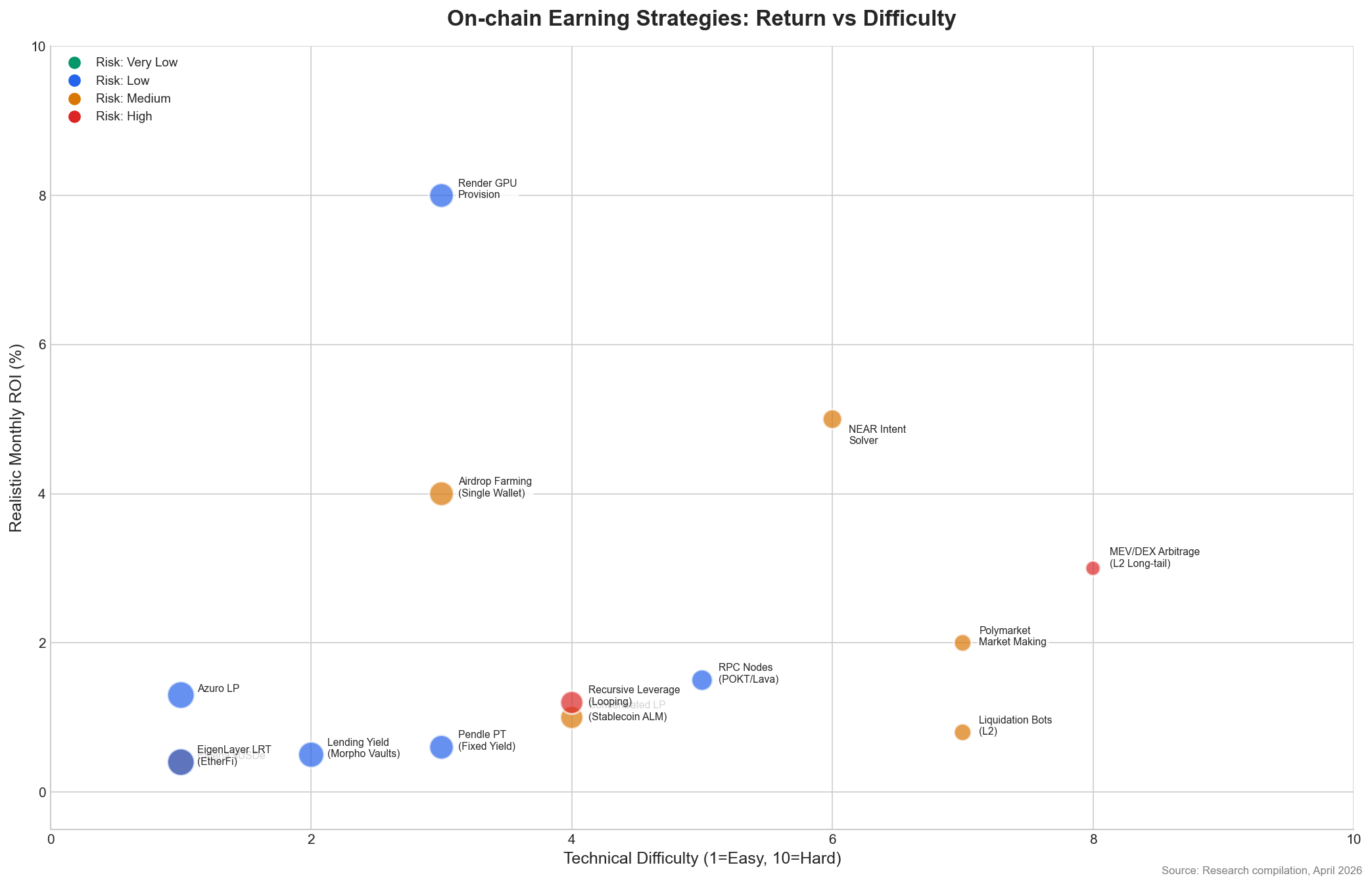
10. Strategy Comparison Matrix
Optimal Combinations by Capital Tier
5K: Starter Allocation
| Allocation | Weight | Expected Annual | Risk |
|---|---|---|---|
| Aerodrome stablecoin LP | 40% | 15-21% | Low-Med |
| Azuro LP | 20% | 15-20% | Low-Med |
| Airdrop farming (gas fees) | 20% | Variable | Medium |
| Morpho Vault stablecoins | 20% | 4-8% | Low |
Expected blended annual return: 12-18% (excluding uncertain airdrop gains)
10K: Developer Allocation
| Allocation | Weight | Expected Annual | Risk |
|---|---|---|---|
| Polymarket market making | 30% | 5-20% | Medium |
| Aerodrome/Bunni LP | 25% | 10-20% | Low-Med |
| Pendle PT fixed yield | 25% | 5-9% | Low-Med |
| EigenLayer LRT + airdrops | 20% | 4-6% + airdrop | Medium |
Expected blended annual return: 10-20% (requires development time to build a market-making bot)
50K: Advanced Allocation
| Allocation | Weight | Expected Annual | Risk |
|---|---|---|---|
| NEAR Intent Solver | 25% | 30-75% | Medium |
| Polymarket market making + AI | 25% | 5-20% | Medium |
| L2 MEV/liquidation bots | 20% | 10-40% | High |
| Pendle PT + Morpho | 20% | 5-9% | Low-Med |
| Infrastructure (RPC nodes) | 10% | 8-20% | Low |
Expected blended annual return: 15-35% (requires full-time programming development and maintenance)
11. The Full Risk Landscape
DeFi's Systemic Risks
- In H1 2025, DeFi losses exceeded **2.85B)
- 34.6% of attacks stem from incorrect input validation
- Bridge protocol hack losses total over $2.8B cumulatively — roughly 40% of all Web3 theft
Key Risk Per Strategy
| Strategy | Primary Risk | Worst Case |
|---|---|---|
| MEV arbitrage | Getting frontrun by faster bots | Lose all operating capital |
| LP market making | Impermanent loss + JIT attacks | Major losses (54.7% loss rate on volatile pairs) |
| Prediction markets | Directional risk | Single event wipes out months of profit |
| Liquidation bots | SVR + competition compressing profits | Infra costs > revenue |
| Lending/Looping | Cascading liquidation | 5.7x leverage meets 20% downturn = full liquidation |
| Restaking | Slashing | Theoretically up to 100% slashing |
| Airdrops | Sybil detection + 88% token depreciation | Spend 6 months + heavy gas with nothing to show |
| Infrastructure services | Token price risk | Reward token drops 50% |
Universal Risk Mitigation Principles
- Never put all your funds in a single strategy or protocol — smart contract risk is a non-diversifiable tail risk
- Prioritize flash loans (for liquidations, arbitrage) to minimize capital exposure
- Operate on L2 to reduce gas cost erosion on small capital amounts
- Sell 50-80% of airdrop tokens immediately — data supports this as the optimal strategy
- Track DeFi security developments (Rekt.news) — withdraw at the first sign of a protocol exploit
12. My Recommendation: Where to Start
If you're someone who can code, has 10K, and is willing to invest time in learning, here's the path I recommend:
Phase 1 (Weeks 1-2): Build a Passive Yield Foundation
- Deploy $2K in stablecoin LP on Aerodrome (Base) -> Start earning 15-20% APY immediately
- Deploy $1K USDC in Morpho Vault -> Stable 4-8% APY
- Deploy $1K ETH in EtherFi -> 3-5% APY + potential airdrop exposure
Phase 2 (Weeks 3-8): Develop Trading Bots
- Learn the Polymarket API, build a market-making bot using py-clob-client
- Or learn NEAR Intent Solver (if you're more interested in cross-chain, see the companion article)
Phase 3 (Ongoing): Optimize and Scale
- Reinvest yields into Pendle PT fixed income
- Monitor high-EV airdrop opportunities (Base, Polymarket, MegaETH)
- Once your market-making bot stabilizes, consider adding L2 liquidation bots
Core principle: Build a stable passive yield base first, then layer on strategies requiring active management.
Conclusion
On-chain earning opportunities are real, but the vast majority of people overestimate the returns and underestimate both the risks and the required effort. The reality of 2026:
- The era of easy money is over. MEV is monopolized by institutions, airdrops are filtered by anti-Sybil detection, and LP fees are consumed by arbitrageurs
- But smart individual developers still have edge advantages. New chains/protocols, L2 ecosystems, and prediction market making — these are areas institutions haven't fully covered yet
- Coding ability is your greatest asset. At the 50K capital level, the ability to write bots is more valuable than an extra $10K in capital
- Risk management matters more than yield. 88% of airdrop tokens depreciate, 49.5% of LPs lose money, 1/3 of MEV bots don't profit — survival matters more than getting rich quick
Start taking action, but do so with clear eyes.
References
- Extropy: MEV Cross-Chain Analysis 2025
- Helius: Solana MEV Report
- CrocSwap: LP Profitability in Uniswap V3
- Gauntlet: Uniswap ALM Analysis
- Bunni: Dawn of LP Profitability
- ChainCatcher: Polymarket Six Profit Models
- Aave Historical Liquidations
- Chainlink SVR
- Morpho Liquidation Docs
- Contango: What is Looping
- Stablecoin Insider: Ethena USDe Q1 2026
- PistachioFi: EigenLayer Restaking Guide 2026
- BlockEden: EigenLayer $18B TVL
- Airdrop Alert: Crypto Airdrop Data 2025
- WuBlockchain: Airdrop Farmer Interviews
- Coin Bureau: ETH Node Profitability 2026
- Pocket Network
- Lava Network
- Bank of Canada: DeFi Lending Returns & Liquidation Risk (2026)
- Yellow Research: DEX Exploits $3.1B in 2025