Sodium-Ion Batteries Challenging Lithium's Dominance? A Deep Dive into the 2026 Reality vs. Hype
Sodium-Ion Batteries Challenging Lithium's Dominance? A Deep Dive into the 2026 Reality vs. Hype
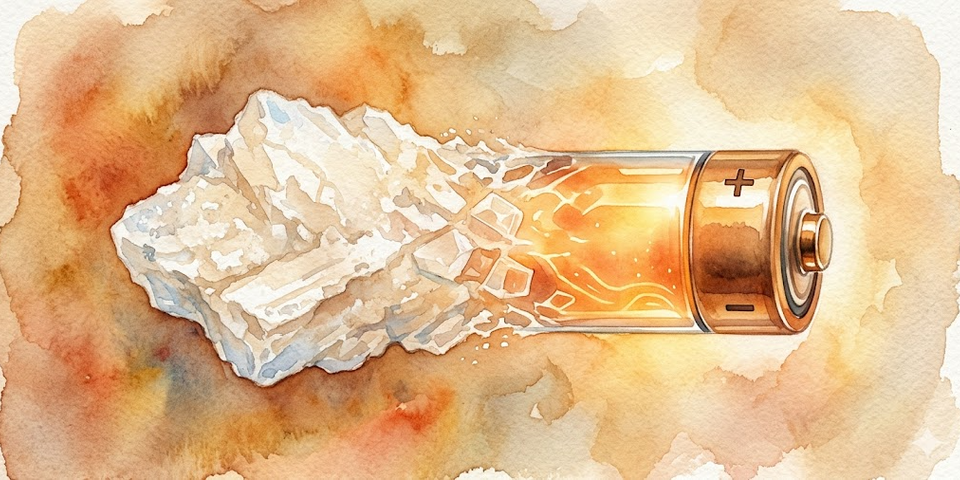
Batteries made from salt -- cheap and inexhaustible. The story sounds too good to be true, and the reality is far more complicated than the headlines suggest.
In early 2026, MIT Technology Review named sodium-ion batteries one of its "10 Breakthrough Technologies of the Year," calling them "a cheaper, safer, more abundant alternative to lithium-ion that is finally making its way into cars and the grid." Almost simultaneously, Changan Auto and CATL jointly launched the Nevo A06, the world's first mass-produced sodium-ion passenger vehicle, equipped with a 45 kWh battery pack and a range of 400 kilometers. Media coverage was euphoric, and the narrative of "salt-powered batteries that will change the world" heated up rapidly.
But if you're willing to dig into the data, a more complex picture emerges: sodium-ion batteries currently cost more per kilowatt-hour than lithium iron phosphate (LFP); 95% of global production capacity is concentrated in China; and a Stanford University study published in Nature Energy found that under stable lithium pricing scenarios, sodium-ion batteries have virtually no path to cost competitiveness.
This article isn't here to tell you sodium-ion batteries are a scam, nor to hype them as lithium's imminent replacement. What we're doing is using data and evidence to honestly examine this technology's real capabilities and limitations.
Technical Specifications: A Head-to-Head Comparison
To assess sodium-ion batteries' competitiveness, we must start with hard data. Here are the key metrics for various battery chemistries in 2025-2026:
Energy Density
| Chemistry | Energy Density (Wh/kg) | Notes |
|---|---|---|
| Sodium-ion (current gen) | 100-160 | Most commercial cells in 2025 |
| Sodium-ion (CATL Naxtra) | 175 | Released late 2025, approaching LFP levels |
| LFP (Lithium Iron Phosphate) | 140-190 | Mature technology, cost-tier benchmark |
| NMC (Nickel Manganese Cobalt) | 200-300 | High-energy lithium chemistry |
| Sodium-ion (2030 projection) | 200+ | Would match current LFP if achieved |
The International Energy Agency (IEA) states plainly that sodium-ion battery energy density is "up to 40% lower than lithium-ion," meaning equivalent range requires a larger, heavier battery pack. This is not a physical limitation that engineering can easily circumvent.
However, CATL's Naxtra at 175 Wh/kg is already quite close to LFP's ~185 Wh/kg. For applications that don't demand maximum range, this gap is no longer a fatal flaw.
Cycle Life
Claimed cycle life for sodium-ion batteries spans an enormous range, from 2,000 to 10,000 cycles. This wide variance itself indicates that the technology is not yet mature. Real-world testing data shows:
- Production cells: 2,300-3,000 cycles (78% depth of discharge)
- Advanced designs: up to 10,000 cycles claimed
- Actual performance typically 20-40% below lab data
- At 45 degrees C, cycle life can degrade by over 50%
UNIGRID CEO Darren Tan noted: "There is a lack of transparency in the details of battery design and performance." This is an issue the entire industry needs to confront.
Cold Weather Performance: The True Killer Advantage
If sodium-ion batteries have one indisputable technical advantage, it's cold weather performance.
- CATL Naxtra retains 90% usable capacity at -40 degrees C, with stable discharge even at -50 degrees C
- Discharge power at -30 degrees C is 3x that of comparable LFP cells
- Standard LFP suffers significant capacity degradation in extreme cold, a persistent pain point for northern-climate users
This isn't marketing spin -- it's a physical advantage rooted in ion dynamics. Sodium ions have lower desolvation energy at low temperatures, allowing electrochemical reactions to proceed even in extreme cold. For markets in northern China, Scandinavia, and Canada, this advantage carries real commercial value. InsideEVs' description of the Changan Nevo A06 as a "Winter Range Monster" is well-earned.
Safety
Sodium-ion batteries can be discharged to 0V for safe transport, eliminating the risk of thermal runaway during shipping. Prussian Blue analog cathode materials feature an oxygen-free structure, further reducing thermal runaway risk. There is also no lithium dendrite formation issue.
However, a common misconception needs clarification: sodium-ion batteries use organic electrolytes similar to lithium-ion batteries, offering no significant safety advantage over LFP. Some experts warn that the pace of technological advancement has outstripped researchers' ability to evaluate safety risks.
The Cost Reality: Not as Cheap as You Think
"Batteries made from salt are obviously cheaper than batteries made from lithium" -- this intuitive conclusion is precisely the biggest misconception.
Raw Materials Are Indeed Much Cheaper
- Sodium carbonate: approximately $290/metric ton
- Battery-grade lithium carbonate: approximately $35,000/metric ton
- Sodium's raw material price is just 0.47% of lithium's
- Cathode material costs are 60% cheaper than lithium cathodes (Ping An Securities)
- Aluminum current collectors replace copper (cheaper)
- Hard carbon anodes are cheaper than graphite
But Battery Cost Isn't Just About Raw Materials
Wood Mackenzie's 2025 data reveals a fact that surprises many:
| Chemistry | Cell Cost ($/kWh) | Source |
|---|---|---|
| Sodium-ion | $59 | Wood Mackenzie 2025 |
| LFP | $52 | Wood Mackenzie 2025 |
That's right -- sodium-ion batteries currently cost more than LFP. Benchmark Mineral Intelligence states bluntly that sodium-ion's cost advantage over LFP "has evaporated."
The reason is straightforward: sodium-ion batteries' production scale disadvantage results in a manufacturing cost premium of at least 30%. The supply chain -- cathodes, anodes, electrolytes -- remains immature. This isn't a materials problem; it's a scale problem.
How Cheap Could They Get?
The International Renewable Energy Agency (IRENA) projects that when global capacity reaches 400 GWh, cell costs could drop to $40/kWh. If achieved, this would be significantly below any lithium chemistry, making grid-scale energy storage extremely affordable.
But "when" is the critical question. Wood Mackenzie estimates cost parity with LFP won't be achievable until around 2035. And LFP's own costs continue to decline, creating a moving-target effect.
Nature Energy's 6,000-Scenario Analysis
This is arguably the most rigorous economic analysis of sodium-ion batteries to date. Stanford University researchers Adrian Yao, Sally M. Benson, and William C. Chueh published a simulation study in Nature Energy covering over 6,000 scenarios, with sobering core findings:
- If lithium prices rise and remain elevated through 2027: More than 55% of sodium-ion technology pathways achieve price competitiveness by 2035
- If lithium prices stay low: Virtually no sodium-ion development scenario achieves price competitiveness without graphite supply disruptions
The study explicitly states: "Economies of scale alone are not sufficient to reach the target -- technological breakthroughs are also required."
In other words, whether sodium-ion batteries can undercut lithium depends primarily on lithium's own market conditions, not on the pace of sodium-ion technological progress. This is a profound structural issue.
Key Players: Who's Serious, Who's Already Out
CATL (China) -- The Giant That Cannot Be Ignored
The commitment of the world's largest battery manufacturer is sodium-ion's most powerful endorsement:
- Launched the Naxtra brand in April 2025
- Began mass production in December 2025
- 175 Wh/kg, supporting 500 km range
- Full deployment across passenger vehicles, commercial vehicles, battery swap stations, and energy storage in 2026
- First vehicle equipped: Changan Nevo A06 (entered dealerships in February 2026)
CATL's Robin Zeng positions Naxtra as "a paradigm shift for affordable EVs and grid-scale energy storage." When CATL invests at this scale, the supply chain follows.
BYD (China) -- Betting Big
- $1.4 billion (10 billion RMB) investment in Xuzhou factory
- Planned 30 GWh annual capacity
- Partnership with Huaihai Group for micro-vehicles and EVs
- Construction began January 2024, but updates have been sparse as of February 2026
Peak Energy (United States) -- Grid Storage Pioneer
- Operating a 3.5 MWh sodium-ion system at SolarTAC in Colorado
- Deploying with RWE Americas in the MISO service territory in Wisconsin
- Passive cooling system reduces auxiliary power consumption by 90%, cutting lifecycle costs by $70/kWh
- Contracts signed: Jupiter Power 4.75 GWh (2027-2030, over $500 million), Energy Vault 1.5 GWh
- First U.S. cell factory under development, with mass production planned for 2026
Peak Energy is the most noteworthy player in the U.S. sodium-ion space, with a business model focused on where sodium-ion has its strongest advantage -- grid-scale energy storage.
Faradion (UK/India)
The world's first company to commercialize sodium-ion batteries, Faradion was fully acquired by Reliance New Energy in October 2024, gaining the backing of Indian billionaire Ambani's conglomerate. Focus is on large-scale energy storage applications.
HiNa Battery (China)
- Completed the world's first kiloton-scale sodium-ion cathode material production line and first GWh-scale sodium-ion battery production line in 2022
- 10 GWh capacity planned for 2025
- Supplying cells for JAC Huaxianzi compact vehicles
- Focused on low-speed electric vehicle market
Natron Energy (United States) -- A Cautionary Tale
This is the most important counterexample in this article:
- Ceased all operations on September 3, 2025
- Closed Michigan and California facilities
- Halted $1.4 billion North Carolina gigafactory plans
- 95 employees affected
- Causes: funding issues, UL certification delays, intensifying LFP competition
Natron's failure proves one thing: outside China's ecosystem, commercializing sodium-ion batteries is far more difficult than achieving lab success. As Energy Storage News quoted: "The bar is going up and up" -- LFP's continued improvement makes sodium-ion's catch-up game even harder.
The First Mass-Produced Vehicle: Changan Nevo A06
The Nevo A06's significance extends beyond being just a car -- it's a milestone for sodium-ion battery technology stepping out of the laboratory.
- 45 kWh sodium-ion battery pack (CATL Naxtra)
- 400 km CLTC range
- Entered dealer networks in February 2026
- 90% capacity retention at -40 degrees C
- Positioning: urban commuter sedan, not a long-distance touring vehicle
Subsequent plans include expansion to Changan's Avatr, Deepal, Qiyuan, and UNI brands. If the Nevo A06 performs well in the market, it will open broader opportunities for sodium-ion in passenger vehicles.
But a clear-eyed view is necessary: 400 km is under CLTC test conditions, and real-world highway range will be considerably shorter. Moreover, this is a car designed for urban commuting, not long-distance travel. Sodium-ion batteries are not competitive in the long-range premium EV segment in the near term.
Where Sodium-Ion Wins
Sodium-ion batteries are not universally inferior to lithium. In specific application scenarios, they possess structural advantages:
Grid-Scale Energy Storage (Best Application): Weight is irrelevant; cost per cycle is the core metric. Peak Energy has already demonstrated commercial viability in the U.S., and IRENA lists this as sodium-ion's primary near-term application. As global solar and wind deployment accelerates, grid storage demand is growing exponentially.
Extreme Cold Climate Vehicles: Discharge power at -30 degrees C is 3x that of LFP -- this isn't an incremental improvement, but a qualitative leap. Northern China, Scandinavia, and Canada represent markets with strong demand.
Two-Wheelers/Three-Wheelers and Micro-Vehicles: Low energy requirements, extreme cost sensitivity, and indoor charging safety needs. Yadea launched 4 sodium-ion two-wheeler models in 2025; BYD is partnering with Huaihai Group for micro-vehicles and EVs.
Urban Commuter Vehicles in Price-Sensitive Markets: 200-400 km range is sufficient for daily city driving. Market demand for $10,000-15,000 EVs is enormous in China, India, and Southeast Asia.
Backup Power and UPS: Short-duration, high-power applications where safety and cost matter more than energy density.
Where Sodium-Ion Loses
We must be equally honest about sodium-ion batteries' weak spots:
Long-Range Premium EVs: Consumers expect 500+ km range in a compact body. The energy density gap prevents sodium-ion from competing at the Tesla Model 3/Y tier.
Consumer Electronics: Smartphones and laptops demand maximum energy in minimum volume. Sodium-ion is too bulky.
Aviation/Maritime: Weight-sensitive applications where low energy density is unacceptable.
Markets Where LFP Is Deeply Entrenched: Switching supply chains has real costs. When performance and cost are comparable, there's no incentive to switch.
Lithium's Counterattack
Sodium-ion battery prospects cannot be evaluated in isolation -- they must be assessed against the backdrop of lithium's continued advancement.
LFP Is a Moving Target
LFP's energy density keeps improving, manufacturing scale keeps expanding, and costs keep falling. LFP's supply chain has been optimized over decades and is highly mature. Part of the reason for Natron Energy's collapse was precisely LFP's competitive pressure. Sodium-ion isn't facing a stationary opponent but an accelerating target.
Direct Lithium Extraction (DLE) Could Make Lithium Even Cheaper
DLE is the lithium industry's counter-weapon:
- Recovery rates of 80-95%, far above traditional evaporation methods' 40-60%
- Processing time reduced from 12-24 months to hours or days
- Construction begins in 2026, production by 2028
- Projected to meet 17% of global lithium demand by 2030
- Market growing at a 19.6% CAGR through 2036
If DLE successfully reduces lithium production costs, the core thesis supporting sodium-ion -- raw material cost advantage -- will be further undermined.
The Solid-State Lithium Battery Threat
Toyota, Samsung SDI, QuantumScape, and others are advancing solid-state lithium batteries. If solid-state batteries achieve commercialization before 2030, their higher energy density and better safety could simultaneously surpass both LFP and sodium-ion, rendering the entire debate moot.
The Geopolitical Reality: The Hollowness of the "Diversification" Narrative
One of the most compelling narratives around sodium-ion batteries is this: sodium is everywhere -- the sixth most abundant element on Earth, 1,000 times more common than lithium in the Earth's crust, and 60,000 times more common in the oceans. In theory, any country could source materials locally, freeing itself from dependence on Australian and Chilean lithium mines.
This logic has one fatal flaw.
China is expected to control 95% of global sodium-ion battery production capacity by 2030 (IEA). This control extends beyond cells to cathode materials, anode materials, and the entire supply chain. Virtually all built and announced manufacturing capacity is in China.
As critics put it: "Countries seeking to reduce lithium dependence by switching to sodium-ion batteries are actually increasing their strategic vulnerability."
The global distribution of raw materials is meaningless if the manufacturing capability to convert those materials into batteries is entirely concentrated in one country. You're not making batteries from local salt -- you're importing finished cells from China, or building factories on the foundation of Chinese equipment, Chinese materials, and Chinese technology.
IDTechEx calls sodium-ion "the battery built for trade resilience," but Natron Energy's collapse and the near-total absence of Western production capacity makes that label look ironic. Peak Energy's first U.S. cell factory under construction is a positive signal, but changing a 95%-vs.-5% landscape requires not a single startup, but systematic industrial policy.
Japan's strategy may be worth watching -- METI is promoting R&D and domestic sodium-ion production, and ELECOM has launched the world's first pocket-sized sodium-ion power bank. But Japan's market size projections -- from 61 million by 2034 -- are not at a game-changing scale.
Market Forecasts: A Dose of Humility
Based on the most reliable current data sources:
- 2025: Global shipments approximately 9 GWh (150% YoY growth), less than 1% of the global battery market
- 2025: Global capacity approximately 70 GWh (mostly in China, per IRENA data)
- Announced/under-construction capacity exceeds 370 GWh globally
- 2030 capacity forecast: 400 GWh annual capacity (IRENA)
- 2030 demand forecast: 50-600 GWh (note the 12x range in forecasts -- itself an indicator of extreme uncertainty)
Benchmark Mineral Intelligence offers the most sober projection: maximum 15.5% market share within a decade. Industry scale grows from 13.1 billion by 2035 (19.7% CAGR).
This is not a trivial market, but it's far from a "lithium replacement" scale. The more likely scenario: sodium-ion establishes a foothold in grid-scale storage and urban low-speed transportation, becoming an important component of the battery technology portfolio, but not the leading one.
Conclusion: A Useful Tool, Not a Savior
Sodium-ion batteries in 2026 occupy a delicate position. MIT Technology Review's designation as a breakthrough technology of the year is justified -- this technology has genuinely moved from the lab to the market, and CATL's scaled investment and the Changan Nevo A06's mass production are real milestones.
But parts of the narrative surrounding sodium-ion batteries are dishonest. "Cheap batteries made from salt will free us from lithium's grip" -- every element of this story needs an asterisk:
- Cheap? Currently more expensive than LFP, with cost parity no earlier than the 2030s -- and dependent on lithium price trends.
- Free from dependence? China controls 95% of production capacity; geographic dependency has merely changed form.
- Replace lithium? Energy density gaps limit the range of applications; long-range EVs and consumer electronics remain lithium's domain.
The real value lies here: sodium-ion batteries add a meaningful option to the global battery technology portfolio. In specific scenarios -- grid-scale storage, extreme cold climates, low-cost urban transportation -- they offer performance characteristics that lithium can't match (or doesn't need to). They won't replace lithium, but they will make the overall energy storage ecosystem more resilient and diverse.
By 2035, the most likely picture is: sodium-ion captures 10-15% of the global battery market, holds significant share in grid-scale energy storage, claims a niche in China's urban EV and two-wheeler markets, and remains marginal in other segments. And manufacturing -- as you might have guessed -- will still be overwhelmingly concentrated in China.
This isn't a pulse-pounding conclusion, but it's an honest one. In the world of battery technology, honesty is worth more than hype.
References
- Wood Mackenzie, "Sodium-ion batteries enter energy storage market," 2025
- Nature Energy, "Critically assessing sodium-ion technology roadmaps and scenarios for techno-economic competitiveness against lithium-ion batteries," Stanford, 2024
- IEA, "Sodium-ion battery momentum grows, but challenges remain," 2025
- IRENA, "Sodium-Ion Batteries: A Technology Brief," November 2025
- MIT Technology Review, "Sodium-ion batteries: 10 Breakthrough Technologies 2026," January 2026
- Benchmark Mineral Intelligence, via C&EN, "Sodium-ion batteries: Should we believe the hype?" November 2025
- CATL Official, "Naxtra Battery Breakthrough & Dual-Power Architecture," 2025
- CarNewsChina, "Changan and CATL unveil world's first mass-produced sodium-ion passenger EV," February 2026
- InsideEVs, "The World's First Sodium-Ion Battery EV Is A Winter Range Monster," 2026
- Manufacturing Dive, "Sodium-ion battery maker Natron Energy shuts down, halts $1.4B factory plans," September 2025
- Energy Storage News, "Natron Energy's closure highlights alternative chemistry challenges," 2025
- Peak Energy / PR Newswire, "First Grid-Scale Sodium-Ion Battery Storage System in the U.S.," 2026
- IDTechEx, "Direct Lithium Extraction 2026-2036," 2026
- IDTechEx, "Sodium-ion: The Battery Built for Trade Resilience," 2026