1. The 72 Hours After Kelp
April 18, 17:35 UTC. $292 million drained from Kelp DAO. The retail holders sitting on rsETH across L2s spent the following week waiting for an answer nobody had — would their deposits get haircut, and by how much. While they waited, four things happened in the next 72 hours:
- Arbitrum Security Council froze 30,766 ETH (about $71M), the portion of Kelp's stolen funds that landed on Arbitrum — roughly 25% of the total haul.
- Justin Sun publicly begged the hacker on X: "Let's just talk." Analyst consensus: the best-case outcome is a 10-15% bounty negotiation, but Lazarus attacks have a negotiation success rate of near zero.
- Aave Umbrella's safety module holds roughly 100M, while Aave's own incident report models the bad debt gap at 230M, depending on how losses get allocated. Staked stkAAVE can be slashed up to 30%. The governance vote is live.
- **Two days earlier (April 16), Tether had just announced a 127.5M from Tether, 285M. The quid pro quo was explicit: Drift swaps its settlement stablecoin from USDC to USDT.
Line these four up and you get the complete picture of DeFi rescue in April 2026. Stolen funds get frozen by an L2 Security Council. Negotiation runs on public pleading. Protocol-level bad debt gets socialized through slashing. And the single biggest rescue check comes from Tether.
This is not a decentralized system healing itself. This is a system in the transitional state right before it admits it doesn't have a central bank.
2. DeFi's Rescue Ledger: Less Than $1B in Total
In the previous piece I argued DeFi is bifurcating — retail DeFi is bleeding out while institutional DeFi is feeding. This piece picks up the thread: when something big breaks, who can actually afford to pay?
Start with the full inventory.
On-chain insurance products
- Nexus Mutual, the largest. Roughly 6B in cumulative protection since 2019. Lifetime realized payouts: 2.4M (TribeDAO / Rari Fuse). Others worth noting: ~5M spread across FTX custodial claims, 250K to Arcadia.
- Sherlock: pivoted mainly to auditing, insurance pool shrunk to low single-digit millions.
- InsurAce, Neptune Mutual, UnoRe, Unslashed: most still running, but TVL is a fraction of the 2022 peak. Risk Harbor, Y2K Finance, Opium Insurance are basically zombie protocols.
Global on-chain insurance capacity adds up to roughly 700M. Kelp alone at $292M is 120x Nexus Mutual's largest-ever payout.
Protocol-native safety modules
- Aave Umbrella: 100M
- MakerDAO Surplus Buffer: 80M historically
- Binance SAFU: 1.46B Bybit theft in February was patched by emergency bridge loans from Galaxy Digital, FalconX, and Wintermute within 72 hours.
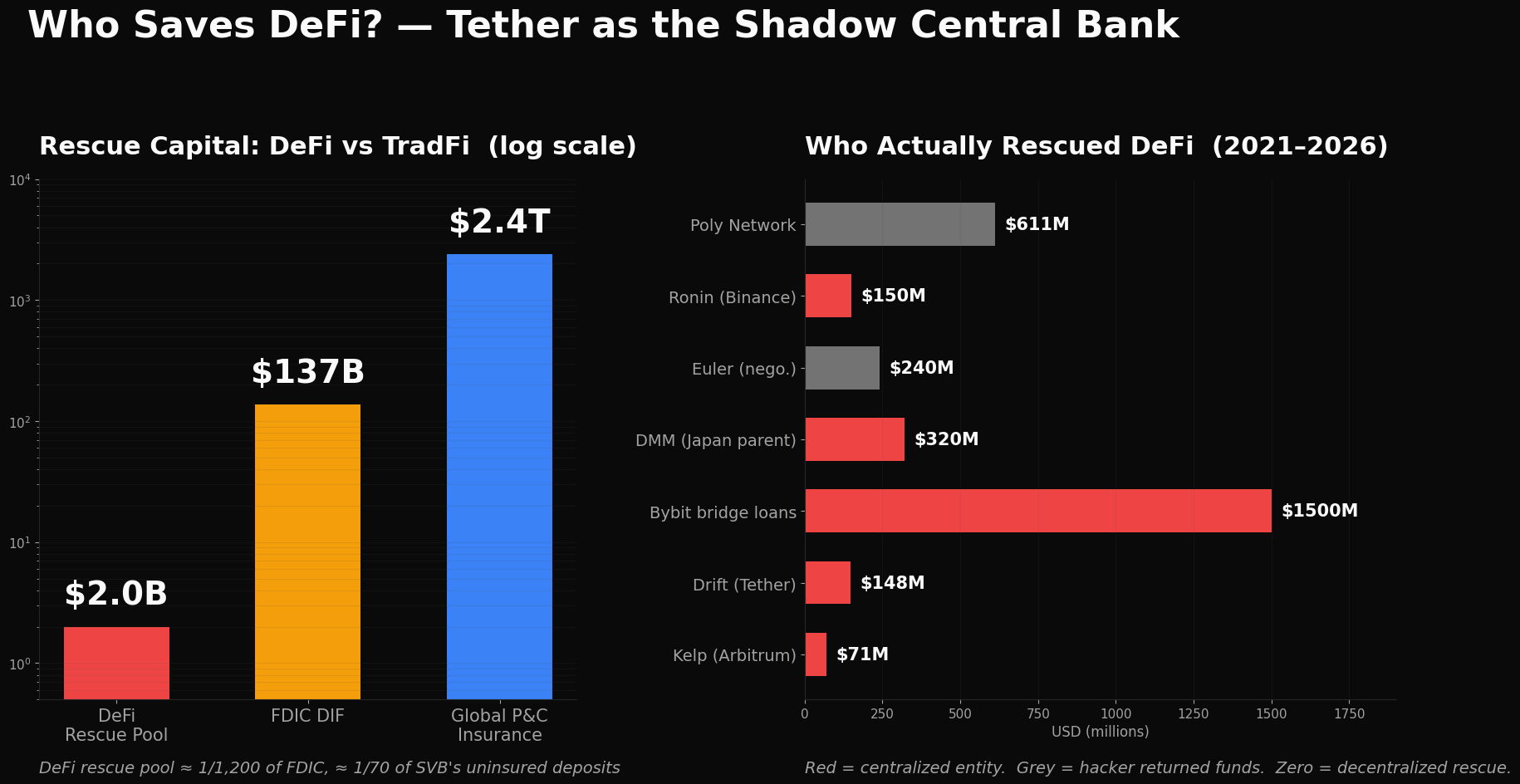
Total industry-level rescue capital: on-chain insurance + protocol modules + SAFU combined, roughly $2B worldwide.
For contrast: the FDIC Deposit Insurance Fund sits around 2.4 trillion annually (Swiss Re 2025). DeFi's self-rescue capital pool is about 1/1,000 to 1/4,000 the size of TradFi insurance. And DeFi TVL is nowhere near 1/4,000 of TradFi's asset base.
The asymmetry of capital density is the real nature of the DeFi rescue problem.
3. Why TradFi Rarely Has Holes Like This
The common misread is that TradFi is "safe because regulated." The colder truth: every layer of TradFi has money, time, and law pre-injected into it.
Start with money. FDIC at 4B, global P&C capital at 3.625B of private money. The Fed itself didn't put up a cent. In 2008, TARP deployed 425.5B, net cost around 151.5B in uninsured deposits, with the cost ultimately covered by a special assessment on surviving banks.
Time is the role people miss. The SEC shortened the settlement cycle from T+2 to T+1 on May 28, 2024, meaning every major transfer now has a full business day of reversibility. NYSE's 7%/13%/20% circuit breakers halt trading the moment the S&P 500 hits a threshold. The classic: in August 2020 Citigroup fat-fingered 504M had to be returned**. You fat-finger it, and the law can fat-finger it back.
Law is the layer DeFi most consistently ignores. FTX collapsed in 2022 with an 8B hole and went through U.S. bankruptcy court. Sullivan & Cromwell spent two years cleaning it up. The final outcome: **creditors recovered 118% in USD equivalent** (because BTC rallied). That result wasn't because Sam Bankman-Fried did anything right. It's because TradFi legal infrastructure can digest an 8B crypto disaster. Contrast with The DAO in 2016 — $60M stolen, and the Ethereum community had to hard-fork to recover the assets, permanently splitting the chain into ETC and ETH. TradFi has courts. DeFi only has consensus. The cost of consensus always exceeds the cost of a courtroom.

When a TradFi disaster looks less ugly than a DeFi one, the key is that TradFi disasters are almost never single-counterparty, permanently irreversible, gone overnight. They get diluted by courts, absorbed by insurance, backstopped by government, and stretched out across time.
DeFi disasters are the opposite. Kelp: $292M drained in 46 minutes. Irreversible. No court. No insurance pool big enough to swallow it.
4. The Heavy Hitters Are Already Rescuing DeFi — Just Not in the Right Shape
Don't misread this: DeFi has been rescued before. But the shape of every rescue looks nothing like TradFi.
Euler Finance (March 2023): 240M.** This is the most successful on-chain negotiation in DeFi history.
Ronin Bridge (March 2022): 150M funding round, with a16z, Paradigm, Animoca, Accel, and Dialectic joining.** Sky Mavis covered a share. By June all users were made whole.
DMM Bitcoin (May 2024): 320M) directly. The exchange still shut down in December, with accounts migrated to SBI VC Trade. Being rescued doesn't mean surviving.
Tether × Drift (April 16, 2026) is the one worth dissecting. Two weeks after Drift lost 127.5M investment, partners added 148M in rescue capital. The structure was revenue-share credit plus a partial grant. The quid pro quo was explicit: Drift swapped its settlement stablecoin from USDC to USDT.
Arbitrum Security Council (April 21, 2026): 30,766 ETH frozen, about $71M. The first meaningful clawback of the Kelp incident. This means an L2 Security Council has become, in practice, the on-chain extension of law enforcement.
Line all four up and the common thread is glaring: the money rescuing DeFi comes from Binance, Tether, the Arbitrum Foundation, a Japanese parent company — every one of them a centralized entity. DeFi fundamentalism has spent years telling itself to be trustless, decentralized, and immune to any single actor dictating protocol fate. But when the real fire starts, the extinguisher is in centralized hands.
This isn't DeFi's failure. It's DeFi's reality.
5. The Tornado Cash Legalization Paradox: Why Laundering Is Still Cheap
Rescue side done. Now the attack side. How can Lazarus steal $577M from three different protocols across three consecutive months and still launder the proceeds clean? Because laundering is still too cheap.
Tornado Cash's legal status has flipped twice. In August 2022, OFAC initially sanctioned 44 addresses (eventually 81), and Circle froze 75,000 USDC within hours. In November 2024, the Fifth Circuit ruled in Van Loon v. Treasury: immutable smart contracts don't qualify as "property" under IEEPA, so OFAC has no authority to sanction them. On March 21, 2025, Treasury formally removed Tornado Cash from the SDN list. By November 2025, Tornado Cash TVL had climbed back to $1.5B — higher than before the sanctions.
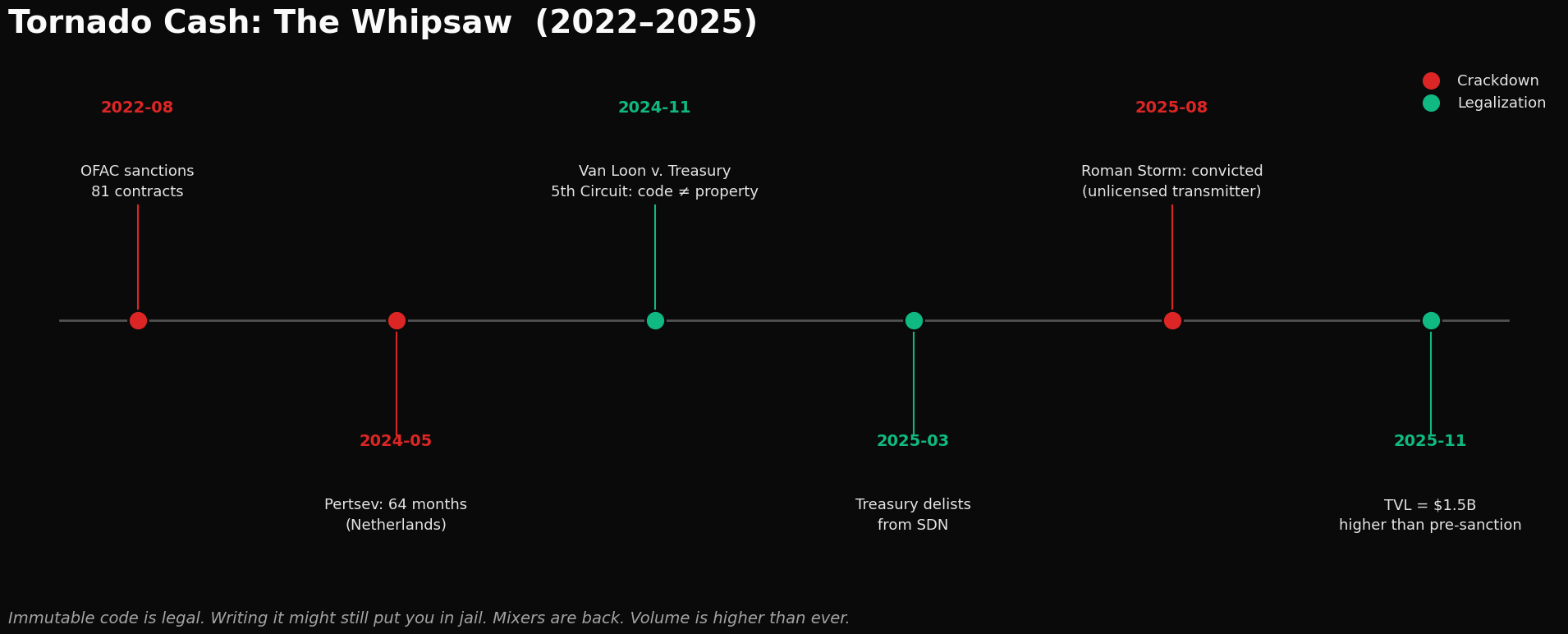
But developer criminal liability didn't flip. A Dutch court sentenced Alexey Pertsev to 64 months in prison in May 2024. Roman Storm was convicted in August 2025 on one count of unlicensed money transmission (up to 5 years). The jury deadlocked on money laundering and sanctions conspiracy. Writing immutable code isn't illegal. The people who write the code go to jail. The paradox's result: compliant developers won't touch privacy infrastructure, and the non-compliant keep running.
Lazarus's laundering playbook has evolved quickly inside this environment:
- Bybit 160M laundered in 48 hours, split across 28 separate Tornado Cash deposits to evade single-deposit-size heuristics. FBI attribution took five days — not bad — but the money had already moved.
- Chain-hopping has gone mainstream: Elliptic has recorded single laundering operations that traverse over 100 bridges and DEXs. Cross-chain bridges are Lazarus's highway system.
- The "black U" OTC market on Tron is estimated at 3.29B across 7,268 addresses cumulatively from 2023-2025 (including 5 Tron wallets totaling $182M on a single day, Jan 11, 2026), but that number also reveals the other side — USDT as a laundering rail is far larger than the amount getting frozen. This isn't a moral gap. It's an execution gap.
6. The Defense Toolkit: The Useful, the Elegant, the Unbuilt
The useful. Forta Firewall filtered 3.7M transactions per day in July 2025 with a 99% attack detection rate and a false positive rate below 0.0002%. Venn Network runs a real-time transaction firewall on EigenLayer with 100-200ms latency and over 200 contracts integrated. Railgun blocked a zkLend hacker's laundering attempt in February 2025, earning public praise from Vitalik — a rare field demonstration of the Privacy Pools-style compliance mechanism.
The elegant but unused. 0xbow's Privacy Pools launched on Ethereum mainnet in March 2025. By November, cumulative volume was only $6M across 1,500 users. The Buterin-Soleimani 2023 paper is technically beautiful. Nobody uses it in the real world. Nocturne Labs, backed by Bain, Polychain, and Vitalik himself, quietly shut down in June 2024.
The unbuilt: real time-lock defenses. Optimism and Arbitrum have 7-day challenge periods for L1 withdrawals, but the finality of LayerZero, Wormhole, THORChain, and Chainflip is measured in minutes. The reason Kelp's $292M scattered across 20 chains is that cross-chain bridges have no time lock. Vitalik has proposed "delayed finality" designs. No major protocol has implemented one. Even with Tornado Cash now legal, nobody has added a time lock to it — privacy protocols with delays aren't competitive, and privacy protocols without delays are Lazarus's best friend.
7. What to Steal from TradFi: Five Concrete Proposals
Five mechanisms TradFi has already battle-tested, which DeFi could honestly borrow:
1. Mandatory 24-hour challenge windows on cross-chain bridges. Copy Optimism's fraud-proof-window concept to every cross-chain message. The cost is worse UX. The payoff is that Lazarus's rapid-laundering toolkit gets cut off at the knees. Lowest-hanging fruit.
2. A voluntary FDIC-style insurance pool at the stablecoin layer. USDC, USDT, and PYUSD jointly carve 5-10 basis points of fees into a DeFi rescue capital pool, with the stablecoin issuers as backstop. Tether has frozen $3.29B over three years but carries zero formal industry rescue obligation — if the stablecoin layer agrees to build its own capital pool, on-chain gets a real lender of last resort. Nobody can force this one. It only happens if the major issuers do the long-term math.
3. zkKYC as an optional layer. Vitalik's "soulbound" concept, Polygon ID, zkPassport — let users preserve privacy while staying clawback-eligible in jurisdictions with legitimate cause. The hardest technical challenge isn't cryptography. It's which court has authority to trigger a clawback — global protocols hit jurisdictional friction immediately. But the evolution has already started: when things actually break, Arbitrum's Security Council is doing this job. It just isn't standardized.
4. Wyoming DUNA legal personhood. The Wyoming DUNA Act, effective July 1, 2024, grants DAOs legal personhood, a tax ID, limited liability, and the ability to sue and be sued. This is the prerequisite for DAOs to be underwritten by the TradFi insurance industry. Without this legal structure, every DAO is a ghost in the eyes of insurers.
5. A default waterfall for shared sequencer layers. Copy the multi-tier default waterfall from DTCC, CME, and LCH — defaulter's margin, guarantee fund, sequencer's own capital (skin in the game), mutualized loss among survivors, recovery tools. Shared sequencer stacks like Espresso and Astria can build this in natively. This copies a century of central-clearing engineering wholesale. Highest execution risk, highest long-term upside.
8. Closing: DeFi's Salvation Isn't On-Chain
My conclusion after writing this is sharper than the last piece: DeFi will not be saved by DeFi.
On-chain insurance capital density will never catch up to on-chain TVL. You cannot backstop a 600M insurance pool. The IMF's September 2025 financial stability report put it bluntly: "Stablecoins that don't access central bank reserves have no lender of last resort. Under stress, nothing backstops them."
Here's my call on what will, should, and won't happen over the next five years:
What will happen: Centralized entities will keep filling the vacuum. Tether already bought Drift's market share from USDC with a $148M rescue — this "bailout for rail" pattern will continue. BlackRock, Coinbase, and Binance will organize industry rescue funds. L2 Security Councils will keep freezing stolen funds. Call it the de facto centralization of central banking.
What should happen: DeFi admits it needs a hybrid architecture. Immutable on-chain base layer, off-chain legal personhood, stablecoin-layer insurance capital, default waterfalls on shared sequencers — these aren't anti-DeFi. They're the prerequisites for DeFi to survive.
What won't happen: A purely on-chain, purely decentralized DeFi rescue infrastructure that depends on zero centralized entities. This ideal has never paid out in the real fight.
Back to the four events that opened this piece: Arbitrum froze 148M, Justin Sun begged publicly, Aave Umbrella faces a $116M gap. Put them together and you have the answer. DeFi is already being rescued. The only problem is that the rescuers don't live inside its own system.
The purest form of decentralization is the one least capable of rescue. The DeFi that wants to live will voluntarily step beyond purely on-chain.
References
Kelp follow-up rescue progress
- CoinDesk: Arbitrum Freezes $71M in Ether Tied to Kelp DAO Exploit
- Aave Governance Forum: rsETH Incident Report (Apr 20, 2026)
- DL News: Justin Sun Pleads with Kelp DAO Hacker
- The Defiant: Aave Models 230M in Bad Debt
Tether × Drift rescue
DeFi insurance and safety modules
- Nexus Mutual: Claims History
- DeFi Coverage: Comparing DeFi Insurance Protocols
- CoinDesk: Binance Converts $1B SAFU to 15,000 BTC
TradFi rescue precedents
- FDIC: Q4 2025 Quarterly Banking Profile
- CBO: TARP Final Report
- Federal Reserve History: LTCM Near-Failure
- FINMA: UBS/Credit Suisse Merger
- Sullivan & Cromwell: FTX $14B Bankruptcy Plan
- Loeb & Loeb: Citi v. Revlon $504M Reversal
- SEC: T+1 Press Release
Tornado Cash legal battle
- U.S. Treasury: Tornado Cash Delisting (Mar 21, 2025)
- CoinDesk: Alexey Pertsev Found Guilty
- Mayer Brown: Tornado Cash Mixed Verdict Analysis
- DL News: Tornado Cash TVL Record High
Laundering and stablecoin freezes
- TRM Labs: Bybit Hack Deep Dive
- CryptoNews: Tether Frozen $3.29B / 7,268 Addresses
- Elliptic: Chain-hopping as Laundering Method of 2025
- Cointelegraph: ZachXBT Accuses Circle of $420M Compliance Failures
Regulatory perspective
- IMF: Stablecoins Global Dominance (Sep 2025)
- Wyoming Legislature: DUNA Act (SF0050)
SEAL 911
- The Block: SEAL Uptick in 2025 Tickets
Previous article