One Meme, One Profanity
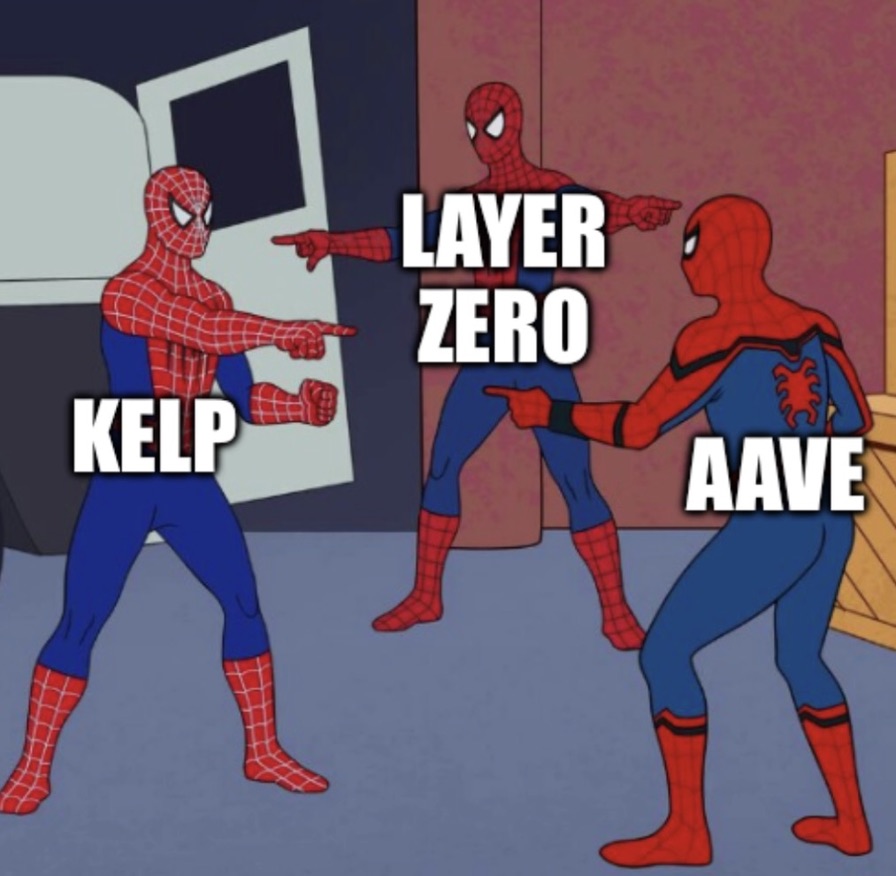
The day Kelp DAO blew up, Leonidas (the top KOL in the Bitcoin Ordinals / Runes scene, 249K followers, the guy behind $DOG) posted the three-Spider-Men-pointing meme. Kelp, LayerZero, Aave — three Spider-Men in the same frame, fingers at each other.
Yearn core developer banteg threw out a tweet almost simultaneously: "We should get LayerZero, Kelp, Aave into a room to figure things out. So far things are not looking good, everyone has lawyered up and going full PvP on each other."
Everyone's lawyered up. Everyone's firing at each other.
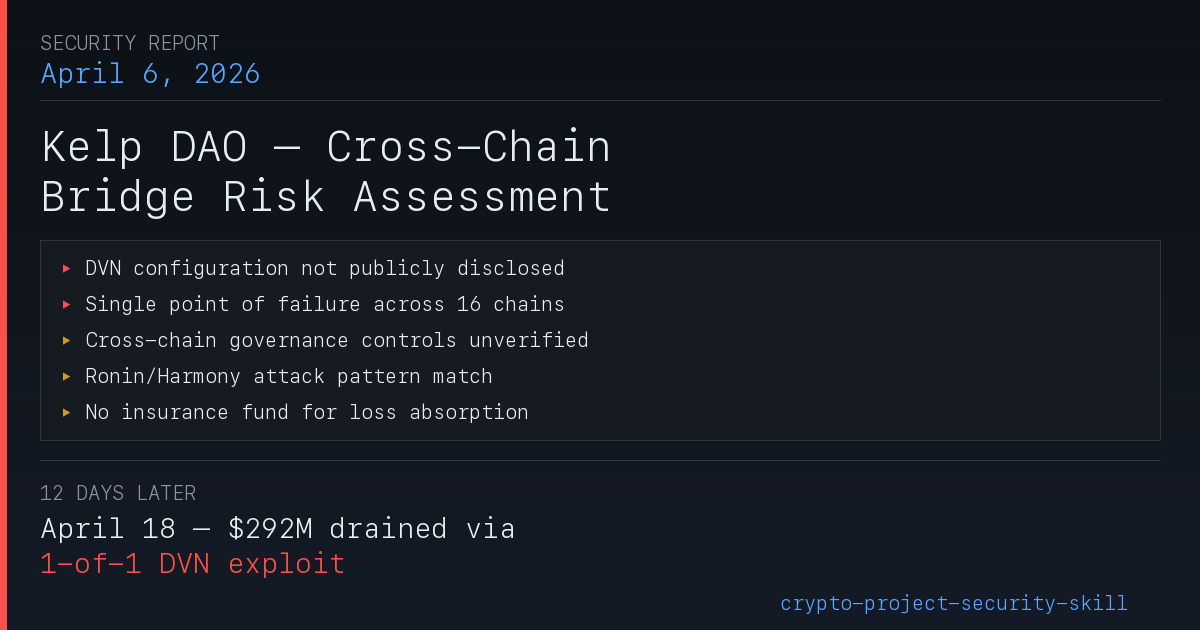
On April 18, 2026, Kelp DAO's rsETH cross-chain reserve pool was drained of 116,500 rsETH in 46 minutes — $292 million, the largest DeFi hack of the year so far. (I flagged this risk twelve days before the hack in a public audit report — but this piece isn't a retrospective on that prediction.)
This piece wants to answer three bigger questions:
Will DeFi die? Where does DeFi go from here? When AI agents actually join the fight, what does DeFi turn into?
I. Kelp Isn't an Incident. It's a Symptom.
The attacker never touched the contract. No admin privileges, no code vulnerability. What got compromised was only the RPC server sitting underneath LayerZero's DVN (Decentralized Verifier Network) — they poisoned the op-geth binary, made the RPC lie to the DVN while telling the truth to every other IP, then used DDoS to knock out the clean backup nodes, forcing the DVN to auto-failover onto the poisoned path. The detailed timeline and trust-chain breakdown is in the 12-days-before post-mortem — I won't repeat it here.
The key point: Not a single line of code was broken. The OFT Adapter ran as designed, EndpointV2 verified as designed, the DVN signed as designed — every component was trusting what it was supposed to trust. The thing it was supposed to trust happened to be a lie.
The reason it worked: Kelp was running requiredDVNCount = 1 — a single verifier. LayerZero said: "This is Kelp going against our multi-DVN recommendation." Kelp fired back: "1/1 is LayerZero's default. We integrated two years ago and never received an explicit upgrade warning." Aave distanced itself: "Our protocol works as designed."
While the three sides were pointing fingers, on-chain this was happening: 89,567 rsETH (77% of the stolen total) flowed into 7 Aave wallets and borrowed WETH. A single position deposited 53,000 rsETH and borrowed 52,460 WETH — basically 100% LTV. Aave ends up carrying 230M in bad debt. AAVE down 10%, ETH down 3%, Aave TVL vaporized 99.5B to $82.4B — a one-year low.
Outside the three-way lawyer-fight and the legal battle over who pays, there's another group that's been silent on Twitter all month — the retail holders of rsETH on L2s. They deposited thinking they'd bought a backed ETH derivative. They woke up voting on whether to accept an 18.5% haircut. How to split the bad debt — DeFiLlama co-founder 0xngmi proposed three versions (socialize across all holders, let L2 eat it alone, snapshot compensation), every version leaves a hole tens of millions of dollars wide. This isn't detail. This is the magnified development of pooled lending's structural problem.
II. The Numbers Are Brutal, But They Aren't the Whole Truth
Pull the camera back.
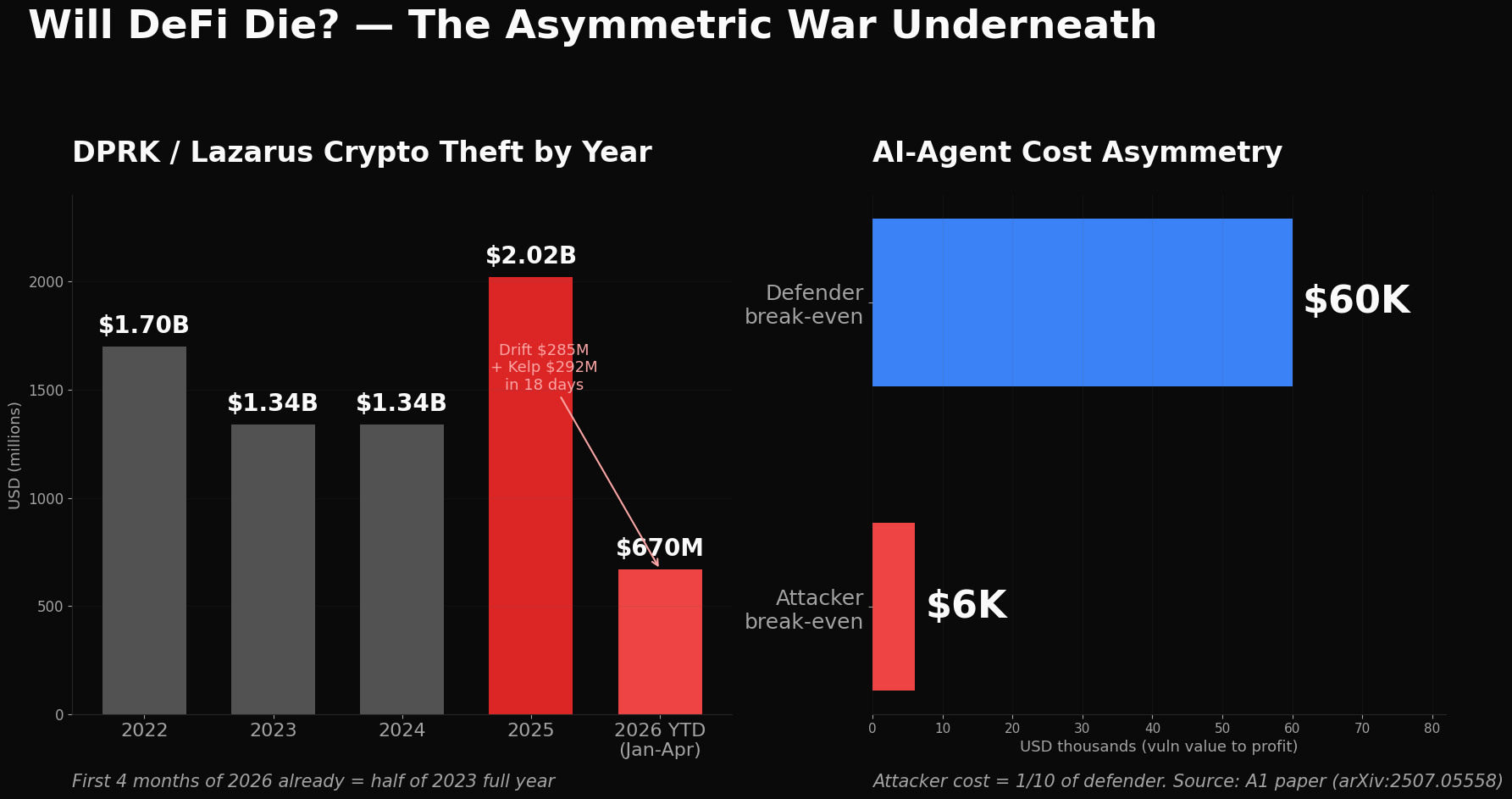
Chainalysis's 2025 annual report says it plain: North Korea-linked hacker groups stole **6.75B. This is not one hacker crew. This is a state financed by crypto raids.
February 2025, Bybit loses 285M — Lazarus's UNC4736 subgroup ran a six-month social-engineering infiltration. April 18, Kelp, $292M.
Eighteen days. Lazarus took $577M using two completely different technical routes.
The same organization can run a six-month social-engineering infiltration, and it can also do RPC supply-chain poisoning combined with precision DDoS. Attack frequency is accelerating, attack technique is diversifying, and the defender's reaction time is still measured in quarters.
But the TVL story isn't just bleeding.
Another set of numbers: **RWA (Real-World Asset) TVL broke 9B at the end of 2025, are projected to break 1.9B TVL and has expanded to Solana. Ondo Finance over 100M two years ago to over 69B peak of the pre-crash CeFi lending era.
So 2026 DeFi isn't dying. It's splitting:
- Retail DeFi is bleeding: the LRT matryoshka game is exhausted, cross-chain bridges keep getting breached, the systemic risk of pooled lending à la Aave is now visible to the whole network.
- Institutional DeFi is feeding: tokenized Treasuries, RWA, private credit are compounding TVL at 50%+ per quarter.
Grayscale's 2026 Digital Asset Outlook literally titled its report "Dawn of the Institutional Era." Vitalik roasted "fake DeFi" on X — governance tokens controlled by small insider circles, which he says isn't DeFi at all.
III. What Dies, and What Doesn't
What we currently call DeFi is the blueprint left by DeFi Summer 2020: AMM + pooled lending + governance token + cross-chain bridges stitching it all together. This structure rests on three premises, all of which are failing at the same time.
Premise 1: Smart contract security audits are enough to protect user funds. Kelp's contracts have no bugs. mETH has been audited 16 times, TimelockController delay is 0. Hyperliquid stations four team validators guarding $3.35B. The loss isn't in the code — it's in the deployment parameters, in the RPC list, in the availability assumptions of the DDoS surface. This industry has spent five years treating "code security" as a synonym for security. Kelp proved that's only half of security.
Premise 2: Pooled liquidity beats isolated markets. Aave's pooled lending became the infection vector in the Kelp incident — one asset (rsETH) loses backing, the whole WETH pool eats the bad debt. Isolated-market architectures like Morpho and Euler saw discussion in Chinese crypto circles spike after this incident. Every one of 0xngmi's three bad-debt proposals leaves a multi-tens-of-millions gap. That's a structural problem with pooled models — patches won't fix it.
Premise 3: Cross-chain bridges are DeFi's nervous system. From Ronin 325M, Nomad 292M — cross-chain bridges have cumulatively siphoned over $2.8B, 40% of all Web3 heists. Every time it happens, people say "the next generation of bridges will be safer." Every time the next-gen bridge ships, a new attack surface gets found. This isn't an evolution problem — it's an architecture problem. Any mechanism that tells one chain the state of another chain, given a finite budget, eventually degenerates into a trusted pipe.
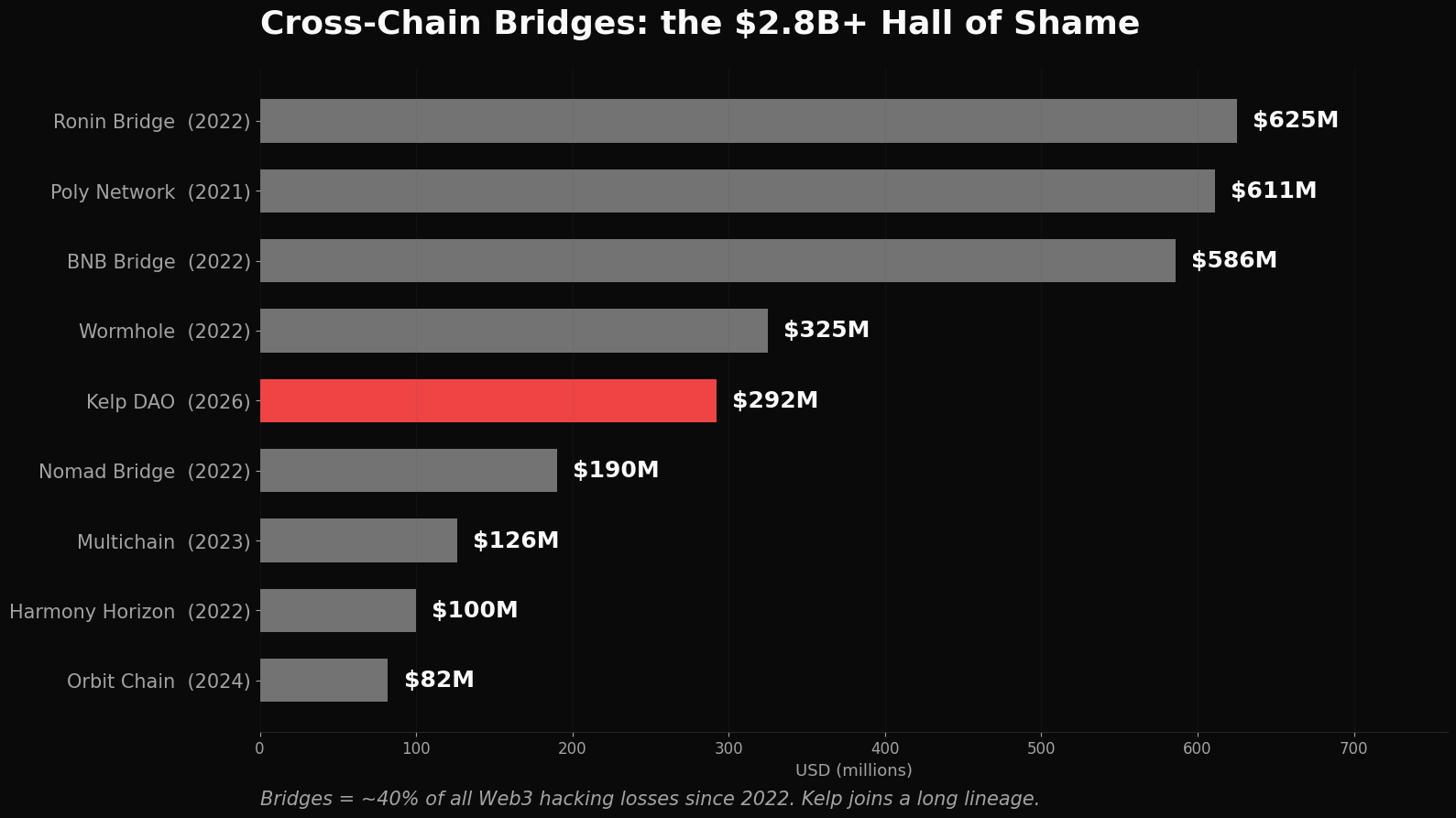
Three premises loosening simultaneously means 2020-era DeFi is already in zombie state. Not dying tomorrow, but every incident rips out another muscle. What dies is this form.
But the demand for censorship-resistant finance, non-custodial assets, and globally composable liquidity doesn't die. Institutions have actually been accelerating into the space these past two years — the growth curves of BUIDL, Ondo, and Maple show that when a safer DeFi form gets built, capital floods in instantly. So the question isn't "will DeFi die?" — it's what does the next form look like.
To answer that, you have to first see clearly what the adversary has become.
IV. AI Agents Are Already in the Arena
A1 (arXiv:2507.05558) is an agentic smart-contract vulnerability discovery system with six domain tools (source fetcher, constructor initializer, state reader, sanitizer, concrete execution harness, revenue normalizer). On the VERITE benchmark it hits a 63% success rate, with a single attack extracting up to $8.59 million. More importantly: A1 found 9 vulnerable contracts that appeared only after the training-data cutoff, never previously discovered — the first batch of AI-agent-discovered DeFi zero-days in history.
The coldest sentence in that paper:
Attackers break even on vulnerabilities worth 60,000.
Attack/defense cost asymmetry is 10:1, pointing at the attacker.
Another time-based curve: attack immediately after a bug is found, 86–89% success. Delay one week, down to 6–21%.
February 2026, OpenAI and Paradigm released EVMbench — 120 bugs, 40 audits. GPT-5.3-Codex in exploit mode hit a 72.2% success rate. Six months earlier, GPT-5 was at 31.9%. Paradigm's comment: "We can now clearly see that a large fraction of future audits will be done by agents."
Attack cost cut to 1/10, attack capability doubling every six months, probability of funds being drained within 7 days of a bug being found is 10x higher than delaying another week.
This isn't future threat. Lazarus already weaponized AI in 2025: AI-driven reconnaissance tools, deepfake recruiter personas, automated vulnerability scanning, laundering funds through Tron-based mixers — full-stack automation (TRM Labs, Elliptic). They use malware like BeaverTail to infiltrate Web3 developer machines via fake job interviews — at least 197 malicious npm packages have been pinned.
That "lies to specific IPs, tells the truth to other IPs" malicious op-geth binary in the Kelp incident? That's 2025 capability. The 2027 version will be an agent persistently observing the DVN's query patterns, learning when lying won't get caught, self-destructing before being monitored. This isn't science fiction. It's the direct implication of the A1 paper.
V. Three Inferences and Two Thought Experiments for 2030 DeFi
From here on is speculation territory. I'll mark which are inferences and which are pure imagination.
Inference 1: Single-DVN / single-verifier / single-oracle architectures will be eliminated from mainstream protocols. Not for moral reasons — because the insurance premium can't be priced. When A1-class agents can 24/7 continuously scan every deployed contract, any single-point-of-trust protocol can't get underwritten by mainstream insurance pools. LayerZero announcing post-Kelp that it will "no longer sign messages for 1/1 DVN configurations" is the beginning of this evolution.
Inference 2: "Agent-native DeFi" becomes a new primitive. Trail of Bits is already doing it — 94 plugins, 201 skills, 84 specialized agents, AI-augmented auditors finding 200 bugs in a week. Certora AI Composer embeds Certora Prover into the LLM's code-generation loop — every generated snippet is formally verified before it's emitted. Gauntlet uses continuous agent-based simulation to protect over $42B in TVL. The next step: protocols ship their own "guardian agent" as part of deployment — the way deploying a contract today means shipping ERC-20 tokens, tomorrow means shipping a 7x24 monitor agent wired into a circuit breaker. Forta's Firewall already hits 99% detection, <0.0002% false positives, millisecond response. The question isn't whether the tech works. The question is who pays for that agent's ops, and whether users will trust an AI gatekeeper they didn't write.
Inference 3: Multi-agent cross-verification replaces human multisig. The problem with human multisig: signers can be social-engineered, phished, infiltrated via deepfake job interviews. Lazarus has already made human signers the main attack surface. The next generation of critical decisions (upgrades, parameter changes, cross-chain messages) may require N independent agents running different models, different RPCs, different on-chain state sources to reach consensus before passing. The executor is AI, not human-operated nodes — each agent's observation scope is unpredictable to the others. The Ethereum Foundation dAI team's ERC-8004 (on-chain agent identity and credit record) is the first slab of foundation for this direction.
Thought experiment 1: DAOs become agent monitoring consortia. Governance-token voting is already dead in practice — even Vitalik calls it fake DeFi. The next version of the DAO might not be "token holders vote" but "a consortium of on-chain credit-scored agents, weighted by on-chain performance, participates in governance." Humans don't drop out — their role shifts to auditor and arbiter for the agents, with day-to-day decisions handed to consensus agent swarms.
Thought experiment 2: The insurance layer evolves into a real-time-priced agent-market. Today's DeFi insurance is priced by expert committees. Tomorrow's insurance market might be: every contract in every protocol has a real-time risk score, continuously repriced by a swarm of competing AI agents. A second before you deposit, you get a live quote: "the probability of this money being stolen in the next 30 days is X% — want to hedge?" This slowly turns "you're on your own" into "the protocol ships with insurance," and the cost of insurance directly decides whether a protocol can launch.
VI. Every Layer Thinks the Problem Is Somewhere Else
Back to Leonidas's three-Spider-Men meme. Kelp points at LayerZero, LayerZero points at Kelp, Aave says not our problem. The joke in the meme is that all three Spider-Men are the same guy — they look like they're pointing at someone else; they're actually pointing at themselves.
Why can't 2020-era DeFi survive the AI-agent era? Because every one of its layers was built on an optimistic assumption that the layer above or below would do its job right. The contract layer assumed the config layer wouldn't do something dumb. The config layer assumed the verifier layer had redundancy. The verifier layer assumed the infrastructure layer wouldn't be locked in by a nation-state adversary. Every layer owns only its slice. Every layer feels it isn't responsible.
That "delay one week and success rate drops to 6%" number in the A1 paper means defenders still have time to patch. But it assumes you know you have a bug. The Kelp incident's whole "the contract has no bugs" illusion is the flip side of that assumption — the place you thought was clean is exactly the place the attacker picks.
There's a line from Vitalik's d/Acc essays I keep coming back to: "Defense-dominance is feasible, but it requires active choice." If the community keeps relying on code audits, human multisig, and single-point verifier nodes, DeFi gets crushed in the AI-agent attack era. If the community chooses to embrace agent-native infrastructure, DeFi evolves into something even we won't recognize.
DeFi won't die. But the next generation of DeFi, to survive, has to accept this first: every layer of this industry thinks the problem is somewhere else, but combined, they are the problem.
References
Kelp Incident Technical Analysis
- LayerZero official statement: https://x.com/LayerZero_Core/status/2046081551574983137
- KelpDAO response: https://x.com/KelpDAO/status/2046332070277091807
- CoinDesk: 2026's Biggest Crypto Exploit: Kelp DAO Hit for $292M
- CoinDesk: DeFi TVL drops more than $13B in two days
- The Block: DeFi losses top $600 million in weeks
- Odaily three-way analysis: https://www.odaily.news/zh-CN/post/5210369
- TechFlow: https://www.techflowpost.com/zh-CN/article/31217
- Wu Blockchain bad-debt crisis: https://wublock123.com/articles/kelpdao-exploit-debt-crisis-defi-bad-debt-resolution-58888
DeFi 2026 and DPRK Data
- Chainalysis 2025 Crypto Crime Report: https://www.chainalysis.com/blog/crypto-hacking-stolen-funds-2026/
- Sherlock Q1 2026 Web3 Security Report: https://sherlock.xyz/post/the-sherlock-web3-security-report-q1-2026-every-major-hack-exploit-and-trends
- Grayscale 2026 Digital Asset Outlook: https://research.grayscale.com/reports/2026-digital-asset-outlook-dawn-of-the-institutional-era
- Chainalysis Drift hack analysis: https://www.chainalysis.com/blog/lessons-from-the-drift-hack/
AI Agent × DeFi Research
- A1: Autonomous Exploit Generation for Smart Contracts: https://arxiv.org/abs/2507.05558
- EVMbench (OpenAI × Paradigm): https://www.paradigm.xyz/2026/02/evmbench
- Trail of Bits AI-native: https://blog.trailofbits.com/2026/03/31/how-we-made-trail-of-bits-ai-native-so-far/
- Certora AI Composer: https://www.certora.com/blog/certora-ai-composer-first-safe-ai-coding-platform
- Forta Firewall: https://www.forta.org/blog/attack-detector-2
Lazarus / Contagious Interview
- Wiz TraderTraitor deep-dive: https://www.wiz.io/blog/north-korean-tradertraitor-crypto-heist
- Microsoft Contagious Interview: https://www.microsoft.com/en-us/security/blog/2026/03/11/contagious-interview-malware-delivered-through-fake-developer-job-interviews/
- The Hacker News 197 npm: https://thehackernews.com/2025/11/north-korean-hackers-deploy-197-npm.html
My Kelp risk report, published 12 days before the hack