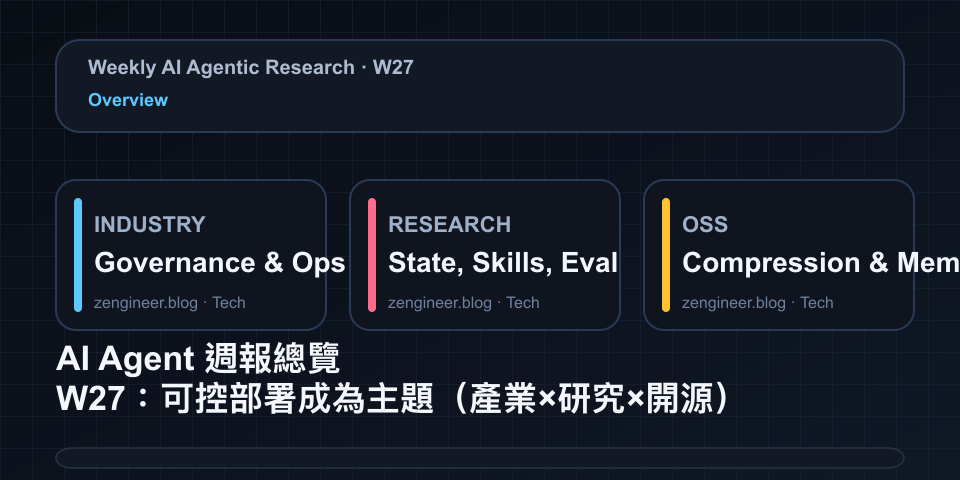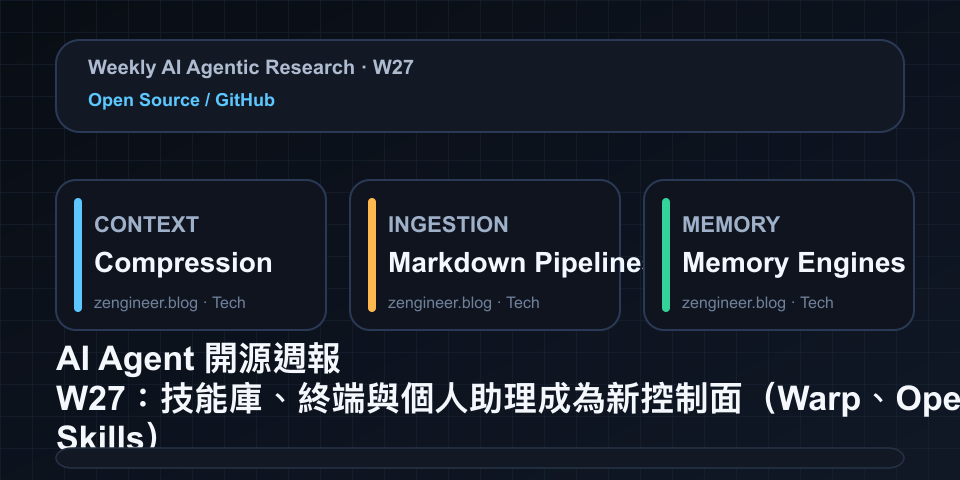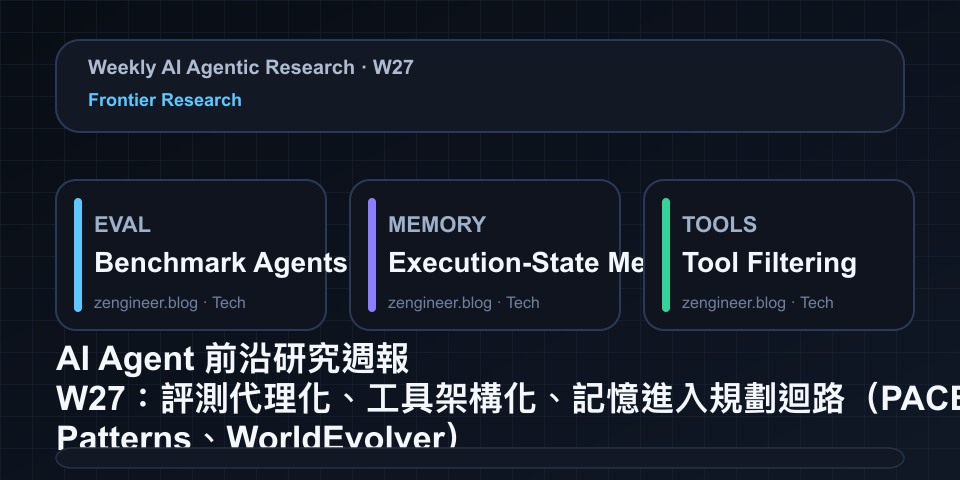
This overview covers AI agent progress from May 4 to May 10, 2026. I split this issue into three tracks: industry news, frontier research, and GitHub open source. The reason is practical. News alone misses the research ideas that change agent design. Papers alone miss deployment pressure. GitHub alone can get distorted by star heat.
The three deep dives are here:
- AI Agent Industry Weekly: News, Products, and Deployment Signals
- AI Agent Frontier Research Weekly: Papers, Labs, and Evaluation Progress
- AI Agent Open Source Weekly: Fast-Growing GitHub Projects and Engineering Progress
One-sentence summary
This week says that agents are moving from "a model feature" into an operating layer that needs deployment, evaluation, orchestration, tool interfaces, and engineering entry points.
In the industry track, OpenAI pushed realtime voice toward executable interfaces. Anthropic packaged finance agents into templates and enterprise services. Microsoft framed agent management as an operating-model problem. NIST/CAISI pushed frontier-model evaluation before deployment. Chinese signals focused on cost reduction, real scenarios, and paid tiers.
In the research track, the important shift was not a cleaner demo. It was more precise failure visibility. Orchestration traces, TRAJECT-Bench, Tool Illusion, and AggAgent all point in the same direction: agents should not be judged only by final answers. We need to see trajectories, tool selection, arguments, order, aggregation, and stopping.
In the GitHub track, open-source attention moved from abstract frameworks toward workflow entry points. Codex, Claude Code, opencode, Ruflo, TradingAgents, and MCP/memory tooling all point to the same demand: developers want agents inside terminals, codebases, financial research workflows, and tool interfaces.
What the three tracks mean together
First, agent competition is moving beyond the single model. The model still matters, but usefulness now depends on tools, data, permissions, audit, cost, interface, and deployment teams.
Second, agent evaluation is becoming system testing. It will not be enough to report answer accuracy. Teams will need replayable trajectories that show which tool was selected, which argument failed, where the system should have stopped, and which subagent polluted the result.
Third, open source will monetize attention first inside developer workflows. Coding agents are the natural wedge because terminals, git, repos, PRs, and issues are observable and testable environments. That helps explain why Codex, Claude Code, and opencode are growing together.
Fourth, finance will remain one of the important vertical battlefields. Anthropic's finance templates and TradingAgents' open-source momentum are different things, but they point at the same structural fit: finance has data, workflows, review, artifacts, risk controls, and high-value tasks.
Builder watchlist
If you only take a few questions from this week, I would use these:
- Does your agent leave a replayable trajectory?
- Does your eval inspect final answers only, or also tool selection, argument correctness, and order?
- When you add tools, do you also measure the new error surface?
- Is your agent performing in a chat box, or is it inside terminals, Office, CRM, data connectors, and codebases?
- Is cost control happening at the model layer, or at the workflow layer?
Next week I will keep watching three things: the enterprise deployment competition between OpenAI Deployment Company and Anthropic's services vehicle; Baidu Create 2026 and whether Wenxin 5.1's claims survive real demos; and coding-agent release/plugin/sandbox/memory progress.