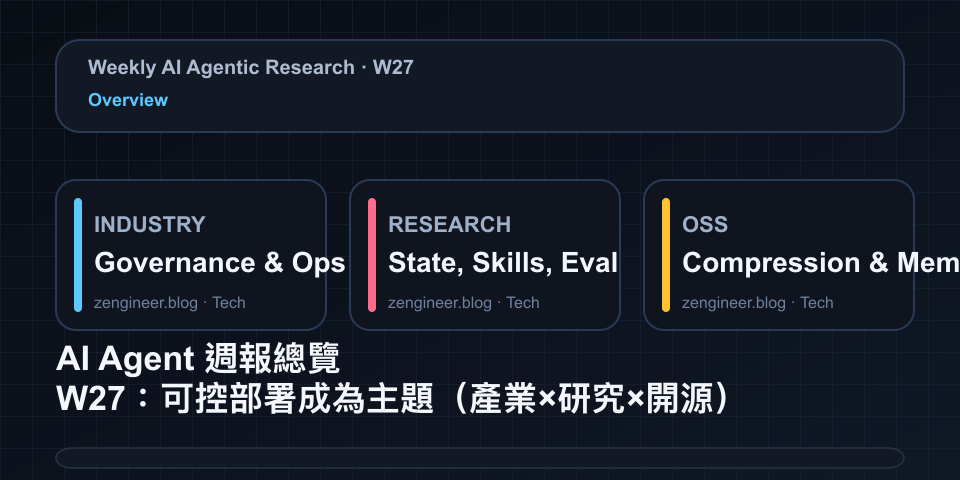
This issue covers May 11 to May 17, 2026 (Asia/Taipei). One sentence summary: agent competition is moving from models to the systems that run them—delivery, governance, evaluation, and platform tooling are becoming the limiters.
Deep dives (same language):
- Industry / news: AI Agent Industry Weekly (News/Deployment)
- Frontier research: AI Agent Frontier Research Weekly
- Open source / GitHub: AI Agent Open Source Weekly
1) Industry: DeployCo + Daybreak productize deployment and security
The week’s headline shift is that “the API won’t deploy itself.” Deployment companies (forward‑deployed delivery) and cyber harnesses (auditable, controlled security workflows) are turning agent adoption into an operational product category.
If you’re deploying inside an organization, the next questions are not only “is the model strong,” but:
- How do permissions and audits work?
- What’s the rollback story?
- How do you control cost?
- Who owns failures?
2) Research: evaluate and train agents as systems
Research signals this week point in the same direction: evaluation is leaving short‑answer comfort zones.
- ExploitGym treats exploitation as a replayable, measurable capability (security forces verification).
- FutureSim uses world‑event replay to evaluate adaptive agents and calibration over time.
- Orchard pushes agentic modeling toward repeatable recipes and frameworks.
- Agent‑ValueBench studies value drift at the agent‑system level (LLM + tools + memory + orchestration).
The shared conclusion: long‑horizon reliability and verifiability are becoming the decisive engineering/research frontier.
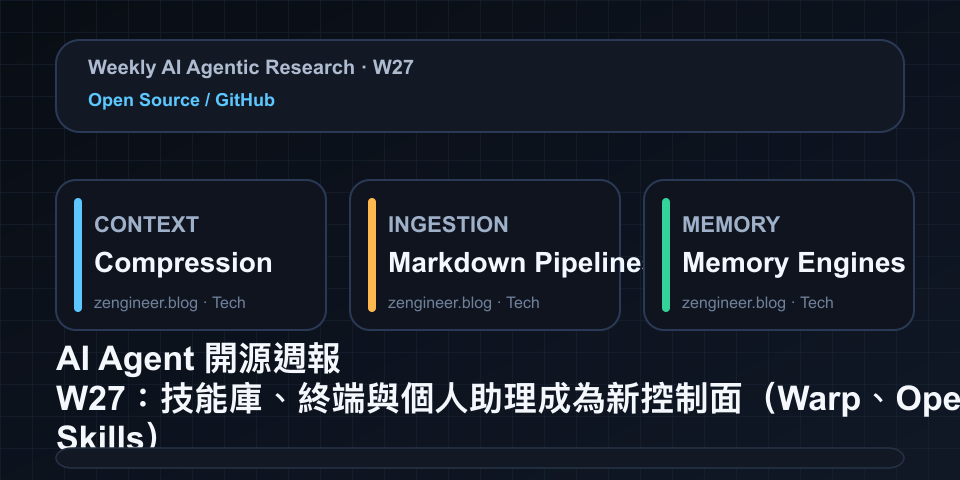
3) Open source: MCP platformization, packaged orchestration, memory as infrastructure
Open source is building a platform + governance layer:
- GitHub wiring secret scanning into MCP makes security a standard agent workflow.
- Orchestration projects package multi‑agent workflows into plugin/skill ecosystems.
- Memory layers are becoming mandatory—and governance (retention/redaction/audit) becomes unavoidable.
Cross-track watchlist for next week
- Will cyber harness access policies become engineering‑friendly and auditable?
- Will long-horizon failure modes (silent corruption, state drift) trigger a new wave of eval/observability tooling?
- Can MCP become the carrier for platform capabilities (security/compliance/governance), not just tool wiring?
- Can memory layers converge on governance standards rather than becoming a new risk surface?