AI Agent Weekly Overview W21: Enterprise Boundaries × Tool Platforms (OpenAI×Dell, MOSS, codegraph)
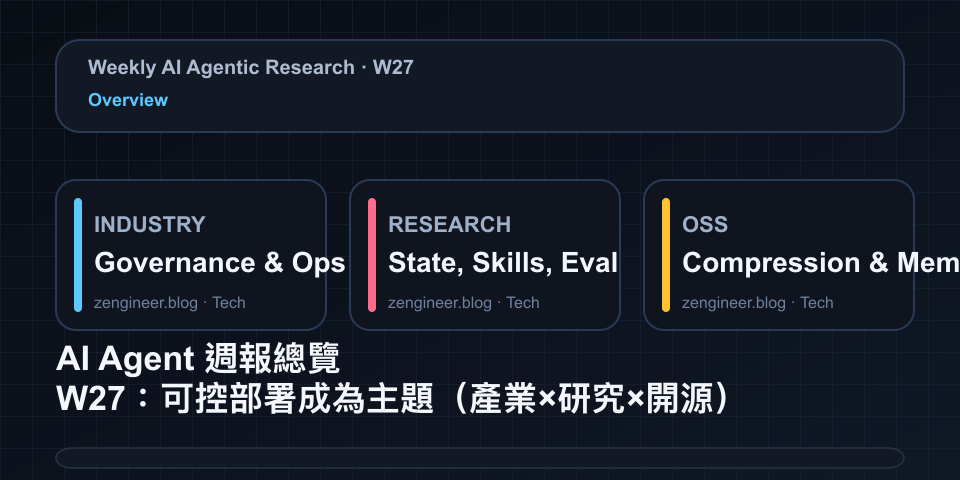
This issue covers May 18 to May 24, 2026 (Asia/Taipei). One-line summary: agents are expanding toward both enterprise boundaries (hybrid/on‑prem) and platformized tool/connectivity layers, while research + open source are rapidly building the “observable, verifiable, governable” systems foundation.
Deep dives (same language):
- Industry / News: AI Agent Industry Weekly (News/Deployment)
- Frontier Research: AI Agent Frontier Research Weekly
- GitHub / Open Source: AI Agent Open-Source Weekly
1) Industry: hybrid/on‑prem + connectivity consolidation will shape adoption speed
The biggest enterprise signal is OpenAI×Dell pushing Codex into hybrid/on‑prem boundaries—accelerating agent adoption in “data can’t leave” environments. In parallel, Anthropic’s Stainless acquisition is a sign that SDKs/connectors/tool integration are becoming strategic platform assets.
Google’s I/O direction with Gemini Spark also reinforces a distribution truth: adoption isn’t only about model scores; it’s about productizing the build→test→observe→deploy workflow for agent builders.
2) Research: evaluate agents as systems—long-horizon and security become the battlefield
Three aligned research vectors this week:
- Self-evolution/self-modification: MOSS pushes to source-level rewriting, forcing rollback and behavioral regression thinking.
- Tool-layer standardization: HarnessAPI unifies streaming APIs with MCP tools, enabling pluggable observability/replay/policy.
- Verifiable long-horizon benchmarks: WorkstreamBench and Spreadsheet‑RL push spreadsheet/finance workloads where outputs are structured and checkable.
Meanwhile, MCP security research (VIPER‑MCP + remote auth measurement) is the reminder that once MCP becomes standard, attacks rapidly target tool handlers and permission scope—not just “protocol theory.”
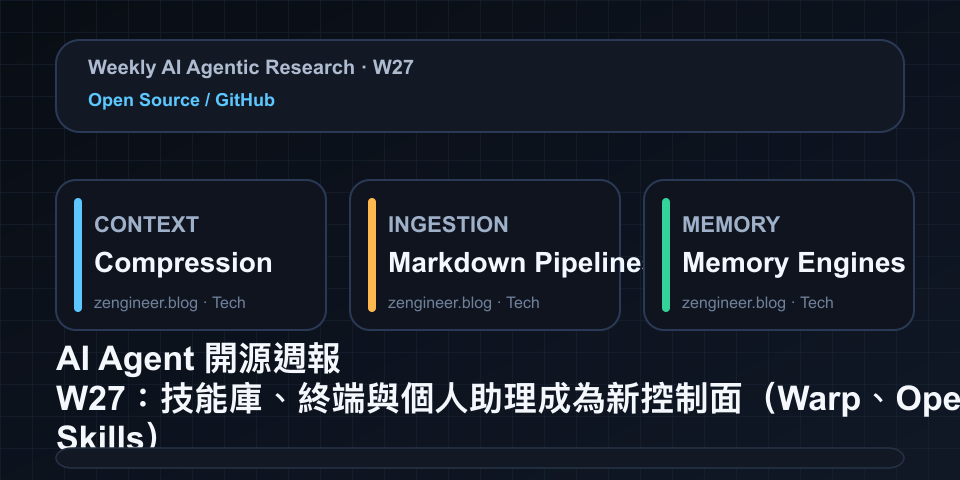
3) Open source: shifting from frameworks to infrastructure
This week’s high-momentum GitHub projects cluster around one goal: fewer tokens, more replay, better governance.
- Local indexing/knowledge graphs (codegraph, Understand‑Anything) address “context is too big.”
- Persistent memory (agentmemory) addresses “how to control long-term state.”
- Methodology/skills (12-factor-agents, superpowers, academic-research-skills) address “how to ship and operate agentic software.”
- Tool harnesses (oh-my-pi) address “how to make patches verifiable and rollbackable.”
One practical recommendation for builders
If you’re building agent products/platforms in 2026, treat these as defaults: least-privilege permissions, evidence/audit, rollback, and verifiers. Across all three tracks, the signal is the same: controllability is the prerequisite for scale.
Watchlist (cross-track)
- Will hybrid/on‑prem deployments quickly converge on enterprise “compliance + cost + observability” patterns?
- Will Gemini Spark-like workflow tools define a new “IDE for agent builders”?
- Will self-modifying agents trigger behavior diff + regression tooling ecosystems?
- Will spreadsheet/finance benchmarks become the main long-horizon reliability eval surface?
- Will MCP security scanning, permission scope standards, and authentication patterns accelerate into standard practice in H2 2026?