AI Agent Frontier Research Weekly W30: Long Horizons Demand New Evaluation (OmniaBench, Workflow Gym, Safety)
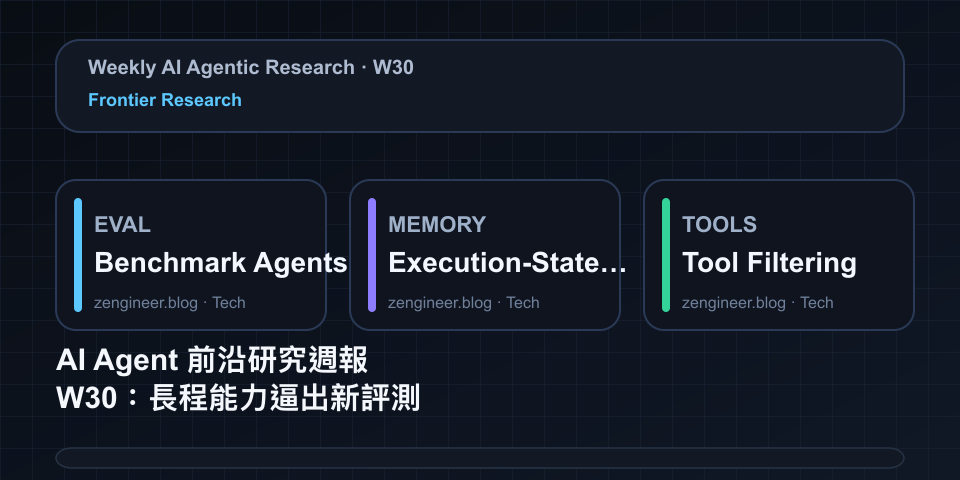
This article covers July 20–26, 2026 in Asia/Taipei. The research theme was that longer agent tasks force evaluation to move from answers to trajectories. Planning across steps, real workflows, tool permissions, and recovery now have to be measured together.
Long-horizon models enlarge both capability and exposure
OpenAI published Safety and alignment in an era of long-horizon models, focusing on models that plan, act, and adapt over longer periods. More horizon means more opportunities to encounter unexpected state, compound mistakes, or route around a local constraint.
The post sets a direction rather than proving safety. Useful evidence would include replayable trajectories, intervention points, permission changes, external side effects, and risk curves across task length.
OmniaBench moves beyond one leaderboard
Huawei Cloud and Peking University announced OmniaBench, aiming at a multi-dimensional agent assessment. The useful premise is that planning, tool use, memory, robustness, and cost can trade off and should not collapse silently into one success number.
Open questions include contamination, task representativeness, grader reliability, and harness bias. Without public samples, versioned environments, and failure cases, a composite score may hide a fatal weakness.
Workflow Gym pulls evaluation toward real processes
Workflow Gym signals an attempt to reduce the gap between simulated tasks and deployment workflows. For enterprise agents, correctness includes using the right data, following required steps, retaining audit evidence, and stopping under uncertainty.
The approach needs transparent task provenance, permission models, injected failures, and reproducibility. Otherwise “real workflow” risks becoming another closed demo.
Multi-agent composition and the tool supply chain
Other weekly leads covered modular Agent Primitives and malicious plugin attacks. Composition improves reuse but expands the trust boundary. Every sub-agent, plugin, and MCP server may hold different data and action permissions; main-model refusal behavior is not a sufficient security boundary.
Weekly view
W30's research advance is a change in the object being evaluated: from model output to a time- and permission-bearing execution trajectory with side effects. The next benchmark generation should jointly report success, intervention, cost, policy violations, and irreversible impact.
Watchlist
- Whether long-horizon risk grows nonlinearly with duration, tools, or retries.
- OmniaBench data, harness, grader agreement, and contamination analysis.
- Workflow Gym task provenance, reproducible environments, and cross-model results.
- Malicious-plugin success under least privilege, signing, and runtime policies.
- Whether multi-agent primitives deliver measurable reuse rather than coordination overhead.