AI Agent Open-Source Weekly W32: The Runtime Periphery Becomes Product (OO-Agents, Open Code Review, Headroom)
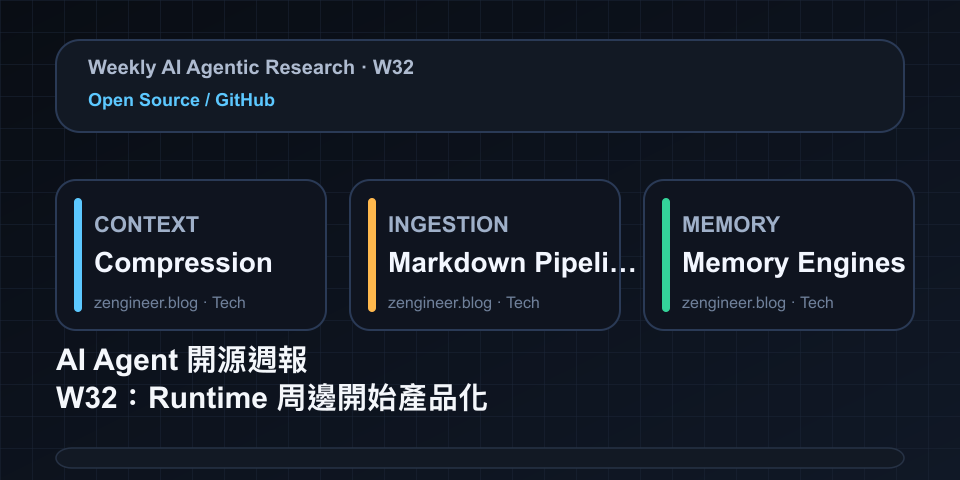
This article covers August 3–9, 2026 in Asia/Taipei. GitHub counts are August 10 snapshots; momentum is corroborated with commits inside the window. W32 was not another chat UI. The runtime periphery is becoming an installable, testable, governable product layer.
NVIDIA OO-Agents makes an agent a Python class
NVIDIA-NeMo/labs-OO-Agents had roughly 1.3k stars and 180 forks. Window commits added Ollama/vLLM examples, sandbox-containment tests, stricter CI prerequisites, and a release script. Those changes matter more than stars: the project is filling in local-model, isolation, and distribution engineering.
GitHub's API did not report an SPDX license (NOASSERTION). Teams must inspect repository and dependency terms before production use rather than infer commercial permission from the NVIDIA name.
Open Code Review combines deterministic pipelines and agents
alibaba/open-code-review had about 19.8k stars and 1.4k forks under Apache-2.0. Commits on August 8–9 added a Mistral provider, Nim allowlisting, JSON preview fixes, and documentation migration. Its important pattern is division of labor: deterministic rules handle decidable checks while an LLM agent handles semantics and cross-file context.
Production risks include false positives, private-code transfer, and provider variance. Teams should build a golden set from historical pull requests and measure rule and model precision, latency, and cost separately.
Headroom and OpenSRE turn context and telemetry into infrastructure
headroomlabs-ai/headroom had about 65.7k stars and 5.0k forks under Apache-2.0. Window commits addressed OpenAI Responses, Anthropic custom upstreams, idle ONNX CPU, and proxy hot paths. Tracer-Cloud/opensre had about 10.3k stars and 1.5k forks under Apache-2.0, with heavy August 9 activity around gateways, timeouts, Grafana, and storage.
Both expose the same constraint: long tasks often bottleneck on tool output, telemetry, and transport rather than prompting. Compression must prove that critical evidence survives. SRE agents need read-only defaults, bounded blast radius, and traces humans can reconstruct.
Weekly view
W32's momentum clustered around the runtime edge: object models, deterministic guardrails, context pipelines, and observability. Stars are not maturity. Better signals are dated releases and commits, isolation tests, licensing, compatibility, and failure handling.
Watchlist
- OO-Agents licensing, release cadence, and sandbox threat model.
- Open Code Review precision, cost, and data boundaries in large monorepos.
- Headroom fidelity tests for critical errors, not token savings alone.
- OpenSRE read-only defaults, approval gates, and rollback integration.
- Convergence on portable trace and policy interfaces.