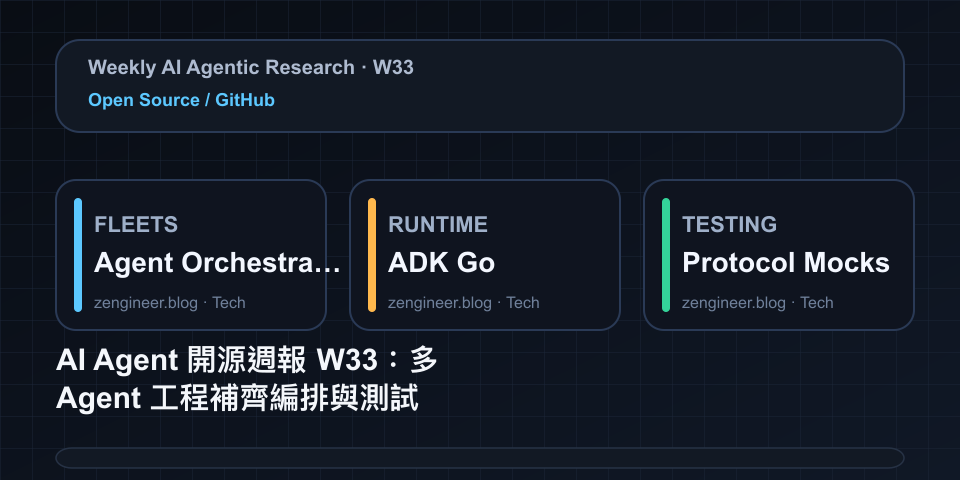
AI Agent Open-Source Weekly W33: Multi-Agent Engineering Adds Orchestration and Testing (agent-orchestrator, ADK Go, aimock)
This edition covers August 10–16, 2026 in Asia/Taipei. No single framework dominated W33. Instead, missing engineering layers appeared together: orchestration, a language runtime, virtual filesystems, and dependency mocks.
agent-orchestrator brings fleets into the IDE
Untrivial-ai/agent-orchestrator surfaced this week with task planning, coding-agent spawning, CI fixes, merge-conflict handling, and code review. It reflects a move from one chat window to task queues and agent fleets. Before adoption, inspect permission isolation, retry semantics, spend limits, and licensing; automated conflict resolution still needs tests and review policy.
ADK Go signals a production runtime
google/adk-go is a code-first Go toolkit spanning agent construction, evaluation, and deployment. Go matters less as a language preference than as a fit for long-lived services, concurrent tool calls, and existing observability stacks. Watch API stability, release cadence, cancellation, timeouts, and trace propagation.
Mirage and aimock productize test surfaces
strukto-ai/mirage proposes a unified virtual filesystem for agents. CopilotKit/aimock mocks LLM, MCP, A2A, AG-UI, vector-database, and search dependencies. Both target reproducibility: external services and state become controlled fixtures, allowing CI to cover failure paths instead of only happy-path demos.
These projects were selected from dated indexing and activity signals, not by misrepresenting current star counts as historical growth. Production review should still inspect commits, releases, issue responsiveness, contributors, and license.
Weekly take
The open agent stack is moving from “how to call a model” to “how to run many agents safely and reproduce failures.” The next maturity gate is cancellable, budgeted, mockable, and replayable execution.
Watchlist
- Isolation for concurrent writes, conflicts, and identities in agent-orchestrator.
- ADK Go compatibility, OpenTelemetry, and deployment examples.
- Mirage semantics for large repos, symlinks, permissions, and remote workspaces.
- aimock coverage for streaming, partial failure, and protocol-version drift.