AI Agent Open-Source Weekly W34: Harnesses Split into Plugins, Context, and Isolated Computers (DeepSeek Harness, Headroom, OpenBot)
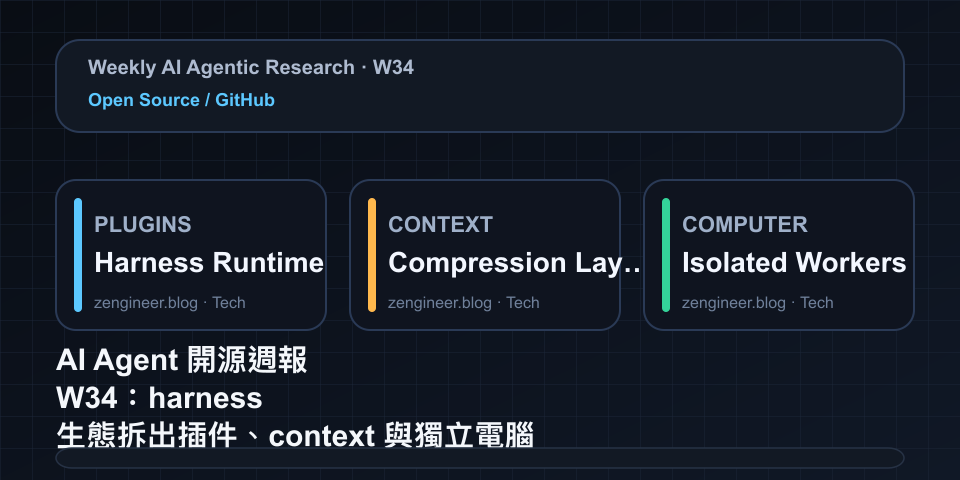
This edition covers August 17–23, 2026 in Asia/Taipei. The GitHub signal was not another monolithic agent framework. Harnesses are decomposing into plugin systems, a context data plane, and isolated execution environments.
DeepSeek Harness exposes runtime boundaries through rapid iteration
deepseek-ai/deepseek-harness continued heavy commit, discussion, and release-candidate activity during the week, with plugins and subagents driving interest. Active reports also cover silent tool-call termination, reconnect loss of pending waits, child-message ordering, and SDK reinitialization. These are not cosmetic bugs; they define durability, ordering, and authority in a long-running runtime. Early adopters should pin versions, isolate profiles, retain event logs, and avoid connecting a preview directly to privileged production systems.
Headroom turns context compression into a separate data layer
headroomlabs-ai/headroom entered this week's discovery surface on August 21. It compresses tool outputs, logs, files, and RAG chunks before the LLM, delivered as a library, proxy, and MCP server. Its claims—20% fewer tokens for coding agents and 60–95% for JSON—need workload-specific reruns, especially for schema, error detail, and security evidence. The larger signal is context engineering becoming an observable data plane rather than a prompt trick.
OpenBot gives each coworker an auditable computer
CopilotKit/OpenBot surfaced on August 23 with a computer, browser, files, and tools for each AI coworker, recording decisions before and actions after execution and accepting AG-UI agents. Isolation plus complete traces is a sound direction, but production evaluation must cover secrets, egress, snapshots, rollback, concurrency, and spend limits.
Thin harnesses and native desktop entry points
browser-use/macos-harness gives an LLM a deliberately thin path to Mac control, while egoist/waku aggregates coding agents in a native app. More entry points do not mean less risk: OS accessibility, shell, and file authority still need lower-layer sandbox and policy enforcement.
Selection uses repos created, committed, discussed, or indexed during the completed week. Point-in-time stars are a weak discovery signal, not a claimed weekly growth rate.
Watchlist
- DeepSeek Harness RC stability, event ordering, approval recovery, and a formal security policy.
- Headroom savings under fixed task success, latency, and evidence-retention constraints.
- OpenBot sandboxing, trace completeness, AG-UI interoperability, and license.
- Default credential, filesystem, and network permissions in macOS harnesses and Waku.