DPRK's $800M Month: Lazarus's April Rampage and DeFi's Trust Reset
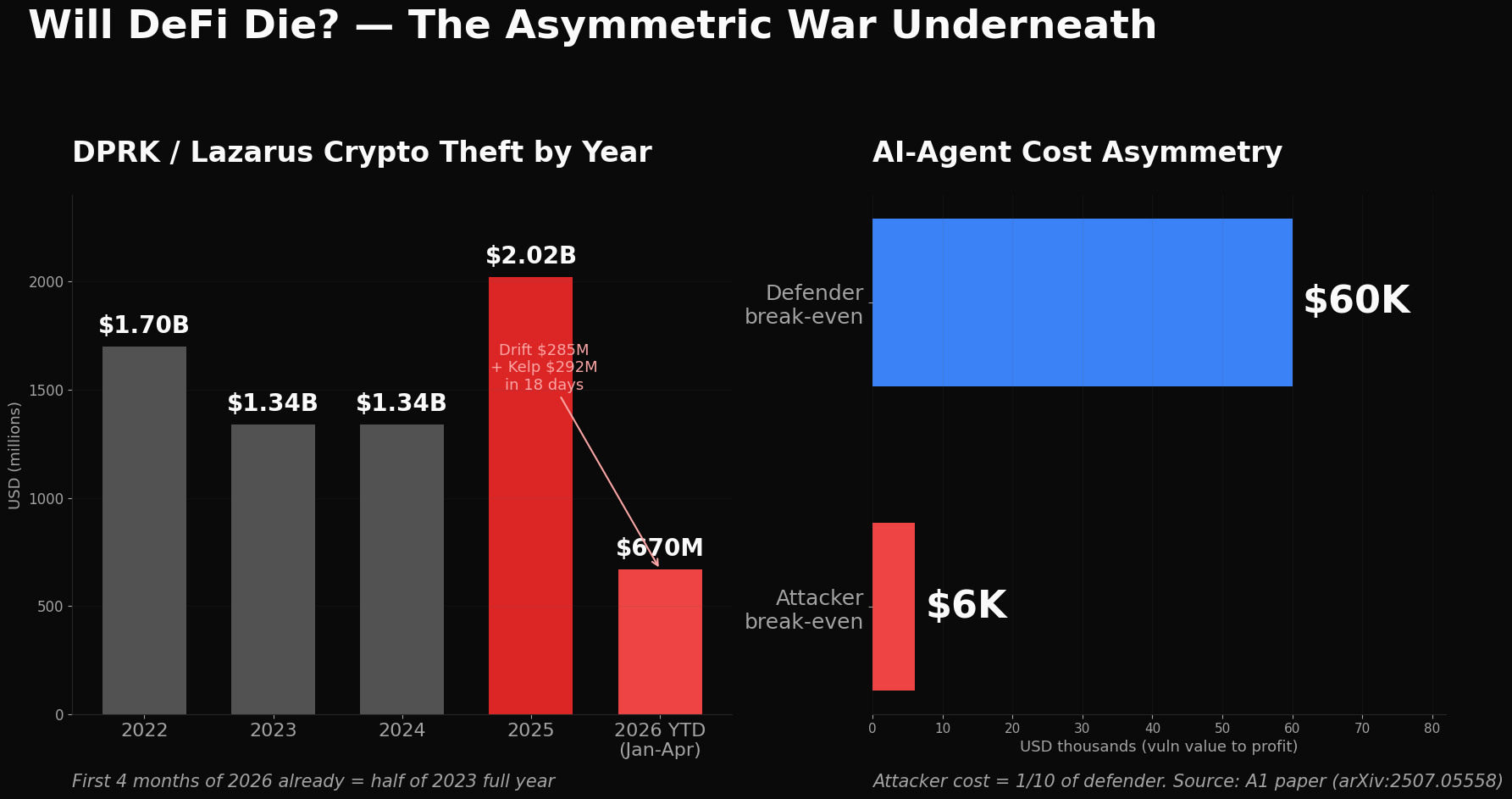
In the first 20 days of April 2026, DeFi lost $606 million.
Of that, $578M was one actor — UNC4736, a subgroup of North Korea's Lazarus Group — in two hits:
- April 1: Drift Protocol (Solana's largest perp DEX) lost $286M. Attack vector: pre-signed Solana durable nonces, waiting six months to execute.
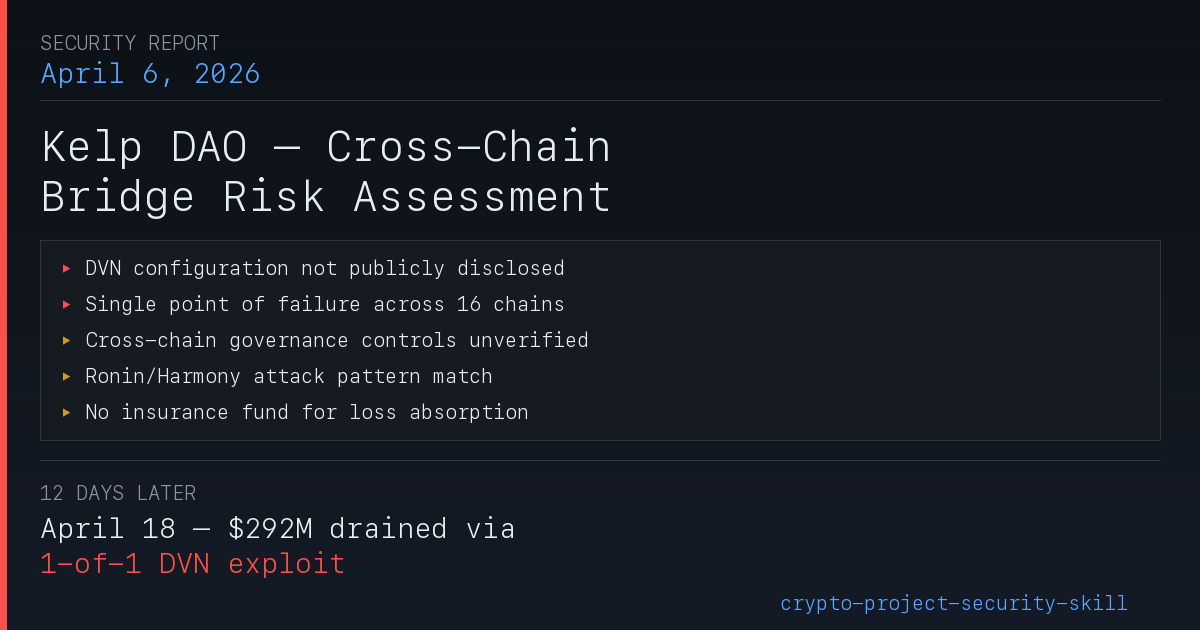
- April 18: Kelp DAO lost $292M (116,500 rsETH). Attack vector: LayerZero DVN RPC poisoning + DDoS forced a failover to tainted verifiers that signed a forged cross-chain message.
The worst DeFi month since the February 2025 Bybit heist. But the dollar number isn't the story. The story is that both attacks expose a DeFi trust stack that needs to be rebuilt.
1. Drift: Solana's "Durable Nonces" Became a Time Machine
This wasn't a smart-contract bug. Attackers had been infiltrating Drift's internal team since October 2025, using Lazarus's signature fake-recruiting playbook to compromise six insiders with signing authority.
The technical trick: Solana's durable nonces are a primitive designed for offline signing. A user can pre-sign a transaction that requires a specific nonce-account state to execute. That transaction can be broadcast at any time.
Lazarus weaponized it into a time machine.
After obtaining signatures, they didn't act immediately. They pre-signed a batch of transactions pointing at nonce states that wouldn't exist until six months later. Then they disappeared, wiped traces, waited for Drift's internal audits to expire, waited for Drift's signer rotations to happen — and broadcast when the time came.
12 minutes to drain the vaults.
The impact on the protocol security model is simple and brutal: every "is the signer compromised today?" check is meaningless. You can defend against today's attack. Durable nonces teleport it to six months from now. Every assumption about governance-key safety needs to be rewritten.
Drift got [232M of USDC had been moved out during the exploit window, and Circle is now facing a class action. Trust migrated from Circle to Tether.
2. Kelp vs LayerZero: Is the "Default Config" Responsible?
Kelp is more complex than Drift, because it forces the question nobody wants: when the industry's standard playbook is itself unsafe, who takes the loss?
Kelp's cross-chain messaging ran on LayerZero V2. Each message passes through a DVN (Decentralized Verifier Network). Kelp's configuration used 1-of-1 DVN — a single verifier declares the message valid, and the message passes.
Lazarus's sequence:
- Poison the primary RPC node of that DVN, via social engineering into the node operator's internal network.
- DDoS the DVN's health-check endpoint, triggering LayerZero's failover.
- Failover lands on a backup node — also pre-poisoned.
- Send a forged cross-chain message: "withdraw 116,500 rsETH from the Kelp vault." It passes verification.
- Kelp's vault contract on Arbitrum sees a "valid" message and executes. Funds gone.
No smart-contract vulnerability. Every step was within LayerZero V2 spec.
The dispute:
- LayerZero: Kelp chose a high-risk config (1-of-1). Not the default's fault.
- Kelp: 1-of-1 is what LayerZero documented as the default deployment.
Both are right. And $292M vanished from a system where everyone followed the spec.
The second-order consequence is bigger: Arbitrum's Security Council froze 30,766 ETH (~$71M). First time Arbitrum has invoked its emergency freeze power.
"Can an L2 freeze assets" used to be theoretical. Now it's happened — on the side of the good guys. The next question writes itself: when the frozen address belongs to a political dissident, a sanctioned user, or an on-chain privacy payment — who defines "legitimate freeze"?
3. Where the DeFi Trust Stack Actually Broke
Drift and Kelp look like separate incidents. They're the same problem.
The DeFi trust stack assumes "attacks happen now, in contracts, and we only need to defend contract bugs."
- Drift proves: an attack can come from signatures six months old. No contract bug required.
- Kelp proves: an attack can bypass the contract layer entirely by poisoning off-chain infra. Contracts execute to spec, money still leaves.
Audits don't fix this. Audits look at "does this contract have bugs today." They don't look at "were these signers socially engineered six months ago," or "has your DVN's backup RPC operator's internal network been phished."
The chain reaction is already visible: Aave lost $8B TVL in the fallout. Not because Aave broke — because the re-staking narrative wobbled. When rsETH → EigenLayer → 20-chain matryoshka has one bridge fail, everyone hits the exit at once. The first real systemic stress test of re-staking.
4. How to Scale a DeFi That No Longer Assumes "Contract ≈ Security"
Three threads from April:
1. Signature lifecycle management, not one-shot checks.
Drift shows that treating signatures as static pass/fail credentials is over. The next generation of DeFi protocols needs to treat signatures as objects with a lifecycle — creation time, expiration, revocation, on-chain audit. Solana durable nonces themselves aren't the problem; the protocol layer needs a "nonce age + signer rotation" double-check. Solana needs infrastructure around this.
2. Multi-DVN should be the default.
1-of-1 DVN has no business being anyone's default. LayerZero has visibly shifted toward 3-of-5 and 5-of-7 defaults after April 21. But the real fix is cross-chain verification that uses fundamentally different trust assumptions — optical verification, ZK proofs, fraud proofs — not bigger committees.
3. Agent-native payment rails (x402 Foundation).
The ironic counterpoint: in the same month Lazarus tore up DeFi, Coinbase's x402 protocol went live at Agent.market, with a foundation backed by Visa, Mastercard, Google, AWS, Circle, Stripe, Solana Foundation. x402 is effectively bypassing the traditional DeFi trust stack by combining TradFi prudence + stablecoin settlement + AI-agent-native payment — rebuilding machine-to-machine finance on new assumptions.
On how the agent economy puts finance onto stablecoins, I wrote Why DeFi Will Die in the AI Agent Era. Reading April: DeFi doesn't die. DeFi's trust stack gets rewritten by the infrastructure the agent era requires.
Closing
Drift's durable nonces, Kelp's DVN default, Arbitrum's emergency freeze, Circle's trust collapse, Aave's systemic drain — these aren't five separate events. They're a continuous stress test: DeFi's trust stack is fragile against 2026's attack surface.
The winners of this cycle won't be "the most decentralized protocol" or "the one with the most audits." They'll be the protocols that honestly face where their trust stack is breaking and rebuild with new primitives.
x402, ZK-verified bridges, signature-lifecycle management — these three paths are competing to define DeFi security for the next five years. April is just an expensive, painful starting gun.
For related analysis on zengineer.blog: The Most Dangerous Protocols list (2026-04-21) and Tether as DeFi's De Facto Central Bank.
References
- $606M April nightmare — Crypto Times
- Drift $285M DPRK attribution — The Hacker News
- Drift Protocol Elliptic breakdown
- Drift rescue + USDT settlement — CoinDesk
- $292M Kelp exploit — CoinDesk
- Kelp vs LayerZero blame fight — CoinDesk
- Arbitrum freezes $71M ETH — CoinDesk
- Tether freezes $344M USDT on Tron — CoinDesk
- Coinbase x402 Agent.market — CryptoNews
- x402 Agentic.market launch — Invezz
- Tether vs USDC post-hack — Decrypt
- Kraken IPO filing at $13.3B — BeInCrypto