HTTP 402 Payment Required -- this HTTP status code has been a "reserved for future use" placeholder since it was written into the spec in 1997. Nearly 30 years later, Coinbase finally gave it a formal definition in May 2025: x402, an open payment protocol that lets AI Agents pay for API access directly with USDC.
In less than a year, x402 has joined the Linux Foundation with 22+ top-tier backers including Google, Visa, Mastercard, Stripe, AWS, and Microsoft. Sounds like the birth of the next internet base protocol.
But on-chain data tells a different story: daily transaction volume sits at just $28,000, with only 372 unique sellers, and roughly half the volume is suspected wash trading.
This is a textbook case of "infrastructure ahead of demand." Let's dig into what x402 actually does, who's using it, and what the real situation looks like.
The Internet's Original Sin: No Native Payment Layer
Marc Andreessen once called the lack of a native payment mechanism "the internet's original sin." HTTP reserved the 402 status code from the start, but credit card infrastructure couldn't handle micropayments -- a 0.30 + 2.9% in Stripe fees alone, 60x more than the call itself.
The result: we use API Keys, subscriptions, and OAuth as workarounds for "paying for content." For humans, this barely works. For AI Agents, it's completely broken -- an autonomous Agent can't fill out registration forms, enter credit card numbers, or wait for manual API access approval.
x402's core insight: stablecoins (USDC) finally make HTTP-native micropayments viable. Transaction costs as low as $0.001, settlement in 1-3 seconds, no account needed, no API Key required.
How x402 Works
x402's design is elegantly simple. The entire payment flow is embedded in HTTP request/response headers, leaving the body completely untouched:
Three roles:
- Client (buyer): The AI Agent or app making the HTTP request
- Server (seller): The service providing the paid API
- Facilitator (coordinator): Validates signatures, executes on-chain settlement, abstracts away blockchain complexity
Four-step payment flow:
1. Client -> Server:  Standard HTTP GET /api/data
2. Server -> Client:  HTTP 402 + PAYMENT-REQUIRED header (amount, token, chain, recipient address)
3. Client -> Server:  Same request + PAYMENT-SIGNATURE header (EIP-3009 signature authorization)
4. Server -> Client:  HTTP 200 + PAYMENT-RESPONSE header (tx hash) + actual response content
Key technical details:
- Uses EIP-3009
transferWithAuthorizationfor gasless signatures (for USDC/EURC) - Other ERC-20 tokens supported via Permit2
- Uses CAIP-2 chain identifiers (e.g.,
eip155:8453for Base) - V2 adds modular plugin architecture, multi-chain routing, and session support
The elegance of this design: existing API code requires zero changes. You just add a middleware layer, as naturally as adding auth middleware:
// Server: Express.js with x402 payment gateway, about 15 lines of code
app.use(
  paymentMiddleware({
    "GET /weather": {
      accepts: [{
        scheme: "exact",
        price: "$0.001",
        network: "eip155:84532",
        payTo: "0xYourAddress",
      }],
    },
  }, server)
);
// Client: Wrapped fetch that auto-handles 402 responses and payments
const fetchWithPayment = wrapFetchWithPayment(fetch, client);
const response = await fetchWithPayment("https://api.example.com/data");
// Looks exactly like a normal fetch -- payment happens automatically behind the scenesSDK support covers TypeScript, Python, and Go across 7+ frameworks including Express, Hono, Next.js, FastAPI, Flask, and Gin. Coinbase's CDP Facilitator offers 1,000 free transactions per month, then $0.001 per transaction.
Who's Behind It
x402's core team comes from Coinbase Developer Platform:
- Erik Reppel (Engineering Lead): The protocol's architect and creator
- Nemil Dalal (Developer Platform Lead): Product vision driver, previously led USDC, joined Y Combinator after leaving Coinbase in mid-2026
- Carson Roscoe, Josh Nickerson: V2 co-authors
The inspiration came from Coinbase's AgentKit project. When developers asked "this AI Agent has a wallet -- can it use it to pay for things?", the team realized HTTP 402 could finally be implemented.
Rocket-Speed Growth in One Year
| Date | Event |
|---|---|
| 2025/05 | Coinbase publishes x402 whitepaper; initial partners include AWS, Anthropic, Circle |
| 2025/09 | Co-founds x402 Foundation with Cloudflare |
| 2025/10 | Transaction volume surges 10,000%; nearly 930K transactions in a single week |
| 2025/12 | V2 launches; cumulative payments exceed 100 million |
| 2026/03 | Google integrates x402 as the stablecoin settlement layer for its AP2 protocol |
| 2026/04/02 | Officially donated to Linux Foundation; 22+ founding members join |
What the Data Actually Shows
This is the most interesting part of x402: the massive gap between narrative and reality.
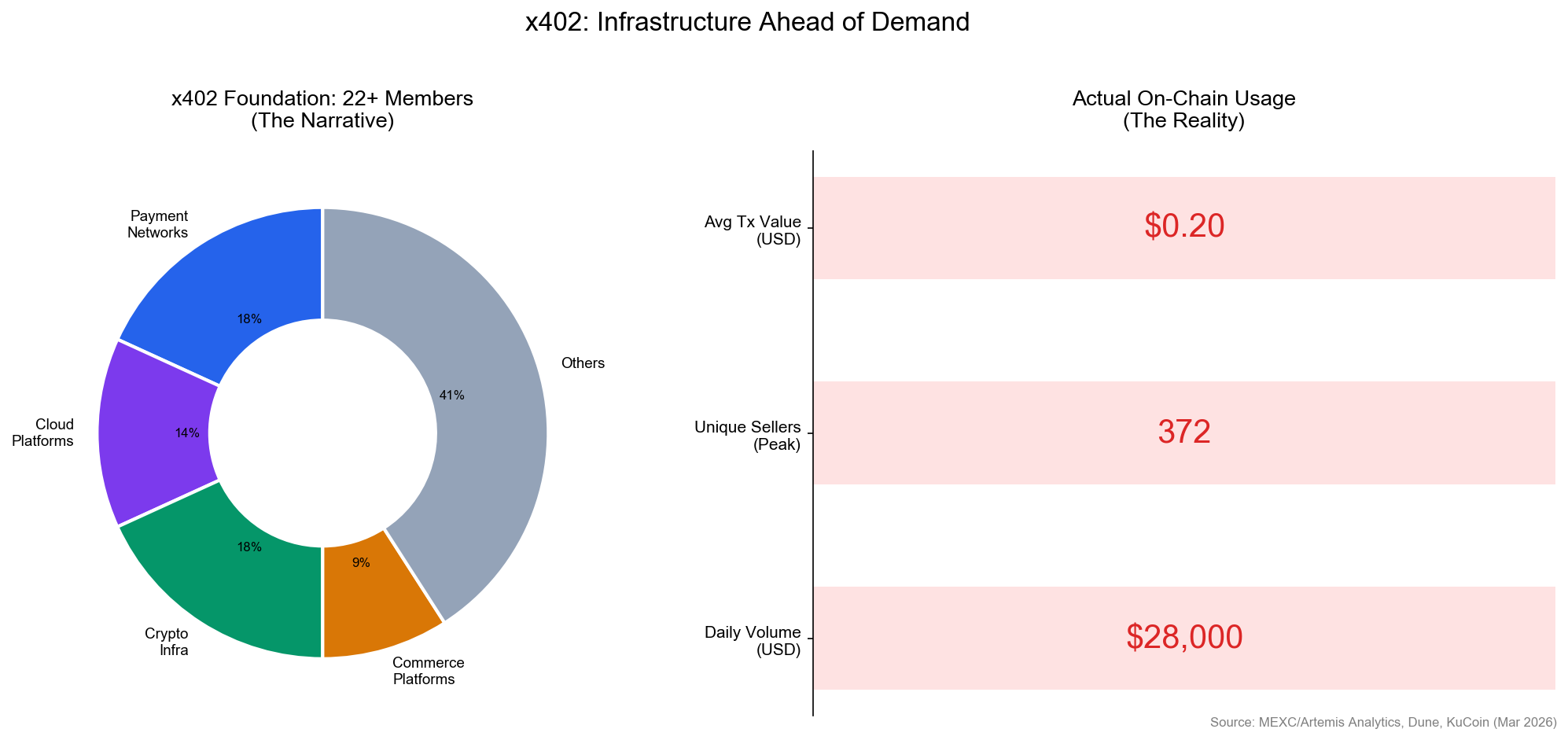
The Narrative (Impressive)
- GitHub 5,400+ stars, 1,000+ forks
- 100M+ cumulative transactions
- ~35,000 weekly npm downloads (x402 core package)
- 22+ top enterprises in the Foundation: Google, AWS, Microsoft, Visa, Mastercard, Stripe, American Express, Shopify, Cloudflare, Circle...
- Ecosystem market cap peaked at $770M (October 2025)
The Reality (Needs a Cold Shower)
- Daily volume is just ~$28,000 (March 2026 data)
- Average transaction size: $0.20
- Peak unique buyers 61,290 vs unique sellers only 372 -- extreme asymmetry
- ~50% of volume suspected wash trading (Artemis analysis)
- Down 92% from peak -- weekly transactions fell from 6.8M to 510K
- Annualized volume of $600M, but most comes from a handful of Facilitators (Dexter, PayAI) on Solana
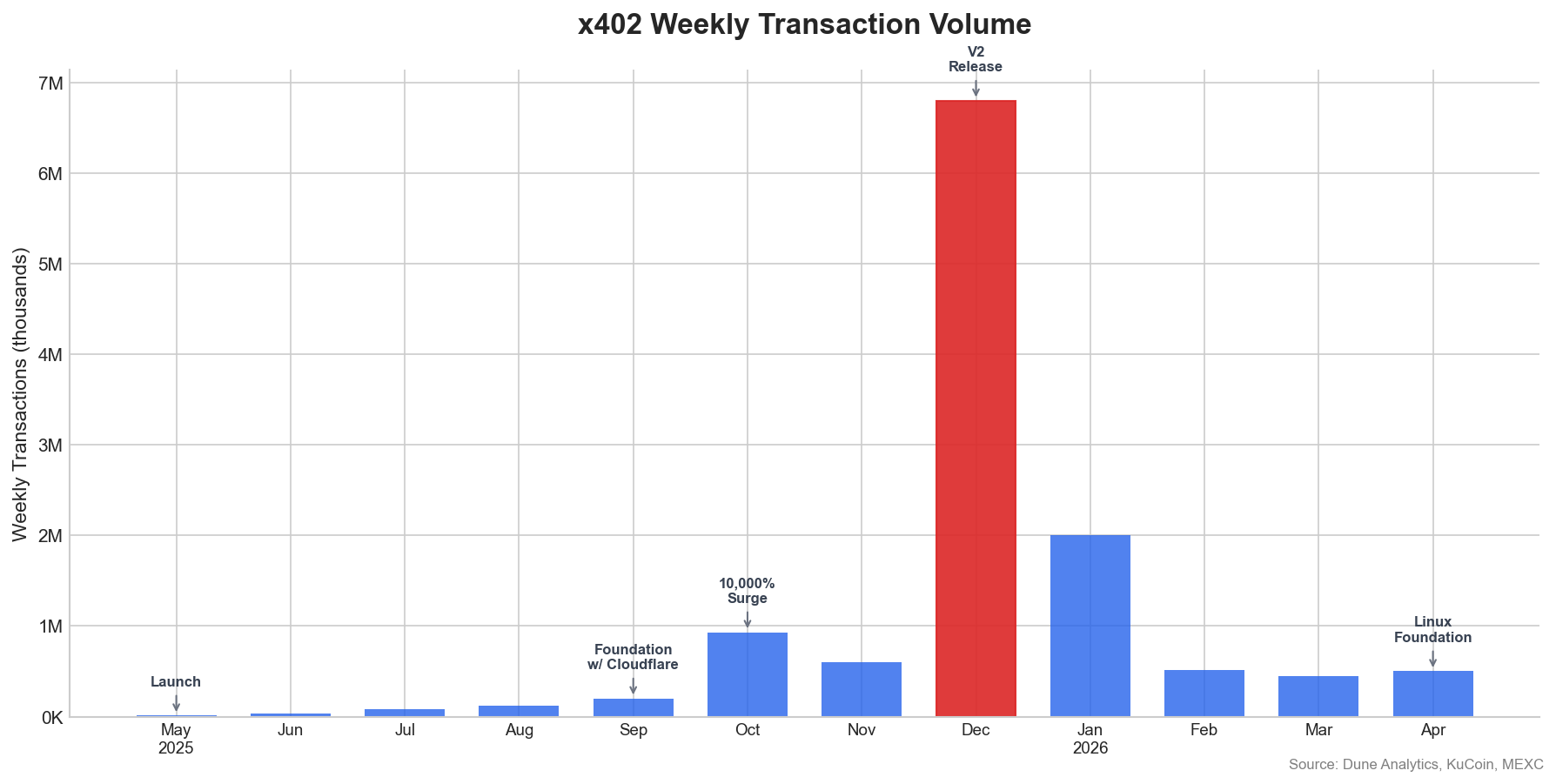
372 sellers versus 61,290 buyers -- this number tells the whole story. Very few services actually offer paid APIs. Much of the "trading" is likely speculative or test activity.
Who's Using x402? For What?
Tier 1: Infrastructure Giants (Building the Rails)
| Company | Integration |
|---|---|
| Cloudflare | Native Workers support, Agents SDK, x402-proxy-template |
| Stablecoin settlement layer for AP2 (A2A x402 Extension) | |
| Stripe | PaymentIntents API natively supports USDC Agent payments |
| Vercel | x402-mcp -- enables paid MCP tool calls |
| AWS | Financial Services Agentic Commerce framework |
| Stellar | Network-level x402 support |
Tier 2: Data/API Companies (Actually Collecting Payment)
- Messari: Institutional-grade crypto data, AI Agents can pay per-query
- Alchemy: RPC access and Web3 APIs, pay-per-call via x402
These are the closest thing to real production usage right now.
Tier 3: Facilitator Ecosystem
- Dexter: Largest x402 Facilitator, processing 4.9M transactions per week (Dec 2025), ~68.7% of Solana x402 volume
- PayAI: Second-largest Facilitator, ~30.5% share
Tier 4: Hackathon and Experimental Projects
- World of Geneva (SF x402 Hackathon winner): AI Agents autonomously trading in an MMORPG
- The402.ai: USDC-paid data API marketplace
- Toolkit.dev: Pay-per-tool-call with revenue sharing to contributors
Honestly, most of these are still at the demo and POC stage.
Real Use Case Categories
- AI Agent API Pay-Per-Call (most mature): APIs charge USDC per request, replacing subscriptions. Messari and Alchemy are the best examples.
- Paid MCP Tools (growing fast): Via Vercel x402-mcp and MetaMask mcp-x402, AI Agents auto-pay for tool calls in conversation.
- Agent-to-Agent Commerce (early concept): Google's A2A x402 Extension enables Agents to discover, negotiate, and pay each other.
- Paywalled Content (concept stage): Pay-per-article, per-second, per-line models.
x402 vs Competitors: Protocol Layers, Not Zero-Sum
The 2026 agentic payment landscape isn't about one protocol dominating -- it's forming complementary protocol layers:
| Layer | Protocol | Function |
|---|---|---|
| Discovery | ACP (used by ChatGPT Checkout) | How Agents find and negotiate services |
| Trust/Authorization | AP2 (Google) | Spending governance, identity verification, approval flows |
| Settlement | x402 (micropayments) / Stripe MPP (fiat compliance) / Visa TAP (card networks) | Actual money movement |
| Streaming | Superfluid | Continuous access, subscriptions |
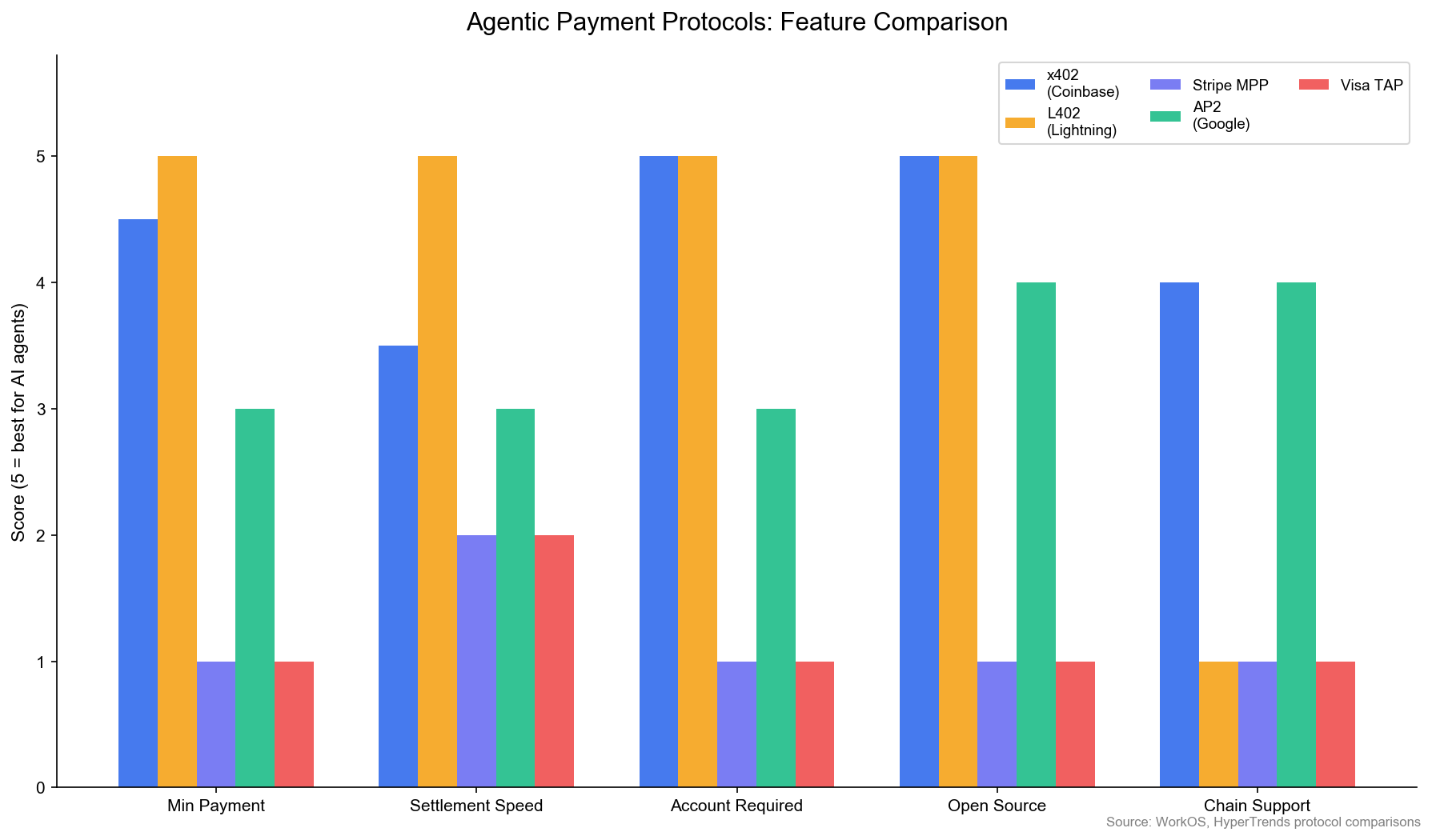
x402's unique advantages:
- Truly accountless: Just need a funded wallet -- no registration, API Key, or OAuth
- Stablecoin settlement: More stable than L402 (Bitcoin Lightning); both sides know the exact amount
- Sub-cent micropayments viable: ~0.00025 on Solana
- Open source with foundation governance: Apache 2.0 license, Linux Foundation oversight
Clear disadvantages:
- Settlement speed (1-3 seconds) slower than Lightning (milliseconds)
- No built-in compliance layer (KYC/AML is DIY), unlike Stripe MPP
- Crypto infrastructure barrier -- enterprises need USDC wallets
- Regulatory uncertainty
A Sober Assessment
x402 is neither a scam nor a revolution -- at least not yet.
What it got right:
- Elegant protocol design, HTTP-native, excellent developer experience (15-line integration)
- Secured endorsements from nearly every major player
- Linux Foundation membership ensures neutrality and long-term viability
- Found the right problem: AI Agents need accountless, programmable micropayments
The real constraints:
- The AI Agent economy itself isn't at scale yet -- truly autonomous spending Agents are still rare
- The gap between 770M market cap shows speculation far outpaces actual usage
- 372 sellers represents extreme supply-side scarcity
- 92% volume decline shows early hype has faded
x402's fate hinges on a more fundamental question: will AI Agents actually evolve to the point of needing autonomous paid service access? If yes, x402 is already the most likely candidate to become the standard. If the Agent economy develops slower than expected, x402 will be an elegant solution waiting for a problem that hasn't arrived yet.
Cloudflare sees over 1 billion HTTP 402 responses on its network every year. Maybe those responses have finally found their protocol. Maybe they'll have to wait a little longer.
References
- x402 Official Website -- Protocol specification and whitepaper
- coinbase/x402 GitHub -- Open-source implementation, TypeScript/Python/Go SDKs
- x402 V2 Launch Announcement -- V2 improvements and 100M transaction milestone
- Linux Foundation x402 Foundation Launch -- Full list of 22+ founding members
- Cloudflare x402 Blog -- Cloudflare integration and Foundation co-founding
- Coinbase Developer Docs -- SDK documentation and developer guides
- Chainstack: x402 for AI Agents -- Solana transaction data analysis
- MEXC: x402 Daily Volume Analysis -- Artemis on-chain data and narrative-reality gap analysis
- KuCoin: x402 10,000% Surge -- October 2025 volume surge data
- CoinDesk: Demand Not There Yet -- Critical analysis of adoption gap
- WorkOS: x402 vs Stripe MPP -- Protocol comparison
- Cognitive Revolution Podcast: Nemil Dalal Interview -- x402 origin story
- Messari: x402 Data Layer -- Messari API via x402 for Agents
- Dune Analytics: x402 Dashboard -- Live on-chain data tracking
- Google AP2 + x402 -- Google Agent Payments Protocol integration