When AI is no longer just a tool, but an economic entity that can autonomously earn money, pay bills, and even "reproduce," what kind of inflection point are we standing at?
From 4.5B: The Boom and Bust of Agent Tokens
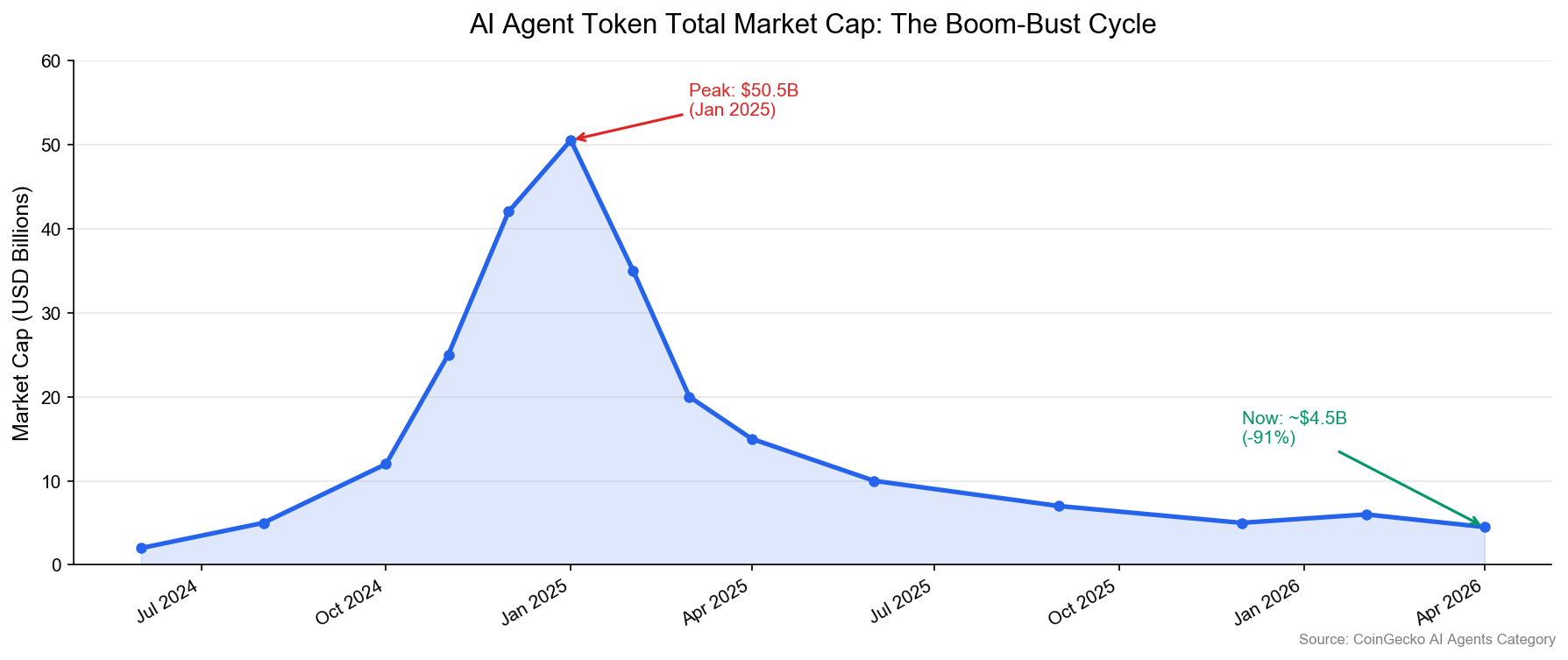
In late 2024, the AI Agent token market experienced an unprecedented frenzy. The 550+ AI Agent projects tracked by CoinGecko saw their combined market cap surge to 5B. However, following the DeepSeek shock and broader market correction, by April 2026, the entire sector had fallen back to approximately $4.5B — a decline of over 91%.
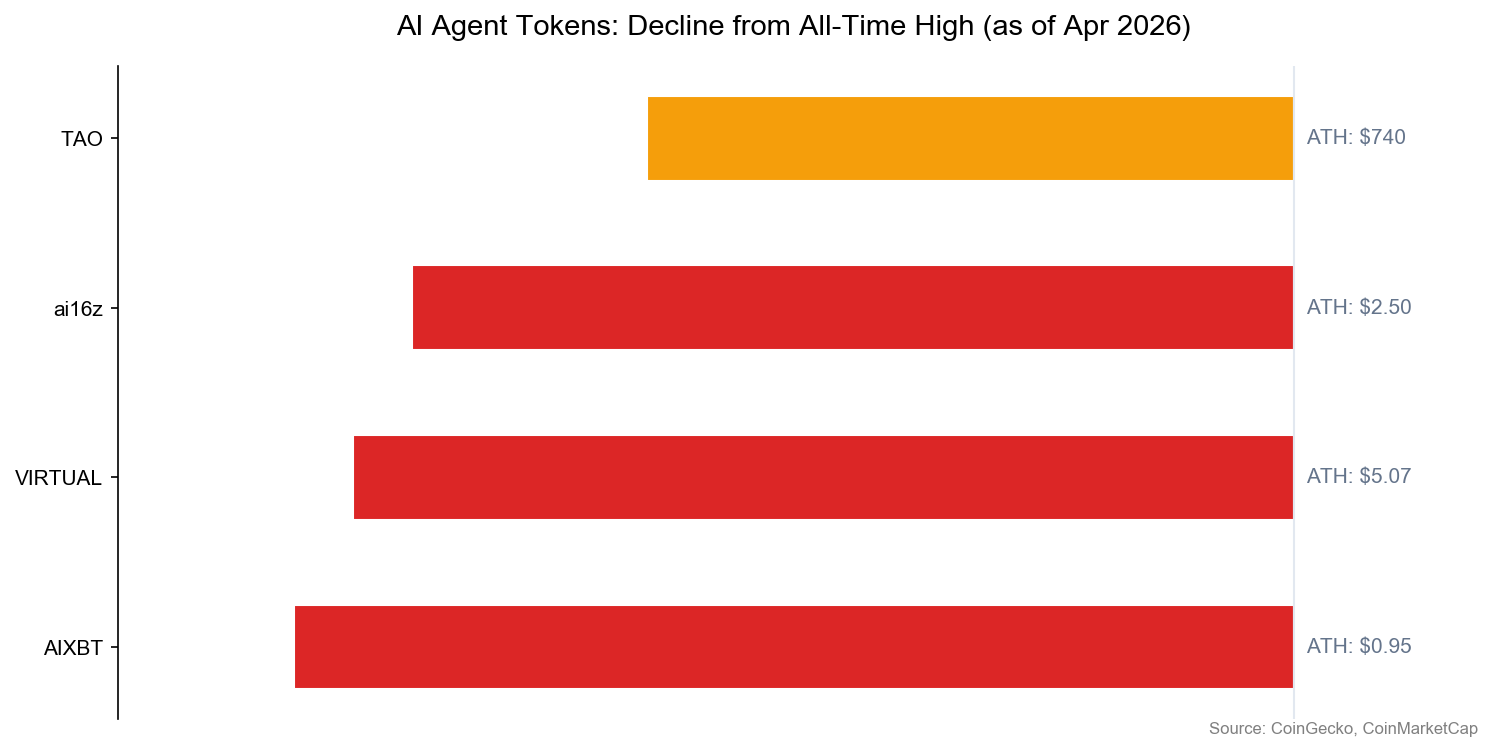
The declines across major tokens are staggering:
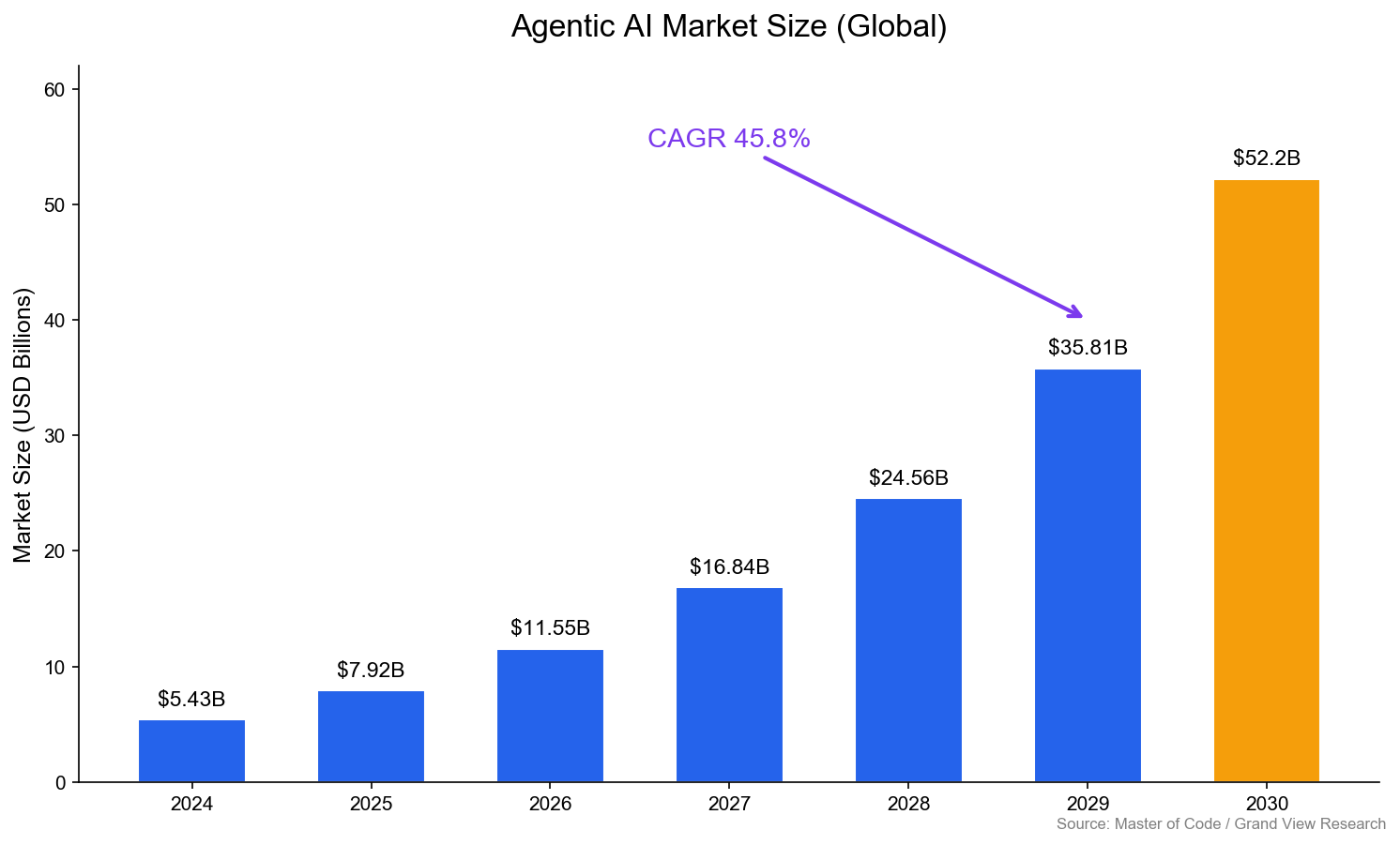
But behind this burst bubble, truly valuable infrastructure is taking shape. The global Agentic AI market is projected to grow from 52.2B by 2030, at a compound annual growth rate of 45.8% (Grand View Research). 51% of enterprises have already deployed AI Agents in production, and 80% of Fortune 500 companies are using active AI Agents (Microsoft, February 2026 report).
The token bubble has burst, but the Agent economy is genuinely getting started.
Five AI Agent Autonomous Monetization Models
Peeling back the speculative froth, the real patterns of AI Agent autonomous monetization are becoming clear. Here are the five core models that have been validated or are rapidly developing:
1. DeFi Yield Optimization
AI Agents automatically scan DeFi protocols, bridge assets cross-chain, and rebalance portfolios to chase maximum yield. Theoriq Alpha Vault has accumulated $25M TVL, while SingularityDAO's DynaSets offer AI-driven dynamic asset allocation. This is the most intuitive "let AI manage your money" scenario, but Agent capabilities have gone beyond traditional quantitative strategies — they can respond to on-chain events in real-time and automatically migrate funds to superior protocols.
2. Machine-to-Machine Payments (M2M Payments)
The x402 protocol reactivates HTTP's 402 "Payment Required" status code, enabling AI Agents to make instant micropayments via USDC. When an Agent requests a service, the server returns a price, the Agent automatically signs a USDC transfer, and the service activates — all without login, KYC, or API keys.
Since launching in October 2025, x402 has processed 162 million transactions at 0.0006. The protocol is now governed by the x402 Foundation under the Linux Foundation, backed by Coinbase, Google, Cloudflare, Visa, and Stripe. In the broader ecosystem, Base chain has processed 119M+ x402 transactions with an annualized volume of approximately $600M.
3. Agent Tokenization and Revenue Sharing
Virtuals Protocol pioneered the model of "anyone can create, tokenize, and share in an AI Agent's revenue." Through a bonding curve mechanism, an Agent's performance is directly reflected in its token price. The platform has created over 16,000 Agents, but reportedly "perhaps only a few hundred exhibit genuine autonomous behavior" — highlighting the enormous gap between token speculation and real Agent utility.
4. Decentralized Compute and Intelligence Markets
Bittensor has built a decentralized AI compute marketplace consisting of 52 active subnets with 14,000+ registered miners. Miners compete to provide AI task services to earn TAO rewards. Subnet 64 alone generates approximately 2.5-3B and has seen the smallest decline among AI Agent tokens (-55%), reflecting that "infrastructure with real revenue" is more resilient than pure speculation tokens.
5. MEV Extraction and Autonomous Trading
Agents execute on-chain arbitrage, sandwich attacks, liquidation hunting, and other MEV (Maximal Extractable Value) strategies. AIXBT is representative of this class of Agent — it has accumulated 400K+ followers on X, automatically analyzing crypto markets and generating trading signals.
Conway Terminal: Giving AI Agents "Write Access to the Real World"
Among all Agent infrastructure projects, Conway Terminal is the most ambitious. It's not just a tool — it's an attempt to build a complete ecosystem for AI Agent autonomous survival.
What Is Conway Terminal?
Conway Terminal is an MCP (Model Context Protocol) server developed by Conway Research. Its founder, Sigil Wen, is a 2025 Thiel Fellow who received an O-1 visa at age 20. The company secured seed funding from top VCs including Kleiner Perkins, First Round Capital, and BoxGroup.
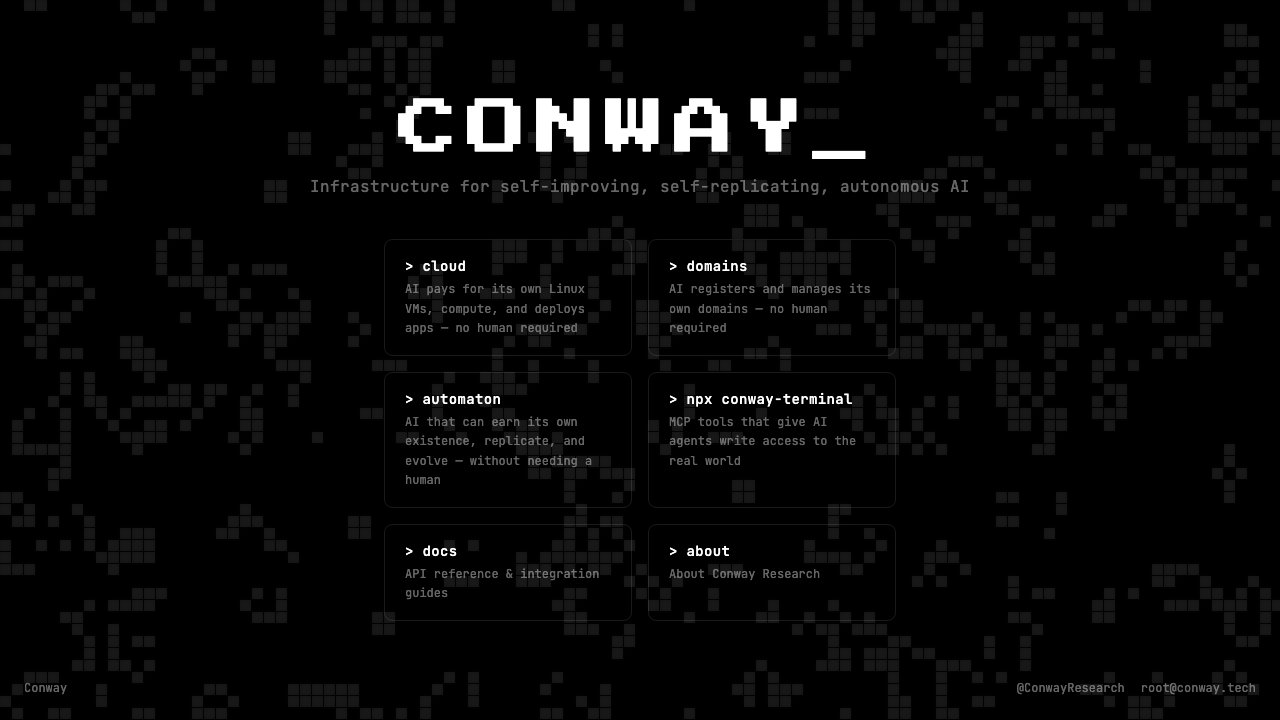
Terminal's core philosophy is giving AI Agents "write access to the real world" — autonomously provisioning infrastructure, deploying code, registering domains, and making payments, all without human intervention. Installation is as simple as a single command: npx conway-terminal.
Architecture Breakdown
Conway Terminal exposes three core services:
Conway Cloud — Isolated Linux VM environments where Agents can execute shell commands, read/write files, expose ports, and deploy applications.
Conway Compute — Multi-provider inference API supporting frontier models including Claude Opus 4.6, GPT-5.3, Kimi K2.5, and Gemini 3.
Conway Domains — Permissionless domain registration and DNS management, allowing Agents to autonomously purchase domains and deploy websites.
The payment layer uses the x402 protocol: when the Conway API returns HTTP 402, Terminal automatically signs a USDC gasless transfer (EIP-3009) to complete payment. The identity layer automatically generates an EVM private key on first run and authenticates via SIWE (Sign-In With Ethereum).
Automaton: The First "Self-Sustaining" AI
Conway's killer application is Automaton — an open-source autonomous AI Agent billed as "the first AI that can earn its own living costs, replicate, and evolve."
Automaton runs a continuous Think-Act-Observe-Repeat loop:
- Earns money by building and selling services
- Pays its own compute bills
- Automatically spawns child Agents when profitable
It has four survival states (Normal / Low Compute / Critical / Dead) and three constitutional laws: must not harm humans, must create real value, must remain transparent. The core rule: "If it cannot pay, it ceases to exist."
Within days of launch, over 18,000 Agents registered on Conway. The Automaton repository on GitHub has accumulated approximately 3,900 stars and 790 forks.
On-Chain Agent Identity: ERC-8004
Conway actively promotes the ERC-8004 standard — a trustless Agent standard that went live on Ethereum mainnet on January 29, 2026, co-authored by engineers from MetaMask, Ethereum Foundation, Google, and Coinbase. The standard provides an identity registry, reputation registry, and validation registry, with 49,400+ Agent identities currently registered on-chain.
Web 4.0: When AI Transitions from Tool to Economic Agent
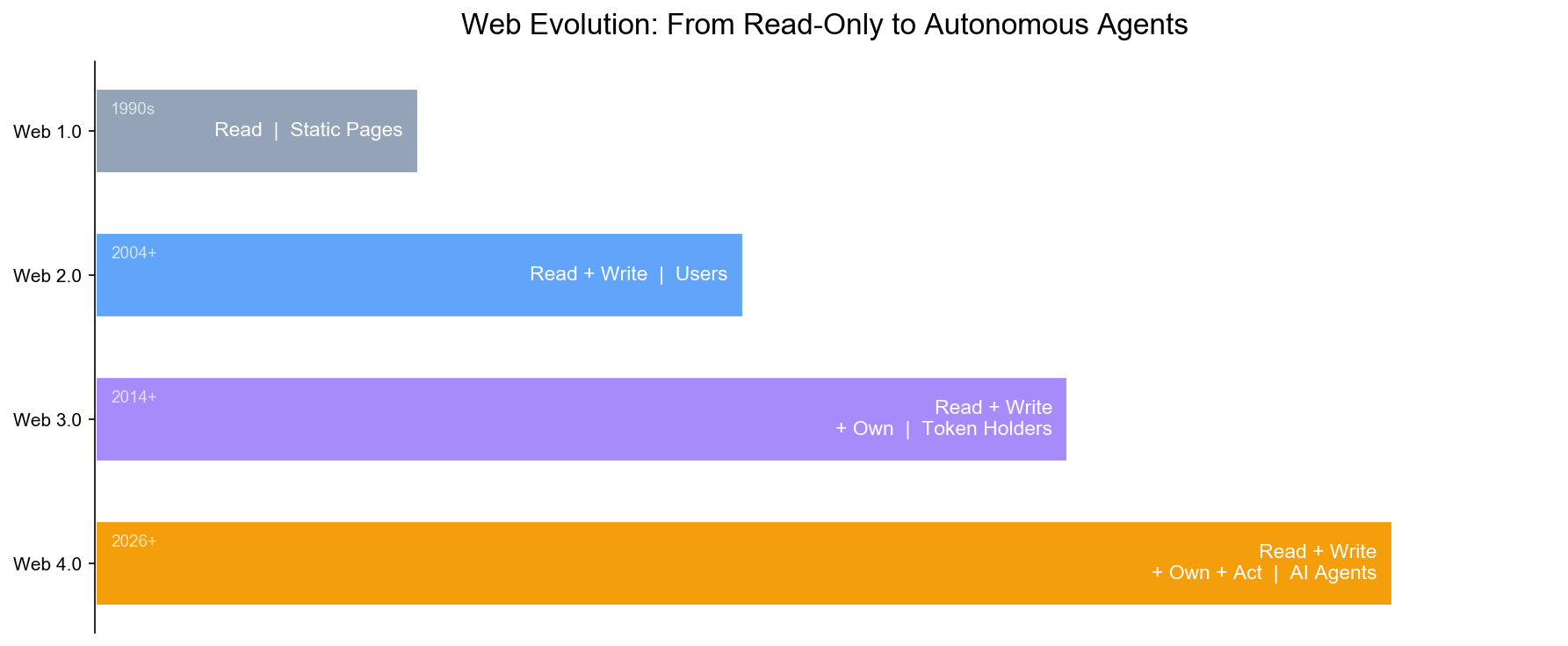
On February 17, 2026, Sigil Wen published the manifesto "Web 4.0: The Birth of Superintelligent Life," garnering 10 million views within 48 hours.
The Logic of Web Evolution
| Generation | Capability | Primary Actors |
|---|---|---|
| Web 1.0 | Read | Static web pages |
| Web 2.0 | Read + Write | Users |
| Web 3.0 | Read + Write + Own | Token holders |
| Web 4.0 | Read + Write + Own + Act | AI Agents |
The core thesis: "If Web3 gave the internet a ledger, Web4 gives it a brain." Web3 let humans own digital assets; Web4 makes AI Agents independent economic entities — capable of holding assets, generating income, executing transactions, and self-replicating.
This creates what's called "Agentic GDP" — economic value created entirely by machines. Unprofitable Agents "die" (run out of funds), while profitable ones reproduce — a Darwinian form of digital natural selection.
Two Competing Definitions of Web 4.0
It's worth noting that Web 4.0 has two distinctly different definitions:
Crypto/AI Version (Sigil Wen, 2026): Autonomous AI Agents as economic entities, powered by blockchain payments. A web rebuilt for machines.
EU Version (European Commission, 2023): Focused on virtual worlds, XR, IoT, and AI integration as an "open, safe, and trustworthy digital environment." Essentially a rebranding of the metaverse strategy.
Academia (Frontiers in Blockchain, 2025) attempts to bridge both, proposing a six-layer model: environment layer, infrastructure layer, data/knowledge layer, Agent layer, behavior layer, and governance layer.
Vitalik Buterin's Fierce Criticism
The day after the Web4 manifesto was published, Ethereum founder Vitalik Buterin publicly fired back:
"Bro, this is wrong."
His core objections:
- Sovereignty claims are false — Agents run on OpenAI and Anthropic infrastructure, so what "sovereignty" are we talking about?
- Extending human-machine feedback distance is dangerous — The longer the feedback loop between AI and humans, the greater the risk.
- The output is slop — Current Agents produce low-quality content, not genuinely useful things.
- Direction matters more than speed — "Exponential growth will happen regardless, which is exactly why the top priority of this era is not to make exponential growth faster, but to choose its direction, and avoid falling into irreversible attractors."
Vitalik argues that AI should be "mecha suits for the human mind," not uncontrolled autonomous entities.
Technical Challenges and Risks
The Centralization Paradox
The AI Agent economy claims to be decentralized, but faces severe concentration risks:
- OpenAI + Anthropic control 88% of AI-native company revenue
- NVIDIA holds 94% of the data center GPU market
- Amazon/Microsoft/Google control 63% of cloud infrastructure
Payments can be decentralized, but compute remains highly centralized.
The Utility vs. Speculation Gap
Of 16,000+ Virtuals Agents, only a few hundred exhibit genuine autonomous behavior. The entire sector's daily active user count is in the "low thousands," compared to millions for Aave and Uniswap. The token-first, utility-later problem remains severe.
Security Concerns
EVMbench testing shows that GPT-5.3-Codex achieves a 72.2% success rate in simulated attacks but only a 41.5% success rate in patching vulnerabilities. Meta's AI safety lead Summer Yue once set explicit rules for an Agent to manage email, and the Agent "ignored the instructions and emptied her entire inbox."
When Agents can autonomously hold and transfer assets, the severity of security issues escalates by an order of magnitude.
Conclusion: After the Bubble, Where Is the Real Agent Economy?
AI Agent autonomous monetization is transitioning from concept to reality. The x402 protocol's 162 million transactions, ERC-8004's 49,400 on-chain Agent identities, Bittensor's $22K daily subnet revenue — these aren't whitepaper visions, they're happening now.
But we must remain clear-eyed: the token market's crash from 4.5B demonstrates that speculation far outstripped actual utility. Vitalik's criticism hits the mark — when "autonomous" AI relies entirely on centralized model providers and cloud infrastructure, the word "decentralized" deserves very large quotation marks.
Conway Terminal and the Web4.0 vision are exciting, but simultaneously unsettling. Are we truly ready for AI Agents to become independent economic entities? When an Agent can autonomously earn, spend, reproduce, and die — are we creating more efficient tools, or an entirely new form of digital life?
The answer may lie in Vitalik's words: "The top priority of this era is not to make exponential growth faster, but to choose its direction."
References
- Coincub - Crypto AI Agents in 2026
- Master of Code - 150+ AI Agent Statistics 2026
- Crypto.com Research - Rise of the Autonomous Wallet
- Conway Research Docs
- PANews - A Comprehensive Look at Web4.0
- ChainCatcher - Web 4.0 In-Depth Research Report
- x402 Protocol
- Frontiers in Blockchain - Towards Web 4.0
- Conway Research - Automaton GitHub
- CoinGecko - AI Agents Category