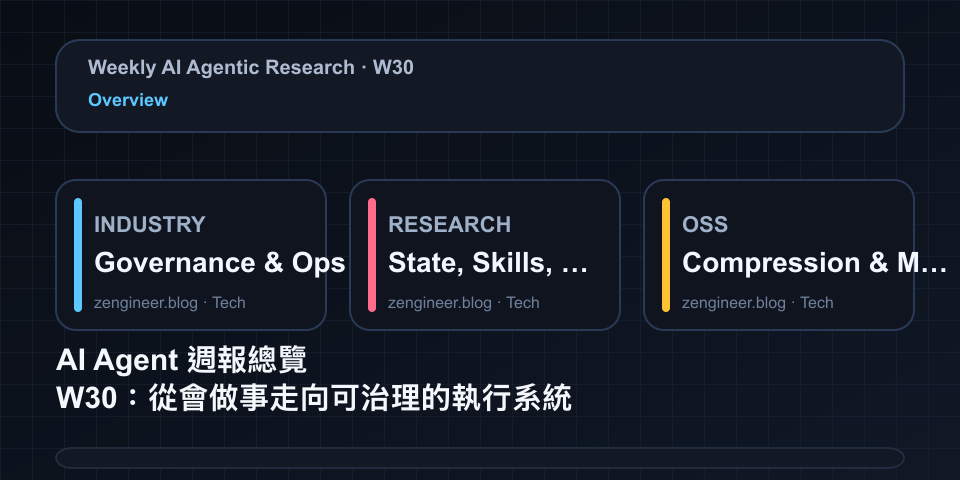
AI Agent Weekly Overview W30: From Capability to Governed Execution (Industry × Research × Open Source)
This article covers July 20–26, 2026 in Asia/Taipei. W30's shared signal is that AI agents are moving from “can it act?” to “can it operate over time under permissions, economics, and incident accountability?”
This week's deep dives:
- Industry: capability meets deployment governance
- Research: long horizons demand new evaluation
- Open source: the control plane takes center stage
How the three tracks connect
Industry launches such as Claude Opus 5, segmented Gemini Flash models, and enterprise agent services put coding, latency, cost, and governance in one buying decision. Research argues that long-horizon capability cannot be judged by the final answer alone; the permission-bearing trajectory must be evaluated. Open-source projects including Paperclip, QwenPaw, and OpenSRE are turning adapters, sessions, policy, gateways, and traces into a real execution layer.
Their intersection is the control plane. As models strengthen, tasks lengthen, and tools multiply, safety cannot live in a prompt. Identity, least privilege, network boundaries, confirmation for sensitive actions, complete traces, human takeover, and rollback must become first-class architecture.
This week's action for builders
Start with one valuable but recoverable workflow and measure cost per successful task rather than token price. Separate read from write permissions, confirm irreversible actions, retain replayable trajectories, and rerun the same regression tasks after every model or tool update.
Watchlist
- Whether long-task risk grows nonlinearly with duration and tool count.
- Independent, reproducible task economics and intervention rates.
- Shared policy and trace standards across open-source control planes.
- Evaluation-harness isolation and incident-reporting norms.
- Auditable production evidence from China's vertical-agent push.