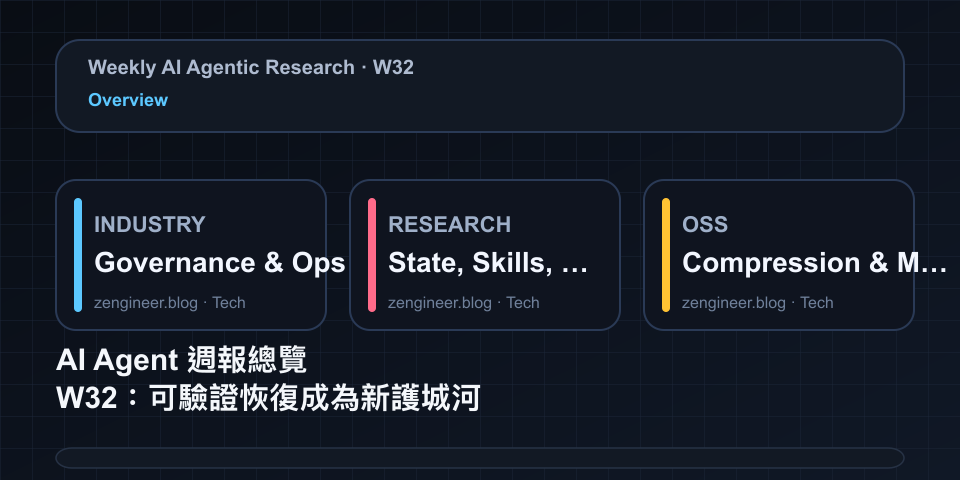
AI Agent Weekly Overview W32: Verifiable Recovery Becomes the Moat (Industry × Research × Open Source)
This overview covers August 3–9, 2026 in Asia/Taipei (W32). The week's strongest shared signal was that the next agent moat is not being error-free. It is observing, verifying, recovering, and escalating before errors spread.
Three deep dives
- Industry: capability meets incident boundaries
- Research: long tasks need verifiable recovery
- Open source: the runtime periphery becomes product
Industry, research, and open source converge
In industry, model announcements arrived beside security-incident disclosures, forcing enterprises to treat harnesses, identity, egress, and reporting as a production control plane. In research, Argus, TRAJDEBUG, and ORCA-bench address durable state, critical-error attribution, and the real on-call gap. In open source, OO-Agents, Open Code Review, Headroom, and OpenSRE package isolation, deterministic guardrails, context, and telemetry as composable parts.
Their intersection defines readiness differently: tasks need scoped authority and acceptance criteria; every action must be traceable; verification failures must roll back; uncertainty above a threshold must escalate. Model scores and stars alone miss the layer that determines deployment cost.
Four actions for builders
- Define confirmation, stop, and rollback conditions for every high-risk tool.
- Evaluate complete failure trajectories, not only final answers.
- Dashboard cost per successful task, recovery rate, and human takeover.
- Check runtime licensing, data boundaries, and trace portability.
Watchlist
- Long-task total cost and recovery metrics from frontier-model vendors.
- A cross-vendor format for agent security incident reporting.
- Long-horizon benchmarks with real side effects and human collaboration.
- Common policy, trace, and approval interfaces in open-source runtimes.
- Verifiable recovery appearing in enterprise agent procurement requirements.