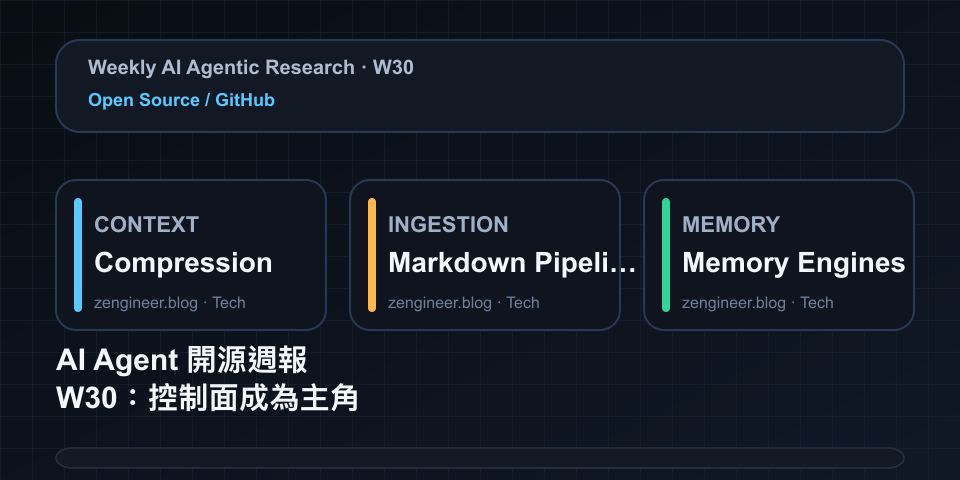
AI Agent Open-Source Weekly W30: The Control Plane Takes Center Stage (Paperclip, QwenPaw, OpenSRE)
This article covers July 20–26, 2026 in Asia/Taipei. The GitHub theme was not another chat UI but the agent control plane: managing workers, constraining networks, connecting messaging surfaces, and packaging incident investigation as an installable system.
Paperclip makes agent management resemble a work operating system
paperclipai/paperclip describes itself as an open-source control plane for agents at work. At observation time on July 27 it had roughly 74.8k stars and 13.9k forks under MIT; those counts indicate current scale, not completed-week growth.
The stronger W30 evidence is commit and PR activity, including a fix for Linux sandbox proxy socket-path limits, allowlisted egress hardening, and continued coding-agent adapter work. The center of gravity is moving from launching agents to operating them reliably. Risks include rapid change, nearly 5k open issues, and a highly privileged control-plane supply-chain node.
QwenPaw moves personal agents toward multi-channel entry points
agentscope-ai/QwenPaw appeared among this week's official GitHub leads. It represents a deployable assistant that combines models, skills, and personal communication surfaces. The engineering value lies in cross-session state, scheduling, and tool integration rather than chat alone.
Before adoption, inspect licensing, default egress, credential storage, messaging permissions, and deletion. Connecting mail, calendars, or files raises convenience and blast radius together. More releases, issue activity, and downstream adoption are needed to establish durable momentum.
OpenSRE puts agents inside the incident-investigation loop
Tracer-Cloud/opensre shipped repeated W30 releases, including v0.1.2026.7.23. Notes list integration work across Datadog, Honeycomb, Sentry, PostHog, PagerDuty, Temporal, Helm, and a shared setup flow. This is dated release velocity rather than a Trending snapshot.
The pattern is practical: the agent orchestrates existing telemetry and incident tools rather than replacing them. Because an SRE agent may see production logs, deployments, and tickets, teams must separate read-only diagnosis from mutation and preserve command-level traces.
Engineering pattern: models are replaceable, control planes are not optional
Across work management, personal assistance, and SRE, the same architecture emerges: provider adapters, tool registries, session state, permission policy, channel gateways, and traces. Durable product value is accumulating in execution infrastructure rather than prompts.
Watchlist
- Paperclip issue pressure, sandbox regression tests, and adapter compatibility.
- QwenPaw release cadence, license, secret storage, and permission documentation.
- OpenSRE false positives, human takeover, and read/write separation.
- Exportable traces, policy-as-code, and supply-chain signing.
- Contributor concentration and maintainer response time in fast-growing repositories.